
Artemis II launches
NASA sends four astronauts past the Moon on ten-day Orion shakedown, next landing target remains 2028 at earliest
Images
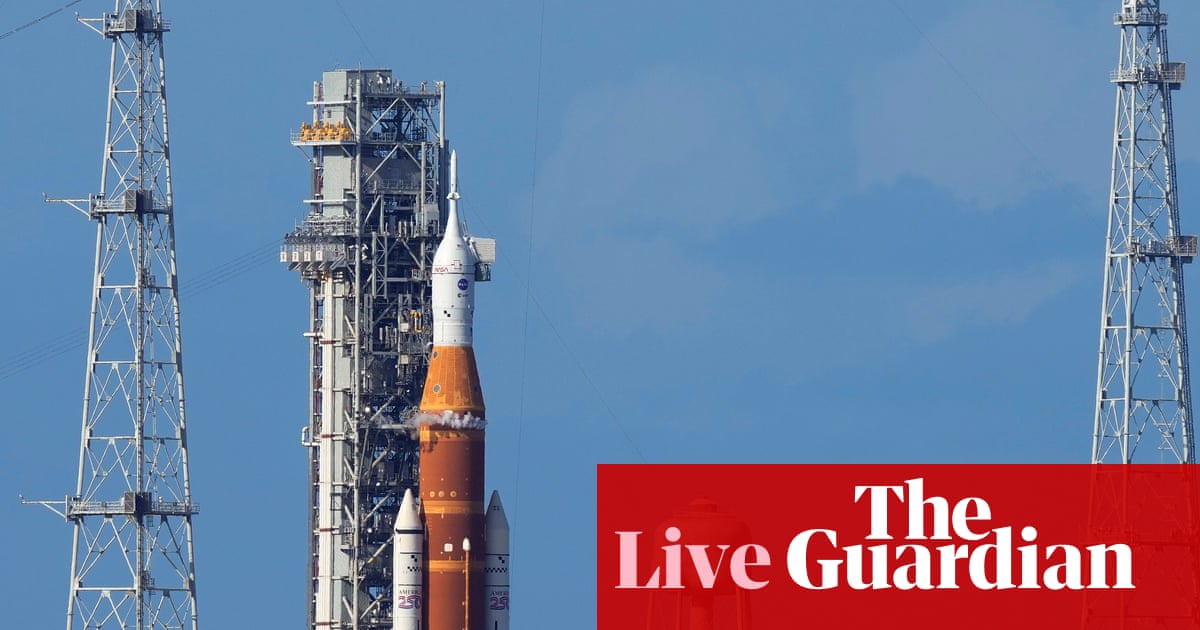 Artemis II live updates: Nasa engineers evaluating battery issue within hour of launch window
theguardian.com
Artemis II live updates: Nasa engineers evaluating battery issue within hour of launch window
theguardian.com
A NASA Space Launch System rocket carrying the Orion capsule lifted off from Kennedy Space Center on Wednesday on Artemis II, the first crewed lunar mission since Apollo and the first time in more than half a century that astronauts have headed beyond low Earth orbit. According to The Guardian’s live coverage, the flight is planned as a roughly 10-day mission that will loop around the Moon without landing, taking four astronauts to nearly 253,000 miles from Earth.
Artemis II is not a Moon landing so much as a systems audit carried out at lunar distance. The mission is designed to stress-test life-support, navigation and communications in deep space, and to track how a longer exposure to radiation and microgravity affects crew health—data NASA needs before it tries to keep people alive for weeks on the lunar surface or months en route to Mars. NASA is also using the flight to validate Orion’s re-entry profile, including heat-shield performance at temperatures it says can reach about 3,000F (1,650C) on return.
The flight plan underlines how the Artemis program is structured around sequential risk retirement rather than spectacle. The crew’s closest approach is scheduled for day six, when Orion will “slingshot” around the Moon and pass between roughly 4,000 and 6,000 miles above the surface, with a focus on imaging the south polar region where NASA wants to land next. That south pole target is not chosen for nostalgia: it is tied to the search for water ice and to the logistics of building a sustained presence, which NASA frames as a stepping stone to Mars.
But the mission also lands in a political economy that has shifted since Apollo. Artemis is a long-running procurement program with a large contractor footprint, and its calendar is shaped by budgets, industrial capacity and congressional priorities as much as by physics. A crewed flyby keeps momentum while leaving the hardest—and most failure-prone—parts for later: lunar landing systems, surface power, habitats, and the supply chain that makes “permanent” more than a slogan. The Guardian notes that NASA is already pointing to a possible next human landing as early as 2028, a date that implicitly assumes stable funding and a clean sequence of technical milestones.
For now, Artemis II’s success will be measured in telemetry and heat-shield ablation rather than footprints. On day six, the crew is expected to pass within a few thousand miles of the Moon’s south pole, take their photographs, and keep going.