
US Supreme Court hears Trump birthright citizenship case
14th Amendment test doubles as referendum on executive orders and nationwide injunctions, citizenship status may be decided by agency paperwork before Congress votes
Images
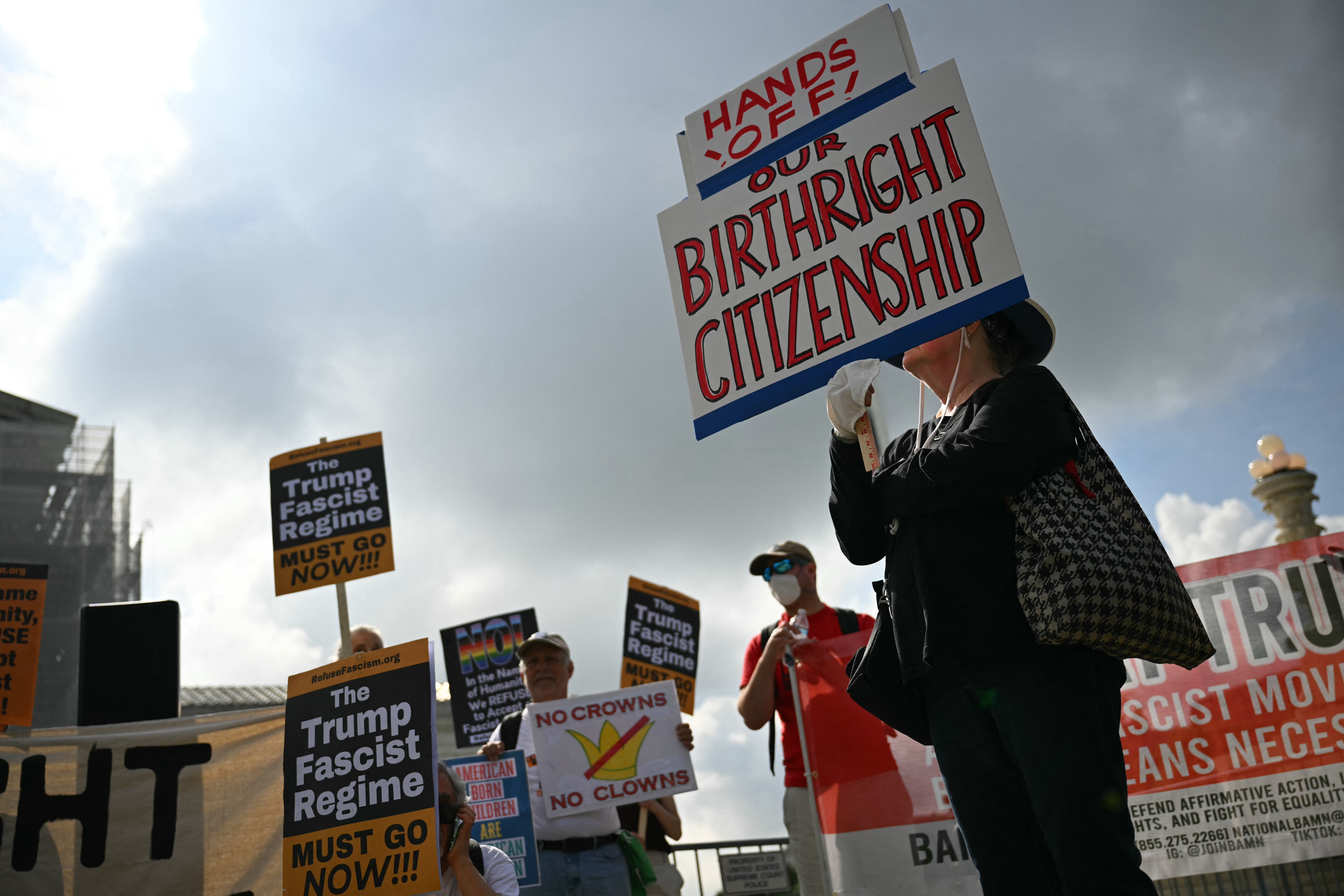 The liberal justices need at least two of the conservatives to join them to form a majority (AFP via Getty Images)
AFP via Getty Images
The liberal justices need at least two of the conservatives to join them to form a majority (AFP via Getty Images)
AFP via Getty Images
 Trump expected to attend supreme court arguments on landmark birthright citizenship case - US politics live
theguardian.com
Trump expected to attend supreme court arguments on landmark birthright citizenship case - US politics live
theguardian.com
US Supreme Court justices hear arguments on April 1 in a case testing President Donald Trump’s executive order that would deny automatic US citizenship to children born on American soil to parents who are in the country illegally or on temporary visas. Trump is expected to attend the hearing in person, an unusual step for a sitting president in a case his administration is defending, according to The Guardian. The dispute turns on the 14th Amendment’s Citizenship Clause and, more practically, on whether a president can rewrite a century of administrative practice with a signature.
The legal fight is being sold as a definitional question—what it means to be “subject to the jurisdiction” of the United States—but the stakes are institutional. Trump’s order tries to narrow a default rule that has functioned as an automatic entitlement, with downstream effects on passports, Social Security numbers, and access to federal and state benefits. That is why the case has drawn a wave of lawsuits: once agencies treat a newborn as not-a-citizen, the burden of proof flips, families must litigate status, and states inherit the costs of verification, schooling and emergency services while Washington controls the rulebook.
The court could decide the headline constitutional question, but it also has procedural escape hatches. Challenges to executive action often hinge on who has standing to sue, and what kind of relief a court can order—questions that can narrow a ruling without narrowing its real-world reach. If the justices limit nationwide injunctions or tighten standing, the administration could still implement the policy in large parts of the country through routine agency processing, forcing opponents into slower, case-by-case litigation. Even a “process” ruling can become a policy outcome when the passport office, border agencies and state ID systems standardise around whatever rule is easiest to administer.
The incentives are straightforward. Politicians prefer automatic rules because they create constituencies without requiring repeated votes; reversing an automatic rule is harder than passing a new program because it produces visible losers. States, meanwhile, pay for many of the services associated with population growth while having limited control over federal citizenship definitions. That mismatch is why birthright citizenship fights rarely stay in the realm of constitutional theory: they become arguments over who bears costs and who gets to set defaults.
The court is being asked to draw a boundary around executive power at a moment when presidents increasingly govern through emergency declarations and executive orders. Whether the justices resolve the citizenship question broadly or retreat into procedure, the immediate practical question will be decided by bureaucratic routines—what clerks enter into databases and what documents are issued at hospitals and DMVs the morning after the ruling.