
Israel expands Lebanon strikes beyond Hezbollah areas
Attacks hit Christian suburb near Beirut and airport road, buffer-zone plan turns air war into territorial policy
Images
 Strikes on the Lebanese capital of Beirut have continued this week
bbc.com
Strikes on the Lebanese capital of Beirut have continued this week
bbc.com
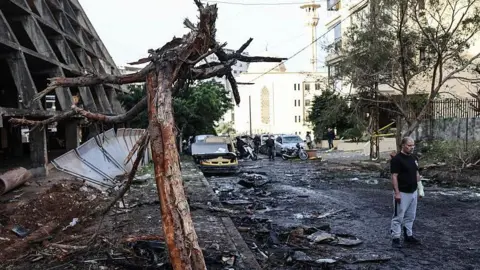 Strikes on the Lebanese capital of Beirut have continued this week
bbc.com
Strikes on the Lebanese capital of Beirut have continued this week
bbc.com
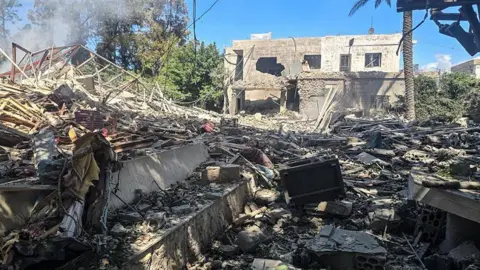 A photograph shows the aftermath of an Israeli strike in the area of Aamriyeh, south of Tyre in southern Lebanon
bbc.com
A photograph shows the aftermath of an Israeli strike in the area of Aamriyeh, south of Tyre in southern Lebanon
bbc.com
Israeli air strikes hit central Beirut overnight and targeted a vehicle in the Christian suburb of Mansourieh on Tuesday, according to the BBC, widening the geography of a campaign that has largely focused on Hezbollah’s southern strongholds and the Dahieh suburbs. Lebanon’s health ministry said a strike in the south hit a health facility and killed a paramedic, bringing the number of health workers killed since the war began to 53. Israel’s military said it struck Hezbollah infrastructure in Beirut and killed a senior commander and another senior figure. The escalation comes weeks after Hezbollah opened a new front on 2 March, firing missiles at Israel following US and Israeli attacks on Iran on 28 February.
The operational picture is shifting from tit-for-tat rocket fire to a map-redrawing ground-and-air campaign. Israel has announced it intends to control large swathes of southern Lebanon up to the Litani River—around 30km from the border—as a buffer zone, with Defence Minister Israel Katz saying Israel would keep “security control” even after the current war ends. That statement turns what is usually sold as a temporary battlefield measure into an open-ended administrative problem: who polices it, who pays for it, and how long the displacement lasts.
On the Lebanese side, the state appears to be shrinking away from the frontier. The Lebanese Armed Forces said the army cleared its last positions in the south, pulling out from Ain Ibel and Rmeish after an Israeli strike reportedly hit an army checkpoint and killed a soldier; Israel had not commented on that reported death, the BBC noted. With regular forces withdrawing, the incentive for civilians to leave rises further—especially when supply lines are being cut by strikes on bridges and infrastructure, making villages functionally uninhabitable.
Israel’s declared return policy makes the displacement explicit. Katz said more than 600,000 displaced Lebanese would be “completely prohibited” from returning to the buffer area until northern Israel is safe, and added that houses in border villages would be destroyed. In practice, a ban on return coupled with systematic demolition converts a security zone into a depopulated strip, leaving UN agencies to argue about legality while insurers, lenders and employers price the region as a long-term risk.
In Beirut, residents described confusion and displacement at street level. A man living near the Jnah neighbourhood told AFP he heard several large explosions and said displaced people were sleeping in the open nearby. The war is now visibly reaching beyond Hezbollah’s core districts into neighbourhoods where the political ownership of the fight is less clear.
Israel’s aircraft struck a vehicle in Mansourieh and a building on the road to Beirut’s airport after an evacuation order, the BBC reported. The airport road is still open on maps, but it is being treated as a military corridor.