
Colombia’s Catatumbo region becomes a closed territory
ELN and FARC dissidents control movement around Tibú, 99000 displaced as trade and farm work stall
Images
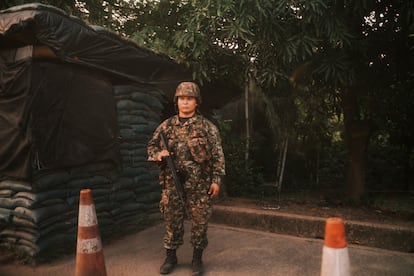 Army soldiers at a checkpoint in Catatumbo.Santiago Mesa
english.elpais.com
Army soldiers at a checkpoint in Catatumbo.Santiago Mesa
english.elpais.com
In Tibú, the main town in Colombia’s Catatumbo region, a guerrilla fighter boards a bus and asks passengers what they are doing there. A young man on a motorcycle points a revolver at an armoured vehicle and demands the windows come down. In Catatumbo, El País reports, nobody enters or leaves without permission.
The region sits on the Venezuelan border and is one of Colombia’s largest coca-growing areas. For years, armed groups have treated the territory as a revenue base, but the current phase escalated sharply after January 16, 2025, when a funeral director from Tibú, his wife and their infant son were murdered. A dispute between the National Liberation Army (ELN) and the 33rd Front—dissidents from the demobilised FARC—then turned into what local monitors describe as Colombia’s worst humanitarian crisis in two decades.
The numbers are large enough to describe a shutdown economy. Vivamos Humanos, an NGO cited by El País, estimates 99,000 residents—mostly farmers—have abandoned homes and crops. There have been more than 4,000 emergency evacuations, over 170 civilian homicides, and at least 262 violent incidents in 2025, making Catatumbo the country’s most volatile region.
When movement itself becomes a target, normal trade stops. Farmers cannot reliably reach fields; merchants cannot restock; public services thin out as staff weigh the risk of travel against salaries already stretched by insecurity. In such conditions, armed groups do not need to “replace the state” in the abstract. They can simply become the gatekeepers of roads, fuel, communications and labour—charging for passage, deciding who can work, and enforcing rules with a speed the formal justice system cannot match.
El País describes the practical innovations of this war economy: mines planted on roads and drones carrying explosives. These tools are cheap compared with maintaining checkpoints and patrols, and they scale intimidation across large areas. In places where internet access is only available via satellite and medical care is sparse, the threat of being caught in crossfire becomes a form of regulation.
Catatumbo’s border location adds another layer. Where legal commerce is disrupted, cross-border arbitrage becomes more valuable: fuel, food, chemicals and cash can be moved through informal channels that depend on armed permission. The more the state cannot credibly guarantee safe passage, the more every transaction starts to include a security premium.
In Catatumbo, El País writes, the first question at the town gate is not where you are going. It is who allowed you to come.