
Bob Dylan lyric draft emerges from Allen Ginsberg book
Torn I’m Not There page from Sally Grossman estate heads to Omega Auctions, a scrap of paper becomes a priced asset
Images
 I’m Not There was released in 2007 and is held in high esteem among many Bob Dylan fans. It was originally written and recorded in 1967 with then-backing group The Band. Photograph: Omega Auctions
theguardian.com
I’m Not There was released in 2007 and is held in high esteem among many Bob Dylan fans. It was originally written and recorded in 1967 with then-backing group The Band. Photograph: Omega Auctions
theguardian.com
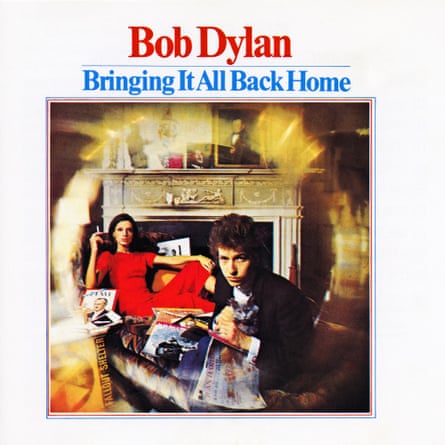 Sally Grossman featured on the cover of Bob Dylan’s 1965 album Bringing It All Back Home. Photograph: f8 archive/Alamy
theguardian.com
Sally Grossman featured on the cover of Bob Dylan’s 1965 album Bringing It All Back Home. Photograph: f8 archive/Alamy
theguardian.com
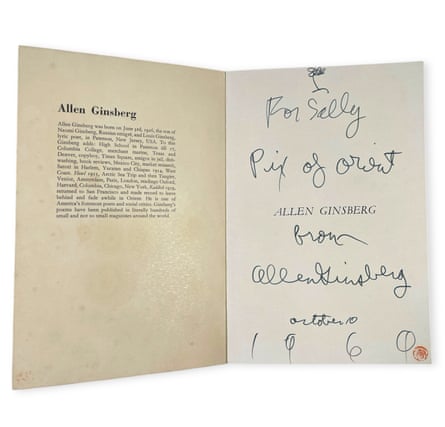 The Allen Ginsberg book includes an inscription made by the writer to Sally Grossman. Photograph: Omega Auctions
theguardian.com
The Allen Ginsberg book includes an inscription made by the writer to Sally Grossman. Photograph: Omega Auctions
theguardian.com
A torn page of lined paper carrying an early draft of Bob Dylan’s lyrics for the 1967 song I’m Not There has resurfaced in an unlikely place: inside a first-edition Allen Ginsberg paperback that once belonged to Sally Grossman, the wife of Dylan’s first manager. According to The Guardian, the sheet was discovered when a book dealer leafed through Ginsberg’s Ankor Wat and the page fell out. Omega Auctions will offer it for sale in April with an estimate of £20,000 to £40,000.
The details matter because the value here is not the words—Dylan’s lyrics are published and the song itself has circulated for decades—but the physical object and the story attached to it. The Guardian reports that Ginsberg inscribed the book to Grossman in 1969, anchoring a chain of ownership that connects the item to a small, name-dense circle around Dylan in the 1960s. That provenance is what turns a scrap of paper into something closer to a financial instrument: a scarce, portable claim on cultural proximity.
Auctions formalise that claim. They translate “found in the right book, owned by the right person” into a catalogue description, a pre-sale estimate, and a bidding process that produces a public price. The Dylan market already has reference points. The Guardian notes that in 2025 two typewritten drafts of Mr Tambourine Man sold for $508,000 at an auction in Nashville, part of a larger sale drawn from the collection of music journalist Al Aronowitz. Once a handful of headline results exist, every new item can be priced against them, and every new sale becomes another datapoint for the next one.
There is also a quiet redistribution happening. The book came from Grossman’s estate, sold after her death in 2021, and the lyric draft appears to have sat unnoticed for years. In practice, estates, dealers, and auction houses act as the logistics layer for cultural relics: they sort, authenticate, market, and move objects from private shelves into a global collector base. Museums can compete, but many do not have acquisition budgets that match private bidders, and the objects themselves are increasingly designed for private storage—small, insurable, and easy to ship.
The paper is torn, the draft is incomplete, and the song was not officially released until decades later.
It is still expected to sell for the price of a new car.