
US Army reviews Apache flights near Kid Rock home
Viral videos turn routine training route into compliance case, social media forces institutions to prove intent
Images
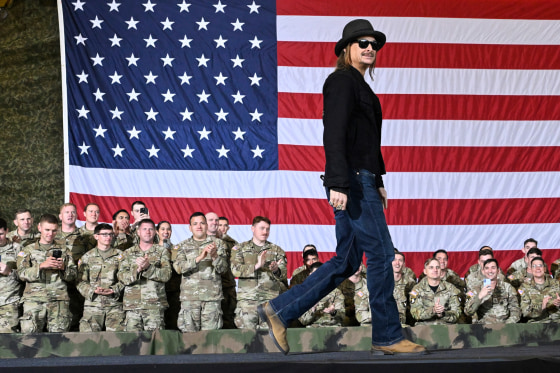 Kid Rock walks across a stage, military in the audience stand to clap, an American flag backdrop is behind them all
nbcnews.com
Kid Rock walks across a stage, military in the audience stand to clap, an American flag backdrop is behind them all
nbcnews.com
Two US Army Apache helicopters filmed near Kid Rock’s home outside Nashville have triggered an administrative review after the videos went viral. NBC News reports the aircraft—identified as AH-64 Apaches from the 101st Airborne Division at Fort Campbell, Kentucky—were following a training route in the Nashville area, and an Army official said their presence was “entirely coincidental” to “No Kings” protests in the city.
In one clip posted Saturday, the musician—Robert Ritchie—stands near an outdoor pool as an Apache hovers for several seconds near his hilltop property, which he calls the “Southern White House.” He claps and salutes as a second helicopter passes by. The post praised US service members and included a profanity aimed at California Governor Gavin Newsom.
The Army’s response has been procedural and reputational. A spokesperson said officials were aware of the video and were investigating because “Army aviators must adhere to strict safety standards, professionalism, and established flight regulations.” The review will assess the mission and verify compliance with regulations and airspace requirements; the Army said “appropriate action” would follow if violations are found.
The incident is less about the novelty of military aircraft over a US city—training flights are routine—and more about how quickly routine becomes contestable once it is framed as targeted power. A helicopter’s proximity that might be unremarkable in a flight log becomes, on social media, a question of intent: was this an intimidating buzz, a political message, or simply a pilot holding position on a planned route?
That ambiguity is expensive for institutions that operate on public trust. When a high-profile figure posts footage, the Army inherits the burden of proving what did not happen, not just what did. “Coincidental” is an explanation that satisfies a flight plan but not necessarily an audience primed to see enforcement everywhere.
The predictable second-order effect is more paperwork. Training routes that once lived inside unit planning can be pulled into compliance checks, approval chains, and after-action documentation designed for a world where any unusual-looking manoeuvre can become a national story within hours.
For now, the Army says the helicopters were on a training route, and the rest is an administrative file.