
Iranian strike destroys US E-3 Sentry at Saudi base
Airborne early warning fleet is small and hard to surge, one missile hit removes a command node not just a plane
Images
 nbcnews.com
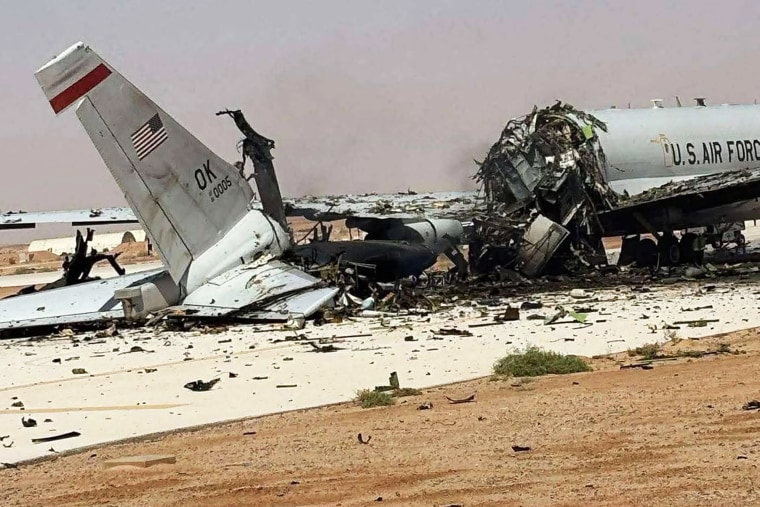 Photos circulated Sunday showing a damaged E-3 Sentry plane after a strike on Saudi Arabia's Prince Sultan Air Base. Obtained by NBC News
nbcnews.com
Photos circulated Sunday showing a damaged E-3 Sentry plane after a strike on Saudi Arabia's Prince Sultan Air Base. Obtained by NBC News
nbcnews.com
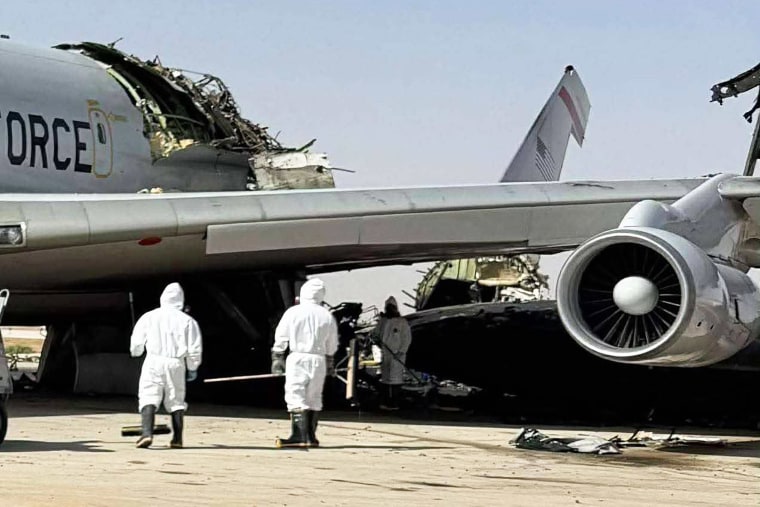 The back end of the E-3 Sentry after the Prince Sultan Air Base attack, in an image that circulated Sunday.Obtained by NBC News
nbcnews.com
The back end of the E-3 Sentry after the Prince Sultan Air Base attack, in an image that circulated Sunday.Obtained by NBC News
nbcnews.com
An Iranian strike has destroyed an E-3 Sentry airborne early warning aircraft at Prince Sultan Air Base in Saudi Arabia, according to NBC News, which verified images circulating online. Two US officials told NBC at least one aircraft was damaged in the Friday attack and several American service members were injured. The E-3’s tail section appears collapsed amid debris on the tarmac at the base southeast of Riyadh.
The immediate loss is a single airframe; the deeper issue is that the E-3 is a scarce node in a wider system. Air & Space Forces Magazine cited by NBC says six E-3s were stationed at Prince Sultan before the strike, out of a total US inventory of 16. That makes each aircraft a sizeable share of available airborne radar coverage, especially in a theatre where the US is trying to track missile launches, drone swarms and aircraft movements across Iran, Iraq, the Gulf and the Red Sea approaches.
Unlike a fighter squadron, an AWACS capability is not easily “surged” by moving pilots and spare jets between bases. It depends on specialised crews, mission systems, maintenance pipelines and protected basing. Andreas Krieg of King’s College London told NBC the strike “gradually” degrades an early-warning network built over decades. Retired US Army Lt Col Daniel Davis argued the opposite of official reassurance: the US is “not militarily prepared” for a sustained campaign, and that assumptions of a quick war have collided with Iran’s ability to keep firing.
The episode also underlines how modern air campaigns hinge on a small number of high-value assets that are expensive to replace and difficult to defend perfectly. Iran does not need to win air superiority to impose costs; it needs to land a few missiles or one-way drones on the right targets, at the right time, to force dispersal, reduce sortie rates, and shift scarce air-defence interceptors to base protection. That matters because the United States is already consuming air-defence and precision munitions at a pace that analysts say outstrips production, a strain that in turn affects what can be spared for other theatres.
Even if most incoming threats are intercepted, the economics are asymmetric: defending a fixed installation requires continuous coverage, while the attacker can probe for gaps. The result is that “logistics” is not a rear-area concern but a front-line vulnerability, with each damaged platform translating into fewer hours of radar coverage, fewer trained crews available, and more aircraft time spent repositioning rather than watching.
The images from Prince Sultan show a broken tail on a runway apron. For the US, the missing radar picture is the part that does not photograph well.