
Barbie Dream Fest leaves fans furious
Fort Lauderdale event sells 450-dollar fantasy but delivers bare warehouse, refunds and chargebacks become quality control
Images
 ‘I’m sorry, is this it?’ … Florida’s Barbie Dream Fest. Photograph: AP Video
theguardian.com
‘I’m sorry, is this it?’ … Florida’s Barbie Dream Fest. Photograph: AP Video
theguardian.com
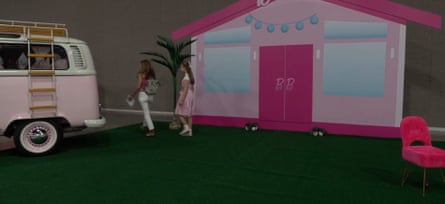 ‘A cheap backdrop’ … the ‘lifesize’ house at Barbie Dream Fest. Photograph: AP Video
theguardian.com
‘A cheap backdrop’ … the ‘lifesize’ house at Barbie Dream Fest. Photograph: AP Video
theguardian.com
A Florida warehouse with a few pink traffic cones became a cautionary tale for the modern “experience economy” last weekend. According to The Guardian, visitors who paid up to $452.50 for Barbie Dream Fest in Fort Lauderdale arrived to find sparse sets, a bare concrete-floor venue, and a “swag bag” that amounted to a disposable plastic pouch with a hairbrush and a small bottle of Barbie-branded hand sanitiser.
The event was marketed as “the ultimate Barbie fan event” and run by Mischief Management under a licence to use the Barbie brand, the paper reports. But social posts from attendees described a lifesize “dream house” as a cheap backdrop with a picnic table on fake turf, while an advertised roller disco was, in one account, simply a marked-out square of concrete with little decoration.
These disappointments are no longer outliers; they are a recurring business model with a familiar timeline. Promoters sell a high-margin promise—immersive sets, curated moments, a weekend that will look good on a feed—then discover that the cost of delivering the promise is higher than the ticket price will bear. The easiest variable to cut is the product itself: fewer props, smaller spaces, less staff, shorter queues managed by doing less. The marketing copy survives because it is written to be non-falsifiable (“ultimate”, “immersive”, “exclusive”), while the contract that matters is the one nobody reads.
Brand licensing adds another layer of distance between the buyer and the party who can actually make things right. A famous name on the poster signals quality, but the operator is often a separate company with a limited balance sheet and a short lifespan. If the event collapses into refunds and chargebacks, the brand can point to the licensee; the licensee can point to vendors; and the customer is left arguing with a payment processor.
What enforces standards in this market is not regulation or pre-clearance but the post-mortem: angry videos, viral ridicule, and a wave of disputes. The Guardian explicitly links the fallout to earlier fiascos such as the 2024 Willy Wonka Experience in Glasgow and the Fyre Festival, episodes where social media did the quality inspection only after the money was taken.
At Barbie Dream Fest, the most concrete souvenir appears to have been the $1 bottle of hand sanitiser—proof that the brand arrived on time even when the event did not.