
Artemis II nears launch window
NASA preps Orion lunar flyby as 10-day crewed systems test, mission science yields to verification and schedule discipline
Images
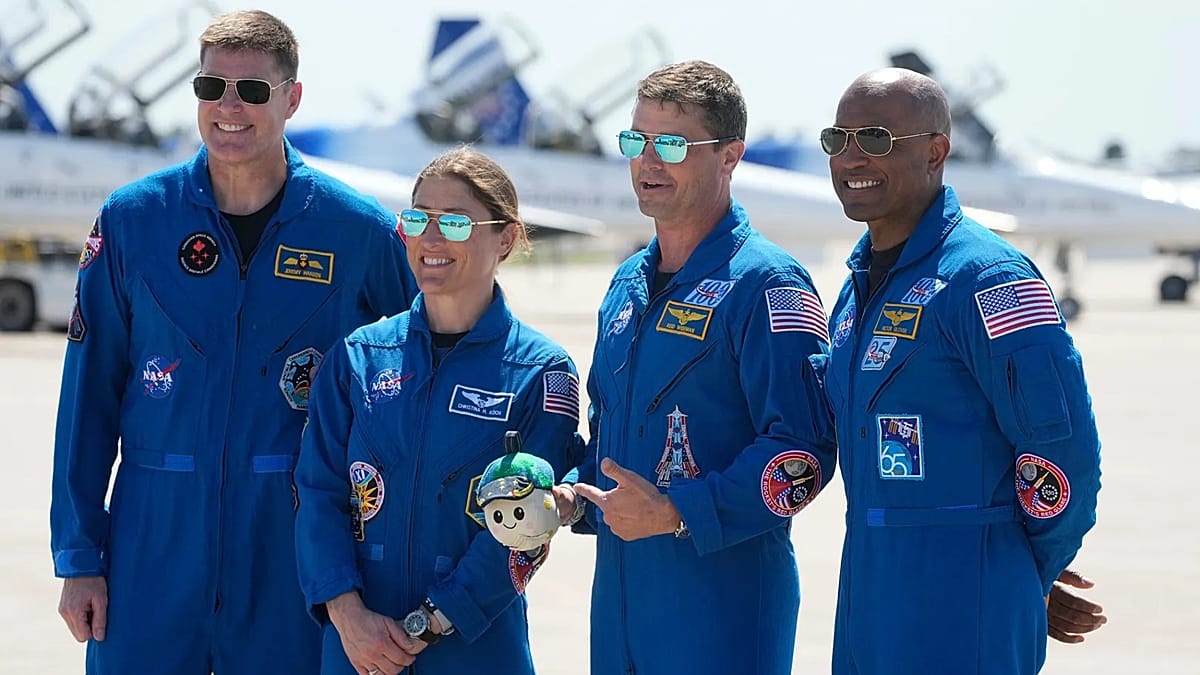 Meet the astronauts going on the Artemis II mission towards to Moon
euronews.com
Meet the astronauts going on the Artemis II mission towards to Moon
euronews.com
Artemis II crews enter quarantine ahead of a launch window that NASA says could open on 1 April, with a four-person team scheduled for a roughly 10-day flight looping around the Moon. According to Euronews, the mission will not attempt a landing; it is a systems test of the Orion spacecraft and its life-support and operations before later surface missions.
The reporting focuses on the astronauts’ biographies—commander Reid Wiseman, pilot Victor Glover, and mission specialist Christina Koch among them—along with the familiar pre-launch choreography at Kennedy Space Center: emergency procedure reviews, time with families, and health controls meant to reduce the chance of illness delaying a tightly sequenced launch campaign. NASA’s acting associate administrator for exploration systems, Lori Glaze, is quoted saying operations have been “going smoothly”, a formulation that often matters more for schedule discipline than for scientific ambition.
For a science audience, the more revealing detail is what is missing. Artemis II is described as a shakedown flight, and shakedown flights are dominated by verification: thermal performance, communications, navigation, power systems, human factors, and contingency handling. Every hour on a crewed vehicle is budgeted against risk, and every kilogram is negotiated against margins. When the mission’s purpose is to prove a spacecraft can keep people alive beyond low Earth orbit, experiments compete with consumables, spares, and instrumentation that exists primarily to validate the vehicle itself.
That dynamic is structural. Crewed programs sit inside procurement chains where contractors are paid to deliver hardware to specifications, and where changes cascade into requalification work, paperwork, and schedule slips. The “payload” in such missions often becomes whatever can ride along without forcing redesign: passive radiation dosimeters, biomedical monitoring that doubles as crew health surveillance, and small technology demonstrations that can be justified as operational risk reduction. Curiosity-driven science—samples, telescopes, or complex autonomous experiments—tends to wait for later flights, when the vehicle is no longer the experiment.
Euronews notes that Artemis II will take the crew “thousands of kilometres deeper into space” than Apollo missions went, a comparison that is rhetorically useful but technically slippery: Apollo’s value came from landing capability and returned samples, while Artemis II is about proving a transport system and its procedures. The scientific output of Artemis II is therefore likely to look less like discovery and more like calibration—data that matters most to NASA program managers and contractors, and only indirectly to researchers.
The mission’s concrete promise remains narrow and testable: if Orion completes its loop and returns safely, NASA will have purchased a new baseline for what it can credibly attempt next.