
China teapot refineries face margin squeeze from Iran war price shock
Shandong independents rely on discounted sanctioned crude, parallel supply chain becomes strategic risk
Images
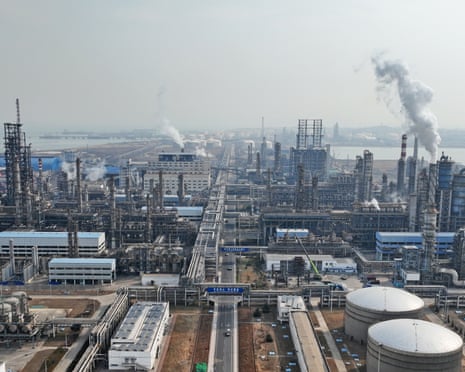 An oil refining plant in Qingdao, Shandong, China. Photograph: CFOTO/Future Publishing/Getty Images
Future Publishing/Getty Images
An oil refining plant in Qingdao, Shandong, China. Photograph: CFOTO/Future Publishing/Getty Images
Future Publishing/Getty Images
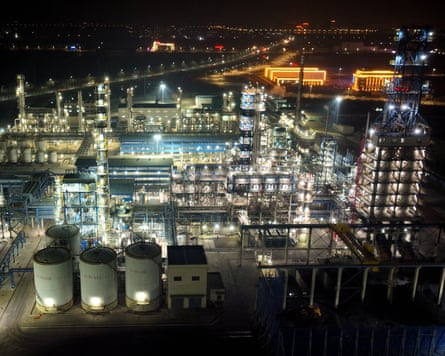 A refinery in Binzhou, Shandong. Oil represents less than a fifth of China’s energy mix but is vital to the economy. Photograph: CFOTO/Future Publishing/Getty Images
Future Publishing/Getty Images
A refinery in Binzhou, Shandong. Oil represents less than a fifth of China’s energy mix but is vital to the economy. Photograph: CFOTO/Future Publishing/Getty Images
Future Publishing/Getty Images
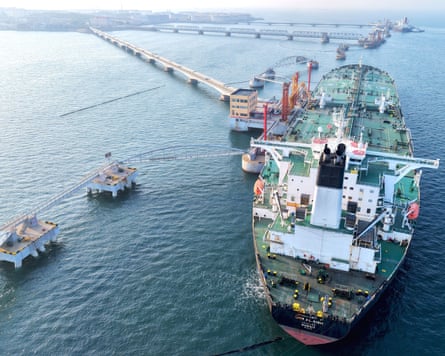 An oil tanker unloads imported crude in Qingdao, Shandong, last year. Photograph: NurPhoto/Getty Images
Getty Images
An oil tanker unloads imported crude in Qingdao, Shandong, last year. Photograph: NurPhoto/Getty Images
Getty Images
China’s network of independent “teapot” refineries in Shandong—small private plants that collectively account for roughly a quarter of national refining capacity—are being squeezed by the Middle East war’s price shock and the logistics that come with it. The Guardian reports from Weifang that these refineries survive on razor-thin margins by buying discounted crude and turning it into petrol and diesel for nearby provinces.
The price shock is not abstract for Shandong. Teapots are built for arbitrage: cheap barrels in, domestic fuel out. When crude prices rise and war-risk premiums distort shipping, the spread that pays wages and debt service narrows quickly. Unlike the big state refiners, these plants have less balance-sheet room to absorb volatility and fewer political reasons to run at a loss.
The war’s geography matters because Hormuz is being constrained without a declared closure. After US-Israel strikes on Iran on 28 February, Tehran’s effective throttling of the strait pushed up costs across Asia, with governments elsewhere responding through rationing and emergency measures. Yet Iranian crude has continued to flow to China. Citing Kpler, the Guardian says China is importing about 1.6 million barrels a day of Iranian crude, up from about 1.4 million in 2025, and analysts say they are not seeing disruption to those flows.
That continuity is not a sign of normality; it is a sign of segmentation. State-owned Chinese refiners are cautious about Iranian oil because they want to avoid being cut off from the dollar-based financial system, the Guardian notes, quoting Columbia University’s Erica Downs. Teapots, selling into the domestic market, take the sanctioned barrels instead. Western sanctions, in that telling, did not end the trade; they helped re-route it toward actors with less exposure to Western finance.
The arrangement creates a parallel energy supply chain that works—until it becomes a single point of failure. If margins collapse, teapots cut runs, delay maintenance, or shut units, and the state must decide whether to backstop private refiners that were never meant to be strategic assets. If margins hold, they continue to launder geopolitical risk into domestic fuel supply, keeping transport and industry running while the rest of Asia scrambles.
In Weifang, the Guardian describes refinery workers filling noodle shops at midnight after shifts end. The fuel that keeps those shifts going increasingly depends on discounted barrels that larger companies avoid.