
Robotic exoskeletons tighten violinists’ timing
Science Robotics study tests haptic coupling as stand-in for visual cues, the best-performing metric may not be the best-performing duet
Images
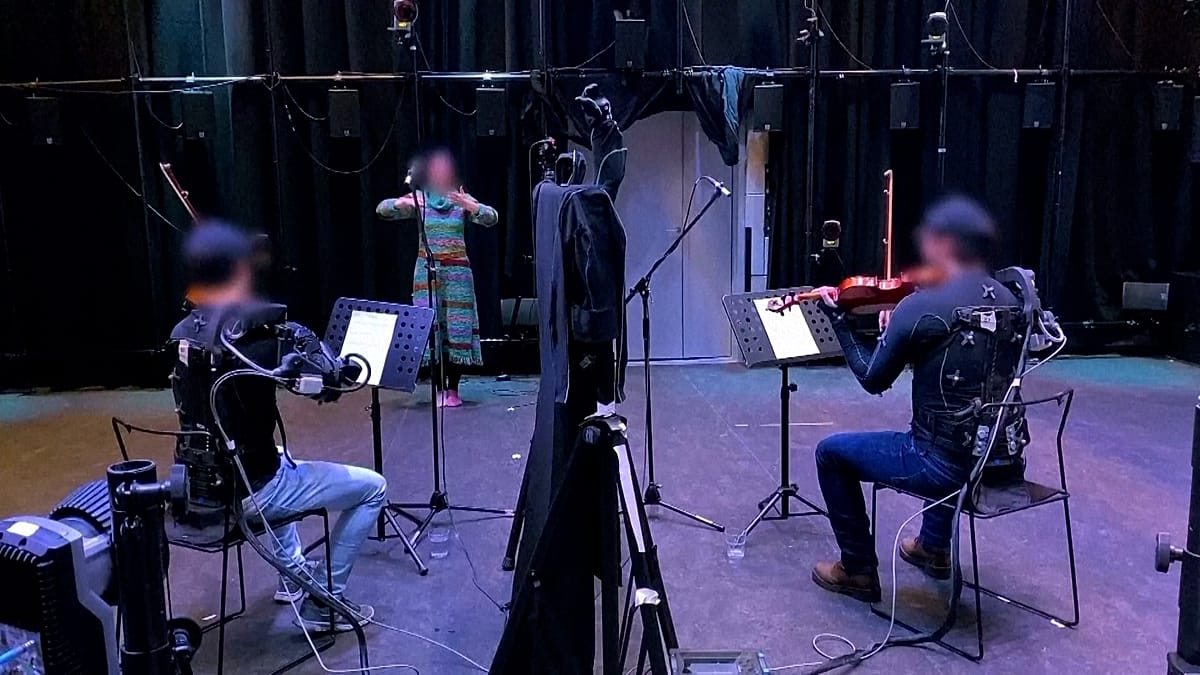 Can exoskeletons help violinists to stay in time? New study says yes
euronews.com
Can exoskeletons help violinists to stay in time? New study says yes
euronews.com
Italian researchers have tested a new way to keep musicians in time: physically coupling them with lightweight robotic exoskeletons that nudge their bowing arms toward synchrony. In experiments with professional violinists, the team recorded joint angles, shoulder position and bow force while pairs played under four conditions, including normal sight-and-sound, sound-only, and vision blocked with haptic feedback delivered by the device, according to an AP report carried by Euronews.
The study, published in Science Robotics, is built around a simple claim with an engineering twist: if you remove one channel of coordination—eye contact—and replace it with a mechanically mediated “touch” channel, ensembles can lock in more tightly. The exoskeletons were designed for elbow flexion/extension and shoulder rotation. Each unit measured its wearer’s motion and transmitted it to the partner’s device; when the two diverged, the system applied bidirectional forces intended to bring them back together. Participants often could not identify that the forces were derived from their partner’s movement, and some described discomfort, yet the researchers report improved coordination “both in kinematics and in musical alignment.”
What the paper appears to measure is, above all, timing regularity: how closely two players’ motions and outputs line up, and how quickly they adapt when alignment drifts. That matters in a laboratory because it is quantifiable. It also creates a familiar problem: once a metric becomes the target, it can replace the thing it was meant to approximate. A duo can become more phase-locked in bowing while becoming less expressive in phrasing, dynamics or microtiming that gives a performance character. A mechanical coupling can function like a metronome with muscles—harder to ignore, and easier to score.
The researchers themselves point to applications beyond concert halls, especially rehabilitation, where therapists and patients could exchange forces through a robot rather than relying on verbal instruction or observation. That is plausible precisely because therapy often values repeatability and controlled movement. Music performance does not always.
The experiment also hints at a second-order effect: the more coordination is outsourced to a device, the more “good performance” may be defined by what the device is built to reward. If the system optimizes for synchrony, performers may learn to play to synchrony—especially in settings like auditions, training, or remote collaboration where the easiest thing to demonstrate is measurable alignment.
In the Euronews report, the exoskeleton is described as improving timing even when musicians could not see each other. The device did not teach them to listen better; it gave them another channel to obey.
The researchers can now show tighter coordination traces on a sensor readout. Whether audiences would prefer the resulting music is a different measurement entirely.