
Kenya exhumes 33 bodies from Kericho mass grave
Investigators say remains were moved from hospital morgue, missing paperwork turns the dead into an administrative problem
Images
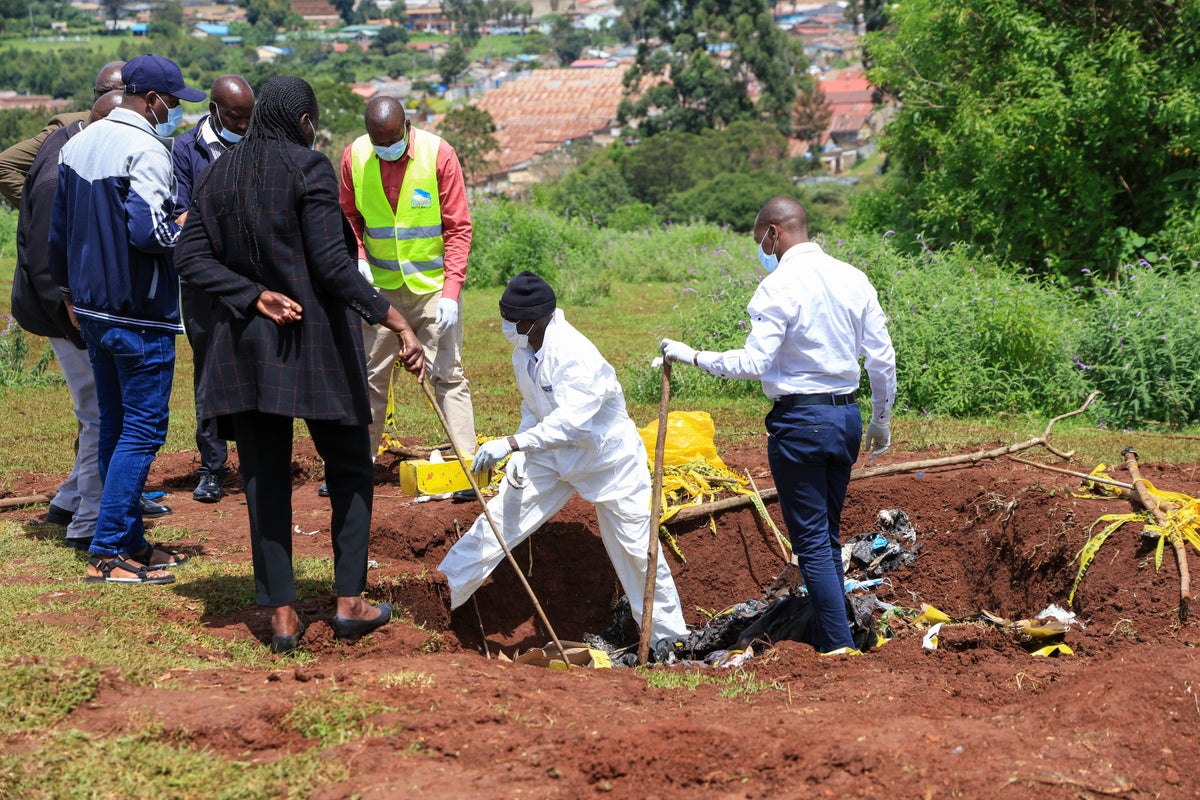 Police in Kenya exhume at least 33 bodies from a mass grave
independent.co.uk
Police in Kenya exhume at least 33 bodies from a mass grave
independent.co.uk
At least 33 bodies — including 25 children — have been exhumed from a mass grave at a church-owned cemetery in Kericho, western Kenya, after investigators said the remains appear to have been moved there from Nyamira District Hospital’s morgue. Kenya’s Directorate of Criminal Investigations said the burials may have bypassed the court order required when unclaimed bodies are disposed of after 14 days. Two people have been arrested, and government pathologists have begun autopsies, according to The Independent.
The immediate question is procedural: who authorised the transfer, who paid for it, and why a hospital’s dead ended up in a private cemetery. But the case lands in a country already arguing about what “normal” looks like when killings and disappearances are treated as administrative noise rather than public emergencies. The Independent notes that Missing Voices, a rights group, documented 125 extrajudicial killings and six enforced disappearances over the past year, compared with 104 reported extrajudicial killings the previous year. Those numbers are not just a human-rights ledger; they describe a market for impunity in which the cost of violence is pushed off the balance sheet.
When bodies can be moved, buried, or misfiled without a clean chain of custody, the practical effect is to raise the price of accountability. Families must spend money and time navigating police stations, morgues, and courts; investigators face missing paperwork and compromised evidence; and anyone who benefits from a case going cold faces fewer risks. That ecosystem does not require a single mastermind. It can be sustained by small, predictable rewards: a paid transport job, a burial fee, a bribe to speed a signature, a quiet favour to avoid scrutiny.
The second-order effects are visible in how people adapt. Where the state cannot guarantee investigation or protection, households buy substitutes: private guards, gated compounds, informal “community policing,” and relocation to areas perceived as safer. That shifts demand in property markets — raising rents and land prices in neighbourhoods with credible security while hollowing out places associated with predation. It also changes migration decisions: leaving becomes less about wages and more about avoiding arbitrary risk.
Kenya has seen other mass-grave shocks in recent years — from the 2023 Kilifi case linked to a religious leader to bodies recovered from a Nairobi dumpsite in 2024 — but the Kericho exhumations are unusually bureaucratic in their alleged origin. The bodies were not hidden in remote bush; they were reportedly moved from a hospital morgue.
Detectives in Kericho are now trying to establish whether the transfers were legal. The grave itself has already answered a narrower question: 33 people can disappear from a morgue and reappear in sacks without anyone stopping the vehicle in between.