
Kerala police orders takedowns of posts sharing Election Commission letter
BJP seal on official document triggers legal requests to X and Instagram, bureaucratic error becomes platform-enforced deletion
Images
 Representative image
|
Justin Tallis/AFP
scroll.in
Representative image
|
Justin Tallis/AFP
scroll.in
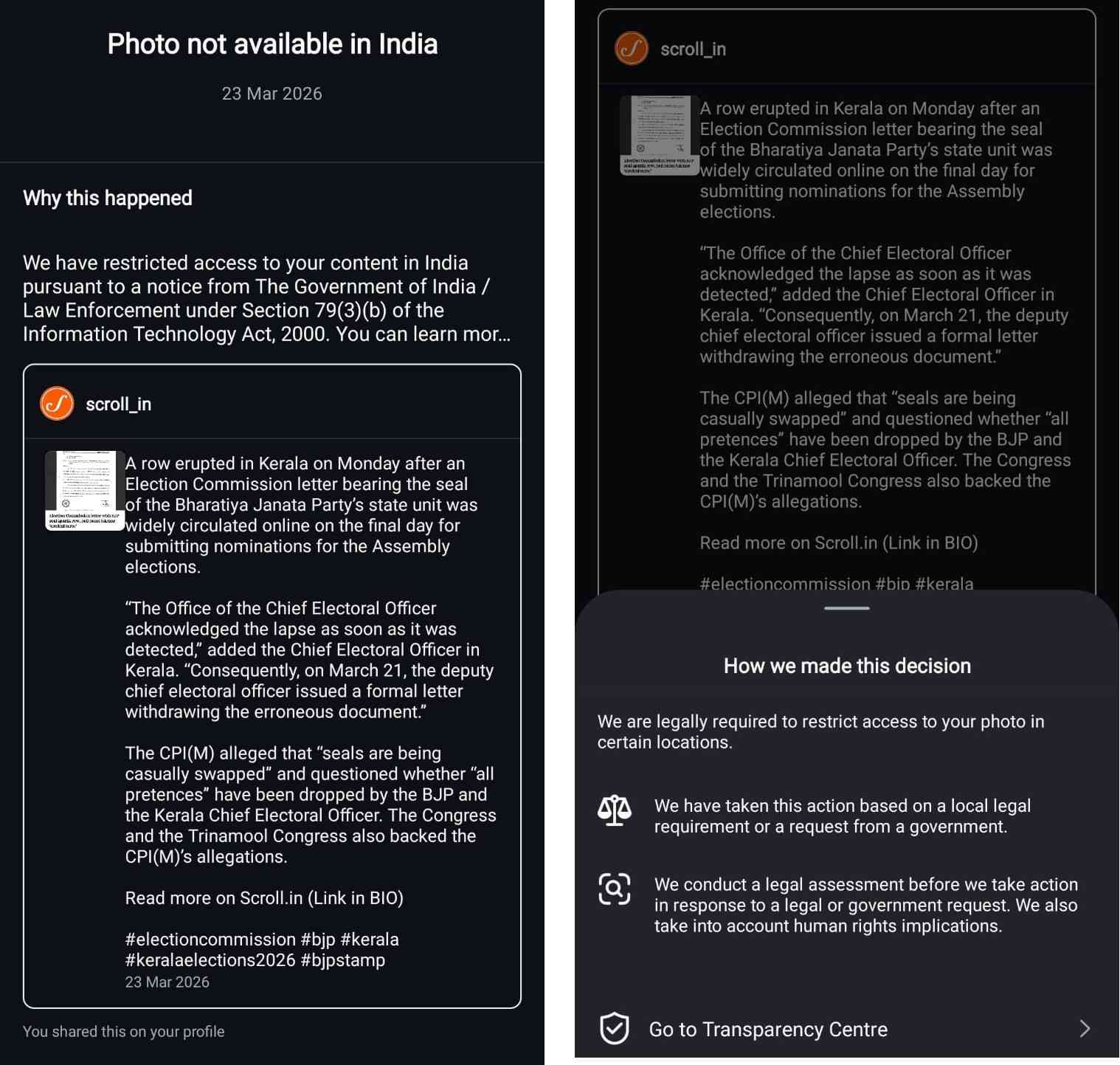 Information provided by Instagram for removing a post by Scroll on Monday.
scroll.in
Information provided by Instagram for removing a post by Scroll on Monday.
scroll.in
Kerala Police has ordered social-media platforms to remove posts sharing an Election Commission letter that circulated with the seal of the Bharatiya Janata Party’s Kerala unit, according to Scroll.in. Users on X said they received takedown notices citing India’s Information Technology Act and the 2021 IT rules for intermediaries; Scroll reported that an Instagram post about the controversy was blocked following a “legal request”.
The underlying document was not a leak or an anonymous “forgery” in the ordinary sense. The Election Commission said the letter—dated March 19, 2019, and describing rules on disclosing candidates’ criminal antecedents—carried the BJP seal due to a “purely clerical error” and that it had been withdrawn. The police notice, as described by recipients, argues that continuing to circulate the retracted letter “blatantly insult[s]” the Commission and could “undermine communal harmony,” framing the posts as a public-order issue rather than a dispute over administrative competence.
That framing matters because it turns platforms into low-cost enforcement arms for institutions that want reputational control. The notice reportedly warns intermediaries they could face liability for “abetment” if they do not remove the content—an approach that shifts risk from the state to private companies that would rather comply than litigate. The practical result is that the fastest actor to respond to the threat of legal exposure becomes the de facto arbiter of what stays online, even when the contested material is a government-issued document and the dispute is about how it was handled.
The episode also illustrates how takedown powers expand in everyday use once they exist. Rules designed and publicly justified around extreme cases—terrorism, violence, incitement—are invoked in a routine political controversy during an election period. In Kerala, the police report to the Election Commission while the Model Code of Conduct is in force, adding another layer of institutional incentives to avoid embarrassment and “restore order” quickly.
For journalists and opposition figures, the message is simpler: sharing primary-source evidence of a bureaucratic mistake can be treated as a threat to public order, and the appeal route runs through the same platforms that receive the legal demands. When the easiest remedy is deletion, the public record becomes whatever remains after compliance teams have finished triage.
The disputed letter was withdrawn after the Election Commission said it had mistakenly redistributed a BJP-stamped photocopy supplied by the party itself. The police response, however, is aimed not at the error’s origin but at the people still posting the document.