
Polymarket ceasefire bets raise insider trading questions
Newly created wallets stake $70000 on US-Iran deal by March 31, war messaging becomes a tradable signal
Images
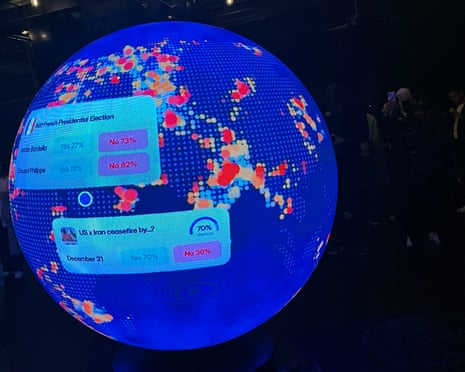 An LED sphere screen seen in Polymarket’s ‘Situation Room’ in Washington DC this week. Photograph: Theo Marie-Courtois/AFP/Getty Images
theguardian.com
An LED sphere screen seen in Polymarket’s ‘Situation Room’ in Washington DC this week. Photograph: Theo Marie-Courtois/AFP/Getty Images
theguardian.com
 Trump would not say who the US had been dealing with in Iran. Photograph: Saul Loeb/AFP/Getty Images
theguardian.com
Trump would not say who the US had been dealing with in Iran. Photograph: Saul Loeb/AFP/Getty Images
theguardian.com
A cluster of newly created accounts on Polymarket placed roughly $70,000 in bets on a US-Iran ceasefire by 31 March, positions that could pay out about $820,000 if the market resolves “yes,” according to the Guardian. Crypto analysts cited by the paper said the pattern—fresh wallets, market-price entries and apparent wallet-splitting—looked consistent with attempts to obscure identity, raising renewed questions about whether war-related prediction markets are being used as an outlet for non-public information.
The bets arrived alongside a second, parallel signal: President Donald Trump publicly floated “very good” talks with Iran and announced a five-day pause on strikes against Iranian power plants and energy infrastructure, the Guardian reports. Iran’s leadership denied negotiations were under way, and Trump declined to name his alleged interlocutor, claiming disclosure could get the person killed. In the same news cycle, markets reacted: Brent crude fell sharply after the pause was announced, highlighting how ceasefire talk itself can function as a tradable input.
Prediction markets pitch themselves as “information aggregators,” but their structure also rewards timing rather than analysis. A participant who knows when a statement will be issued—or when a backchannel has produced a draft understanding—does not need to predict the future; they need only to buy before the headline moves the price. The Guardian notes that Polymarket’s probability for a ceasefire by 31 March rose from 6% to 24% over a few days, with more than $21 million wagered on the outcome. That kind of liquidity turns diplomatic messaging into an instrument that can be tested, refined and monetised.
The platform’s anonymity complicates enforcement. Wallets are visible on-chain, but owners are not, and splitting exposure across multiple accounts can reduce the chance that other traders or investigators can link a position to a single actor. The Guardian quotes one analyst saying the behaviour tends to appear either when a very large trader wants to avoid moving the market, or when someone wants to hide that they should not be trading at all.
Polymarket’s resolution rules add another layer of ambiguity. The ceasefire contract requires “clear public confirmation from both the United States government and the government of Iran” that they have agreed to halt military action, according to the Guardian. That makes the bet partly a wager on what governments will say on the record, not only on what happens on the ground—an incentive to focus on media choreography and official phrasing.
Polymarket, whose investors include a venture capital firm owned by Donald Trump Jr, has already drawn scrutiny over similar war-timed bets earlier in the conflict, the Guardian reports. As trading volumes rise, the market’s promise—crowd-sourced truth—sits uneasily beside the simpler reality that a small number of well-timed wallets can move first and explain later.
Eight new accounts, created around 21 March, were still betting on little else.