
Satellite images show Tehran oil fires burn for days after strikes
Residents report irritation and black residue across city, precision attacks on fuel sites create uncontrolled urban exposure
Images
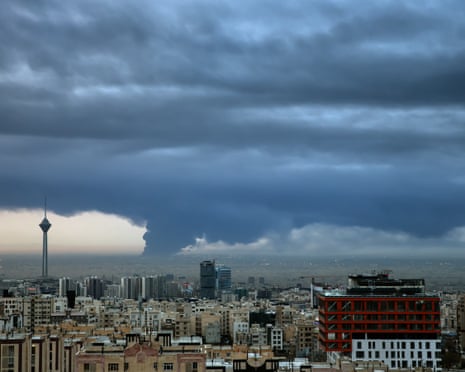 Smoke rises from Shahran oil depot due to Israeli attacks. The city was blanketed with smoke for days. Photograph: Anadolu/Getty Images
theguardian.com
Smoke rises from Shahran oil depot due to Israeli attacks. The city was blanketed with smoke for days. Photograph: Anadolu/Getty Images
theguardian.com
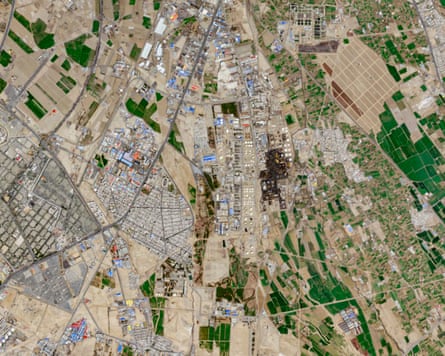 Tehran oil refinery lies south of the city. Photograph: Copernicus Sentinel
theguardian.com
Tehran oil refinery lies south of the city. Photograph: Copernicus Sentinel
theguardian.com
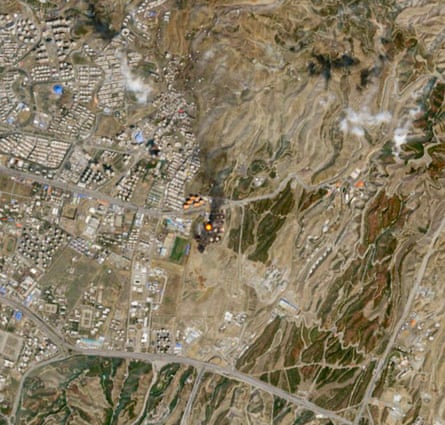 Aqadsieh oil depot was still visibly burning 10 days after the strike. Photograph: Copernicus Sentinel
theguardian.com
Aqadsieh oil depot was still visibly burning 10 days after the strike. Photograph: Copernicus Sentinel
theguardian.com
 Aqdasieh oil depot loop
theguardian.com
Aqdasieh oil depot loop
theguardian.com
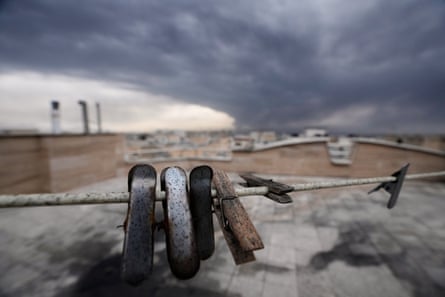 Clothes pegs covered in soot from burnt fuel in Tehran. Photograph: Vahid Salemi/AP
theguardian.com
Clothes pegs covered in soot from burnt fuel in Tehran. Photograph: Vahid Salemi/AP
theguardian.com
Satellite imagery shows oil and fuel sites around Tehran still burning days after Israeli strikes on 7 March, with smoke and residue spreading across the city and reports of “oil-filled rain” after a storm. The Guardian reports that residents described headaches, eye and skin irritation, and breathing difficulties as soot, oil particles and sulphur dioxide blanketed the capital.
The images cited by the newspaper indicate that the Shahran depot in north-west Tehran and the Tehran refinery to the south continued to burn at least two days after the attacks, with later European Space Agency imagery showing smouldering and renewed visible flames at the Aqdasieh oil depot in the north-east around 10 days after the strikes. Iran has labelled the attacks “ecocide”, arguing that the impact goes beyond military targets.
The episode illustrates how strikes marketed as “precision” can still produce broad, hard-to-control second-order effects in a dense city. Oil fires generate sulphur and nitrogen compounds alongside fine particulate matter; Akshay Deoras, a University of Reading scientist quoted by the Guardian, said the symptoms described by residents match exposure to pollutants produced by burning fuel, and that raindrops can act as collectors as they fall—turning a weather event into a distribution mechanism.
Tehran’s baseline air quality is already poor, residents told the Guardian, with chronic pollution worsened by the use of “mazut”, a low-grade heating oil. But the post-strike fallout was described as different in scale and texture: particles settling on cars, roads and roofs, and surfaces becoming black and slippery. One resident said an outdoor pool used as an emergency water source turned black after the fallout.
The damage is not only medical. When energy infrastructure burns for days, the economic costs start to shift from the targeted facilities to the city’s ability to function: workers stay indoors, businesses suspend operations, and insurers reassess exposure—not just for shipping in the Gulf but for property, health and business interruption in the capital itself. A strike that does not “win” militarily can still degrade a tax base and accelerate private exit.
Iranian doctors have circulated advice on avoiding exposure—staying indoors, discarding contaminated clothing, wearing N95 masks, avoiding shelter under trees—suggesting an informal public-health response in the absence of clear official guidance. The fires, visible from space, have become their own signal: that modern war on energy systems can turn metropolitan air into a hazard without any chemical weapons being used.
On 10 March, the Aqdasieh site was still visibly burning in satellite imagery. In Tehran, the smoke did not need to move far to reach millions.