
Finnish women join reserve shooting clubs
Post-Ukraine training demand lifts Vantaa Reservists membership above 2000, total-defence culture grows through volunteers not decrees
Images
.jpg) Nicole San Juan, a member of the Vantaa Reservists, at a shooting practice at the Loppi range (Annabel Grossman/TheIndependent)
Annabel Grossman/TheIndependent
Nicole San Juan, a member of the Vantaa Reservists, at a shooting practice at the Loppi range (Annabel Grossman/TheIndependent)
Annabel Grossman/TheIndependent
.jpg) Nicole practising with an AK15 – a type of assault rifle used by the special operations units of the Russian military (Annabel Grossman/The Independent)
Annabel Grossman/The Independent
Nicole practising with an AK15 – a type of assault rifle used by the special operations units of the Russian military (Annabel Grossman/The Independent)
Annabel Grossman/The Independent
-(3).JPG) At Naisten Valmiusliitto training courses, women wear distinctive purple beanies along with their camo (Naisten Valmiusliitto)
Naisten Valmiusliitto
At Naisten Valmiusliitto training courses, women wear distinctive purple beanies along with their camo (Naisten Valmiusliitto)
Naisten Valmiusliitto
-(1).jpg) Naisten Valmiusliitto Women's civilian training, Finland (Naisten Valmiusliitto)
Naisten Valmiusliitto
Naisten Valmiusliitto Women's civilian training, Finland (Naisten Valmiusliitto)
Naisten Valmiusliitto
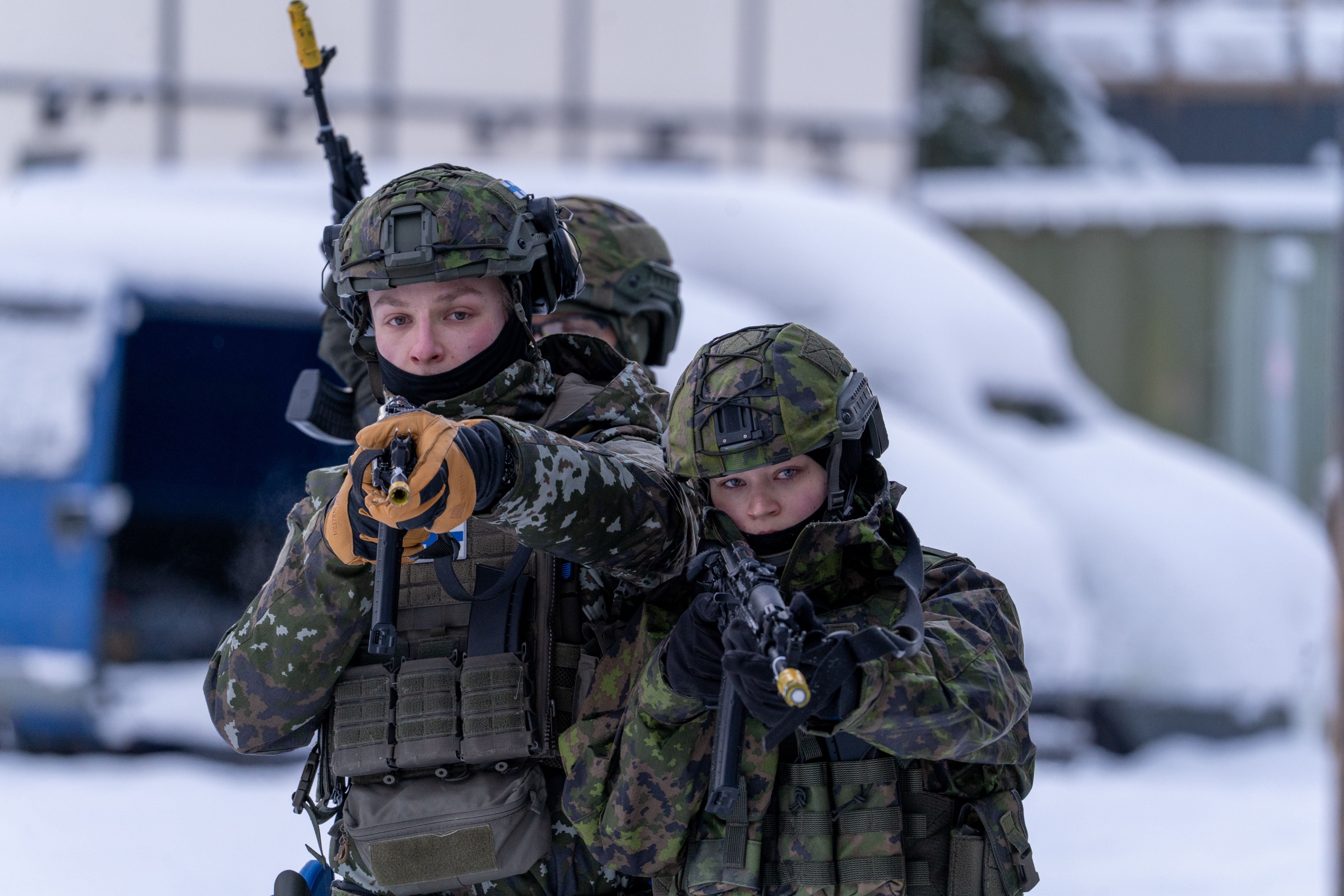 Civilians training with MPK in Finland (Annabel Grossman/TheIndependent)
Annabel Grossman/TheIndependent
Civilians training with MPK in Finland (Annabel Grossman/TheIndependent)
Annabel Grossman/TheIndependent
At a shooting range in Finland’s Kanta-Häme region, a reservist named Nicole San Juan loads an AK15 and fires at a target 100 metres away, part of a weekend training session that has drawn a growing number of women since Russia’s full-scale invasion of Ukraine in 2022. The Independent reports that the Vantaa Reservists association has expanded from about 950 members at the end of 2021 to 2,312 today, with roughly 170 of them women.
The growth is not being driven by a government recruitment campaign or a single new law. It is a response to geography and memory: Finland shares a 1,343-kilometre border with Russia and still carries the legacy of the Winter War of 1939–40, when it lost territory to the Soviet Union. Those facts shape a security posture that treats civilian competence as part of national defence rather than an eccentric hobby. Finland’s “comprehensive security” model—often described as total defence—assumes that resilience comes from many nodes: local organisations, trained citizens, and a population that can function when systems are stressed.
What makes the current wave notable is the way it spreads through existing voluntary institutions rather than through centralised mobilisation. Suvi Aksela, communications manager at Naisten Valmiusliitto, the Women’s National Emergency Preparedness Association, told The Independent that after February 2022 its phones were “ringing nonstop” with women asking how to help, and quickly, where they could learn to shoot. The Vantaa Reservists have become one such entry point, offering training that mixes social cohesion—“girls’ nights” with sauna and cake—with practical skills and logged hours needed to apply for firearm licences.
The economics are straightforward. A standing army and high-end procurement are expensive; distributed competence is comparatively cheap. A few thousand additional trained reservists do not replace air defence or artillery, but they change the cost calculations for an aggressor and reduce the burden on the state during crises. They also shift responsibility: when citizens invest their own time and money into training, the standard for what counts as “prepared” is set by personal risk, not by a ministry’s press release.
The article also hints at a quieter dynamic: equipment and training adapt to the user. Nicole says she prefers a rifle over a pistol because it can be adjusted for smaller hands—an example of how participation broadens the market for gear, instructors, and range capacity. In countries where civilian firearms culture is treated as politically radioactive, those markets remain thin, and preparedness becomes something purchased almost entirely through taxes.
Finland’s approach is not a template that can be copied overnight elsewhere in the Nordics. It rests on decades of policy continuity, social trust inside local associations, and a security environment that makes the trade-offs legible. But it does show what happens when civilian readiness is treated as a normal form of insurance rather than a last-resort ideology.
At the Loppi range, Nicole is still counting hours toward a licence for her own firearm. The targets do not move, but the number of people who want to learn has.