
Hundreds of TSA officers quit during US shutdown
Airport security lines become the only capacity signal, Trump threatens to send ICE to checkpoints
Images
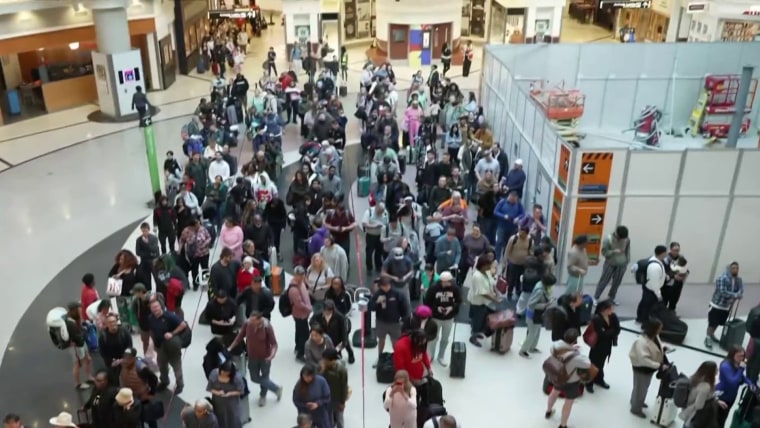 nbcnews.com
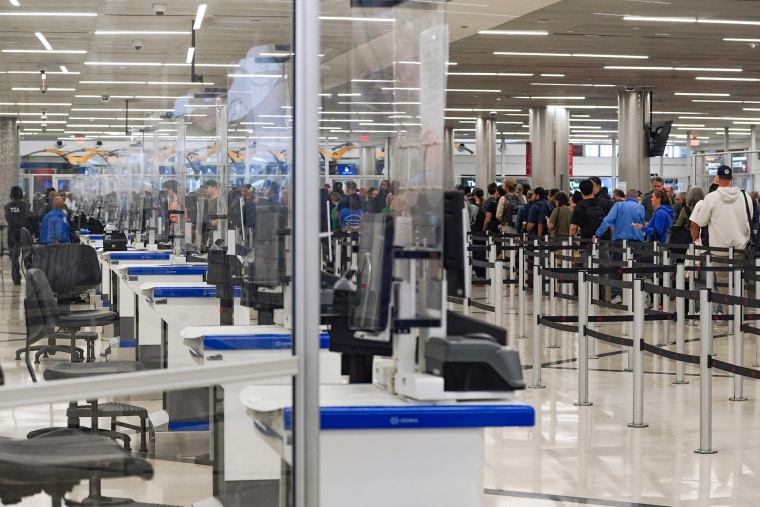 Unstaffed TSA checkpoints at Hartsfield-Jackson Atlanta International Airport on Monday.Megan Varner / Getty Images
nbcnews.com
Unstaffed TSA checkpoints at Hartsfield-Jackson Atlanta International Airport on Monday.Megan Varner / Getty Images
nbcnews.com
 Long lines at Hartsfield-Jackson airport in Atlanta. Photograph: Megan Varner/Reuters
theguardian.com
Long lines at Hartsfield-Jackson airport in Atlanta. Photograph: Megan Varner/Reuters
theguardian.com
More than 400 Transportation Security Administration officers have quit since a partial US government shutdown began on 14 February, according to the Department of Homeland Security, as airports report spike-after-spike in staff callouts and security lines. DHS told NBC News that nationwide callout rates topped 10% on more than half the days of the past week, with individual airports far higher: JFK at 29.5% on Friday, Houston Intercontinental at 36.6%, and Houston Hobby at 51.5%. President Donald Trump has responded by threatening to move Immigration and Customs Enforcement agents into airports if Democrats do not agree to a broader Department of Homeland Security funding deal, the Guardian reports.
The immediate problem is not simply that federal workers are missing paychecks; it is that the TSA is a monopoly service that has no way to clear a market when the underlying input—staff time—suddenly becomes scarce. Airlines can raise prices, add flights, or cancel routes. Airports can adjust gate allocations. TSA checkpoints cannot charge for peak-hour capacity, cannot offer higher wages for hard shifts, and cannot rapidly contract with competing screening providers. When hundreds of officers leave and thousands call in sick, the only “signal” passengers see is the queue.
Washington’s fix, so far, has been to shuffle coercive capacity between agencies rather than change the operating model. ICE is funded even during the shutdown, after receiving $75 billion in additional funding in last year’s legislative package, according to the Guardian; TSA staff, by contrast, are being asked to keep screening without pay while Congress fights over immigration policy. In the Senate, Democrats failed to move a bill that would fund TSA alone; Republicans argued DHS must be funded as a whole, NBC News reports. The result is a workforce asked to absorb the political cost of a standoff it cannot influence.
There is also a quality problem that does not show up in the daily wait-time screenshots. DHS said almost half of those who quit had more than three years’ experience and a third had more than five, meaning the system is losing trained screeners rather than only recent hires. Replacing them is not like filling retail shifts: aviation security requires background checks, training, and on-the-job proficiency. If staffing becomes a revolving door, the screening function becomes increasingly dependent on hurried onboarding and managerial improvisation.
Trump’s threat to put ICE at checkpoints adds another layer. ICE’s mission is immigration enforcement, not aviation screening, and the political temptation is obvious: a staffing crisis at TSA becomes an opportunity to expand arrests at airports. The Guardian notes disputes over warrant authority and the legal limits of immigration enforcement away from borders—questions that tend to be answered in practice first and litigated later.
At Houston Hobby on Friday, DHS said more than half of TSA officers called out. The federal response on offer is not a paycheck, but a different badge at the same checkpoint.