
Drone strike hits El-Daein teaching hospital in East Darfur
WHO records at least 64 killed and 89 wounded, confirmed attacks logged as accountability remains absent
Images
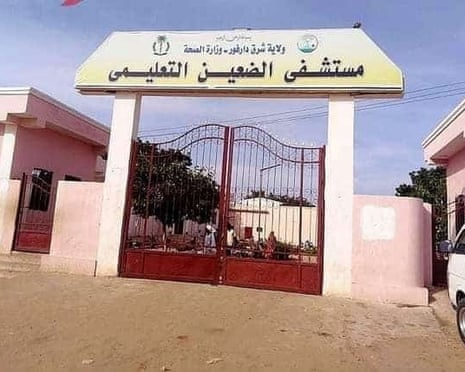 A drone strike hit the emergency department of El-Daein teaching hospital in East Darfur on 20 March 2026 Photograph: sudantribune.com
theguardian.com
A drone strike hit the emergency department of El-Daein teaching hospital in East Darfur on 20 March 2026 Photograph: sudantribune.com
theguardian.com
A drone strike hit the emergency department of El-Daein teaching hospital in East Darfur, killing at least 64 people and wounding 89, according to the World Health Organization’s surveillance system cited by The Guardian. Sudan’s UN humanitarian office said it was “appalled” by the attack, which reportedly killed children among others.
The Emergency Lawyers, a Sudanese rights group documenting atrocities in the war between the Sudanese army and the paramilitary Rapid Support Forces (RSF), said the strike was carried out by the army, The Guardian reported. The WHO entry marked the incident as “confirmed” but did not attribute responsibility, noting that the agency is not an investigative body.
This gap between counting and accountability has become a defining feature of Sudan’s war. The RSF dominates much of Darfur, while the army holds large parts of the east, centre and north. In that geography, hospitals are both strategically important and institutionally exposed. They concentrate scarce supplies, trained staff, and wounded fighters and civilians in predictable locations. Damaging them degrades an opponent’s staying power while imposing costs on a population that cannot easily relocate care.
The mechanics of drone warfare make this easier. Drones reduce the immediate operational risk to the side launching them, and they can be used repeatedly against fixed sites without the political cost that would accompany large ground operations. The UN human rights chief Volker Türk has warned that the parties are using “increasingly powerful drones” and deploying explosive weapons with wide-area effects in populated areas, The Guardian reported.
The result is a familiar pattern: international bodies can verify that a hospital was hit, tally the dead, and issue statements urging restraint. But in a fragmented conflict where control is territorial and enforcement is absent, condemnation does not translate into costs for the actor that ordered the strike. Even the language of record-keeping reflects this reality—confirmed incident, unspecified perpetrator.
By December, the UN said more than 1,800 people had been killed in attacks on health facilities since the war began, including 173 health workers. This year alone, 12 attacks on health care have been recorded, causing 178 deaths and 237 injuries, according to WHO tracking cited by The Guardian.
At El-Daein teaching hospital, the emergency department was struck; the war’s accounting system recorded another confirmed attack, and the city’s patients lost a place to be treated.