
French sailor Strava run reveals Charles de Gaulle carrier position
Le Monde verifies coordinates against satellite imagery, consumer fitness data keeps turning military movement into public OSINT
Images
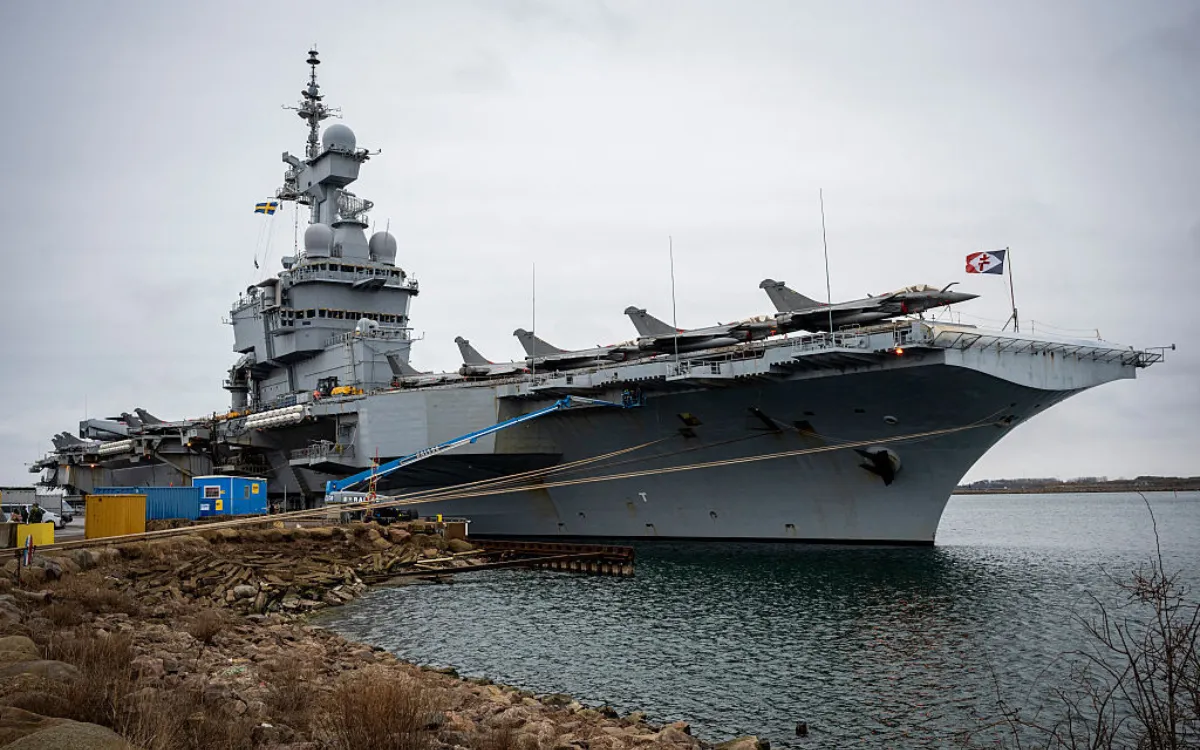 A picture taken on February 25, 2026, shows the French aircraft carrier Charles De Gaulle (R91) during a media tour while moored at the quay of the North Port in Malmo, Sweden.
newsweek.com
A picture taken on February 25, 2026, shows the French aircraft carrier Charles De Gaulle (R91) during a media tour while moored at the quay of the North Port in Malmo, Sweden.
newsweek.com
 Iran War Live: Israel pounds Iran on Persian New Year
newsweek.com
Iran War Live: Israel pounds Iran on Persian New Year
newsweek.com
 The 5 Iran War Traps Trump Must Avoid
newsweek.com
The 5 Iran War Traps Trump Must Avoid
newsweek.com
 RFK Jr’s Big Loss Shows America’s Culture Wars Aren’t Over
newsweek.com
RFK Jr’s Big Loss Shows America’s Culture Wars Aren’t Over
newsweek.com
 Lauren Boebert Lashes Out Over Potential $200 Billion For Iran War
newsweek.com
Lauren Boebert Lashes Out Over Potential $200 Billion For Iran War
newsweek.com
A French sailor’s seven-kilometre run has become a breadcrumb trail for anyone interested in tracking an aircraft carrier headed toward the Iran war. According to Newsweek citing Le Monde, a naval officer aboard the Charles de Gaulle uploaded a workout to Strava on 13 March, broadcasting near real-time coordinates northwest of Cyprus—data that Le Monde says matched satellite imagery taken just over an hour later.
The Charles de Gaulle strike group was redeployed on President Emmanuel Macron’s orders on 3 March, days after fighting began between Israel, the United States and Iran, with the carrier redirected from Nato drills in the Baltic through the Strait of Gibraltar. The deployment itself is not secret; the problem is the precision. A public fitness log can provide time-stamped location data, and repeated logs can outline patterns: speed, direction, and likely operating areas. In a region where drones, missiles and maritime attacks are central to the conflict, a moving ship’s “digital exhaust” matters in ways a press statement does not.
This is not an isolated lapse, and the repetition is the story. Le Monde previously reported similar leaks involving French nuclear submarines, and Newsweek notes earlier cases in which protective details for world leaders exposed travel and hotel locations through jogging routes. The mechanics are simple: Strava is designed to map movement; activities are public unless users change settings; even private activities can still contribute to aggregated products like heatmaps. Security organisations can issue memos, but as long as personnel are rewarded for convenience and normal consumer behaviour—and rarely punished for the small leaks that precede a big one—data keeps escaping.
Banning a single app is also a partial fix. GPS traces can be generated by watches, phones, fitness platforms and even photo metadata; blocking Strava leaves the underlying behaviour intact. The more durable control is organisational: prohibiting wearables in sensitive contexts, enforcing device audits, and treating location leakage as a security incident with consequences. Those measures are costly in morale and administration, which is why they tend to appear after an embarrassment rather than before.
Le Monde’s reporting also underlines a second-order effect: open-source intelligence no longer depends on adversary spies. It can be crowdsourced, automated, and cross-checked against commercial satellite imagery. A single public account, left on default settings, can make a carrier group’s movements “scarily simple” to reconstruct, the newspaper concluded.
The run was logged as exercise. It functioned as a position report.