
US immigration judge denies asylum for family of detained five-year-old
Liam Conejo Ramos case moves to appeals board after Texas detention, procedure runs faster than the family’s timeline
Images
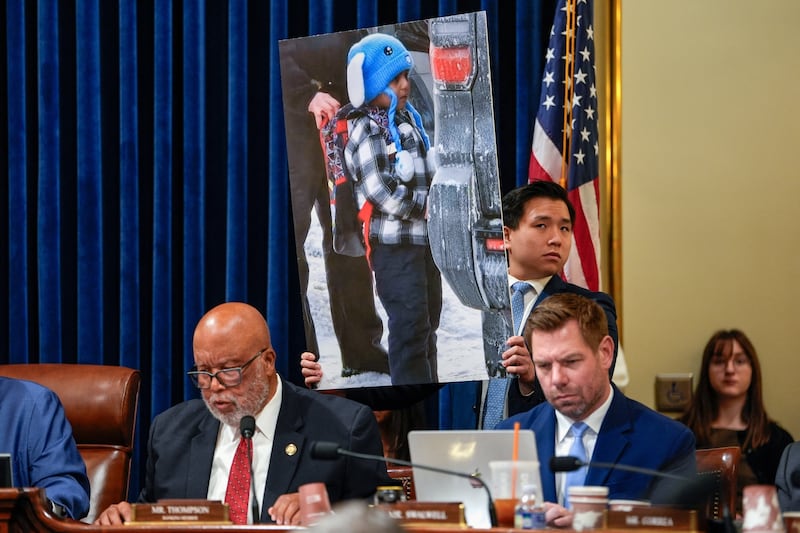 An aide holds up an image of 5-year-old Liam Conejo Ramos as U.S. Representative Bennie Thompson (D-MS) speaks during a U.S. House Homeland Security Committee. Kent Nishimura/REUTERS
Kent Nishimura/REUTERS
An aide holds up an image of 5-year-old Liam Conejo Ramos as U.S. Representative Bennie Thompson (D-MS) speaks during a U.S. House Homeland Security Committee. Kent Nishimura/REUTERS
Kent Nishimura/REUTERS
 Juan Chavez Velasco and Stephanie Villarreal
thedailybeast.com
Juan Chavez Velasco and Stephanie Villarreal
thedailybeast.com
 The young boy's detention sparked protests. Kaylee Greenlee/REUTERS
Kaylee Greenlee/REUTERS
The young boy's detention sparked protests. Kaylee Greenlee/REUTERS
Kaylee Greenlee/REUTERS
 Ndoye confronts Nick Shirley abot filming traders, telling him: "This is how we eat. Get the f--k out of here."
thedailybeast.com
Ndoye confronts Nick Shirley abot filming traders, telling him: "This is how we eat. Get the f--k out of here."
thedailybeast.com
 There were also protests outside the South Texas Family Residential Center, where Adrian Conejo and his son Liam Conejo Ramos were detained. Antranik Tavitian/REUTERS
Antranik Tavitian/REUTERS
There were also protests outside the South Texas Family Residential Center, where Adrian Conejo and his son Liam Conejo Ramos were detained. Antranik Tavitian/REUTERS
Antranik Tavitian/REUTERS
A federal immigration judge has denied asylum to the family of Liam Conejo Ramos, a five-year-old whose detention during an ICE sweep in Minneapolis became a national flashpoint. According to The Daily Beast, the family has been ordered deported to Ecuador after a February 19 ruling by Judge John Burns, with an appeal now headed to the Board of Immigration Appeals. Liam and his father, Adrian Conejo Arias, were held for 10 days in a Texas detention centre before a judge ordered their release, sending the child back to preschool in Minneapolis.
The facts of the case, as reported by CNN and other outlets cited by The Daily Beast, are less notable than the machinery around them. The Department of Homeland Security says the father entered the US illegally in December 2024 and that the family received “full due process” before a final removal order. The family’s lawyers dispute that, saying they entered legally at a Brownsville port of entry as asylum seekers through CBP One, the appointment system created under the Biden administration to channel arrivals into an administrative queue.
Either way, the leverage point is not the final ruling; it is the period before it. Detention, transfers across state lines, and the prospect of family separation impose costs that are immediate and personal while appeals run on institutional time. The family’s attorney told the Minnesota Star Tribune that “every day is a struggle,” and that how long the children can stay in school depends largely on how quickly the appeals board moves. That is a familiar asymmetry: the state can make life expensive quickly, while the target must wait months or years for a review.
The same asymmetry shapes incentives inside the system. Immigration courts are administrative tribunals processing large caseloads under political pressure to deliver visible enforcement. ICE field operations are measured in arrests and removals, not in downstream disruption to schooling, prenatal care, or family stability. When a child becomes a public symbol, the agency can describe its actions as “standard procedure,” because procedure is the product being delivered.
The case also shows how policy churn turns compliance into a trap. A family that uses an official entry pathway can still end up treated like an illegal entrant once the political context changes, while the paper trail becomes one more file in a backlog. Legal entry does not buy certainty; it buys exposure to a process whose timeline and priorities are set elsewhere.
Liam’s photo—bunny hat, Spider-Man backpack—was held up in a House Homeland Security Committee hearing. The deportation order is a document in an immigration court file, and the family is now waiting for the appeals queue to move.