
South-east Asia rolls out fuel rationing
War-linked oil shock hits import-dependent economies, thermostats and four-day weeks substitute for supply
Images
 Workers changing fuel price at a Manila filling station. The Philippines has initiated emergency powers amid instability caused by energy price surges. Photograph: Ted Aljibe/AFP/Getty Images
theguardian.com
Workers changing fuel price at a Manila filling station. The Philippines has initiated emergency powers amid instability caused by energy price surges. Photograph: Ted Aljibe/AFP/Getty Images
theguardian.com
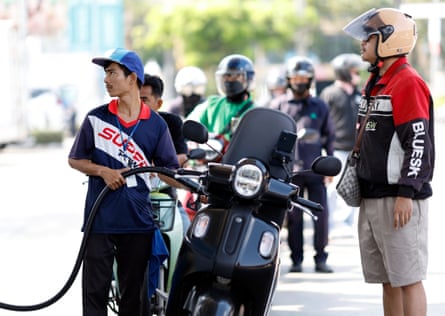 A worker fills a motorbike with fuel in Bangkok. Petrol stations across Thailand have experienced panic buying. Photograph: Rungroj Yongrit/EPA
theguardian.com
A worker fills a motorbike with fuel in Bangkok. Petrol stations across Thailand have experienced panic buying. Photograph: Rungroj Yongrit/EPA
theguardian.com
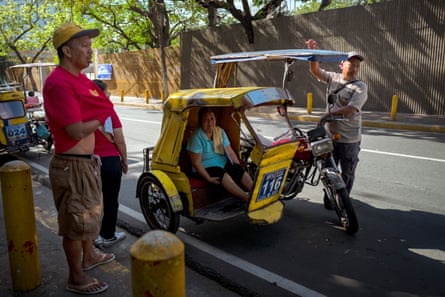 Tricycle drivers in Manila wait to receive cash aid being distributed amid rising fuel prices caused by the US-Israel war with Iran. Photograph: Ezra Acayan/Getty Images
theguardian.com
Tricycle drivers in Manila wait to receive cash aid being distributed amid rising fuel prices caused by the US-Israel war with Iran. Photograph: Ezra Acayan/Getty Images
theguardian.com
Fuel rationing has spread across parts of south-east Asia as governments scramble to contain a price shock tied to disrupted Middle East supply routes. The Guardian reports that Thailand is asking offices to set air-conditioning at 26–27C and even telling news anchors to drop jackets, while the Philippines has moved government staff to a four-day week and won emergency powers to suspend or cut fuel excise taxes.
The measures read like public-relations campaigns, but they are also a map of where governments still have levers: public-sector work rules, thermostats, travel budgets, and subsidies. In the Philippines, which the paper says sources about 90% of its oil from the Gulf, the state is offering cash handouts to public-transport drivers and ordering agencies to cut electricity and fuel use by 10–20%. Thailand is discussing dimming billboards after 10pm and even closing petrol stations if the crunch deepens, while also suspending most oil exports and nudging biofuel blends higher. Indonesia is accelerating a biodiesel programme built around palm oil.
What these steps cannot do is conjure physical supply. When a region is structurally dependent on imported crude and refined products, the binding constraint is not how citizens behave on a weekday but whether cargoes can be sourced, financed, insured and delivered on time. War-risk insurance, freight availability and refinery margins decide what arrives; domestic price caps and rationing decide only who gets it first. The Guardian’s reporting shows the political logic: protect households from the full price signal, then manage the shortages that follow with administrative controls.
The distributional effects are already visible. A jeepney driver in Metro Manila told the Guardian his take-home pay has fallen by more than half as diesel costs rise, leaving daily earnings that barely cover food staples. When governments suppress prices or promise compensation, demand stays high while supply tightens, and the shortage becomes a queue, a ration card, or a subsidy line item. The same dynamic pushes governments to restrict exports “temporarily” to keep domestic pumps supplied, shifting the problem onto neighbours and trading partners.
For countries that have spent years talking about “resilience” and “strategic autonomy,” the crisis is exposing a simpler dependency: the ability to buy a barrel is less decisive than the ability to move it through contested sea lanes and insure it once it arrives. In Bangkok, the next policy lever under discussion is billboard brightness. In Manila, it is the workweek.