
Police respond to reported active shooter at Michigan synagogue
Vehicle crash and smoke prompt multi-agency and FBI deployment, escalation precedes verified facts
Images
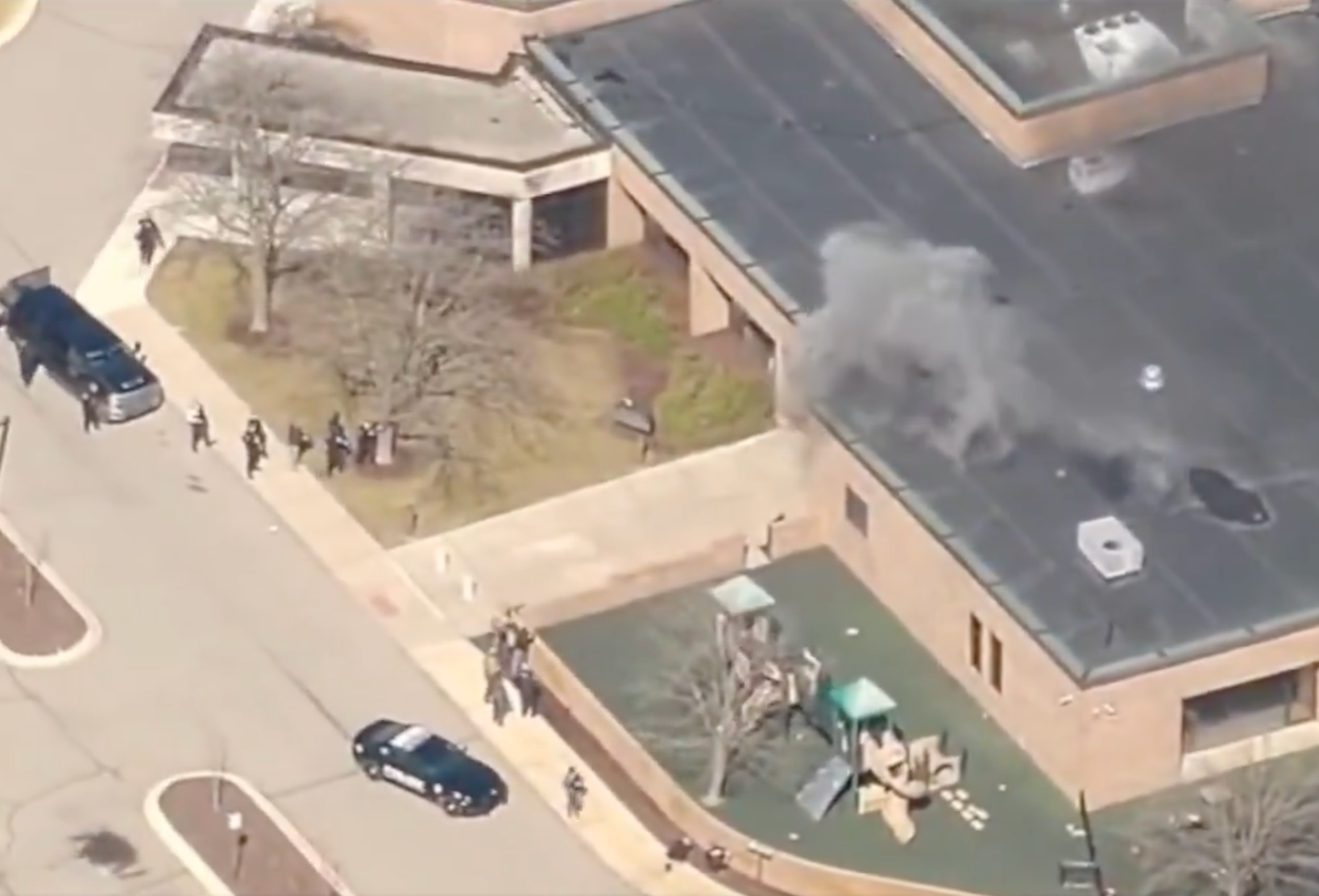 Police are responding to reports of an ‘active shooter’ at a Michigan synagogue (Fox)
Fox
Police are responding to reports of an ‘active shooter’ at a Michigan synagogue (Fox)
Fox
 independent.co.uk
Police and federal agents rushed Thursday to Temple Israel in West Bloomfield Township, Michigan after reports of an “active shooter,” smoke rising from the building, and a vehicle that had crashed into the synagogue. The Independent, citing local statements and regional reporting, said the call came in just before 1 p.m., with the Oakland County Sheriff’s Office announcing that “multiple agencies” were on scene and “emergency personnel” were clearing the building.
Within minutes, the incident’s framing widened from a local emergency to a national-security posture. Ann Arbor police said they were increasing patrols around houses of worship and schools “out of an abundance of caution,” turning a single location into a regional alert. FBI Director Kash Patel posted that FBI personnel were responding to an “apparent vehicle ramming and active shooter situation,” a formulation that simultaneously invokes terrorism-style tactics and an ongoing shooter threat—two labels that trigger different playbooks, funding lines, and investigative authorities.
This is how the U.S. “active shooter” apparatus tends to behave under uncertainty: early fragments of information—crash, smoke, reported gunfire—are treated as additive rather than competing hypotheses. A car into a building can be an accident, a medical episode, or an attack; smoke can be a fire unrelated to violence; “shots fired” can be misheard, misreported, or come from police. But emergency communications reward escalation, not restraint. A dispatcher who under-calls a real attack risks careers and headlines; an agency that over-calls a false alarm can later cite caution and process. That asymmetry pushes the first public description toward the most severe plausible scenario.
Once a high-severity label is spoken aloud, institutions downstream have their own incentives to match it. Local departments surge units; neighboring jurisdictions raise visibility to show responsiveness; state officials issue statements to demonstrate attention; federal agencies arrive because being absent is harder to justify than being present. The Independent reported Michigan Gov. Gretchen Whitmer saying she was “tracking reports” and calling the situation “heartbreaking,” while adding that antisemitism and violence have “no place” in the state—language that can be issued before any motive is known because it aligns with the worst-case narrative already in circulation.
The operational consequence is that verification happens in parallel with mobilization rather than before it. “Clearing the building” is a labor-intensive, time-sensitive procedure; it is also a visible demonstration of action that can be communicated to the public. The same is true of federal presence: it signals seriousness and deterrence, but it also expands the incident’s administrative footprint, from local incident command to federal reporting, evidence handling, and potential terrorism-related investigative steps.
By mid-afternoon, the public record still consisted of reported elements—vehicle impact, smoke, possible shooter—and a growing list of agencies responding. The first confirmed fact was not who did what inside the synagogue, but that the system had already arrived in full.