
African governments spend $2bn on Chinese AI surveillance
Guardian cites report covering 11 countries and thousands of smart cameras, smart city procurement doubles as opposition mapping
Images
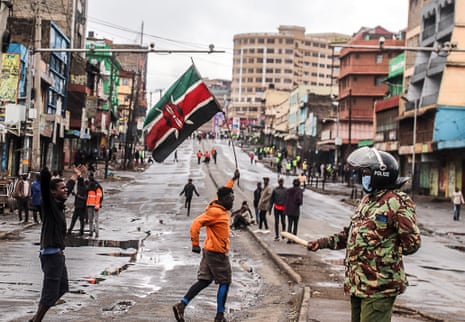 Street protests last year in the Kenyan capital, Nairobi. Unlawful tech-facilitated surveillance systems were used to crack down on the gen Z-led protests there. Photograph: D Odhiambo/Getty
theguardian.com
Street protests last year in the Kenyan capital, Nairobi. Unlawful tech-facilitated surveillance systems were used to crack down on the gen Z-led protests there. Photograph: D Odhiambo/Getty
theguardian.com
 An advanced AI-powered surveillance system in Lagos state, Nigeria. The country has invested $470m on 10,000 smart cameras. Photograph: Lagos state government
theguardian.com
An advanced AI-powered surveillance system in Lagos state, Nigeria. The country has invested $470m on 10,000 smart cameras. Photograph: Lagos state government
theguardian.com
‘At least $2bn’ has been spent by 11 African governments on Chinese-built surveillance systems that can recognise faces and track movements, according to a report cited by The Guardian. The study, produced with the African Digital Rights Network and the Institute of Development Studies, describes packages that typically bundle CCTV, facial recognition, biometric data collection and vehicle-tracking cameras, often financed via loans from Chinese banks.
The spending figure is large enough to show how quickly surveillance has become a line item rather than an emergency measure. The report singles out Nigeria as the biggest buyer, saying it invested $470m in 10,000 “smart cameras”, while Egypt has installed 6,000 and Algeria and Uganda about 5,000 each. Researchers say governments market the systems as “smart city” infrastructure and crime-reduction tools for fast-growing urban areas.
The report’s central claim is not that surveillance exists, but that it is being deployed with weak constraints on what data is collected, how long it is stored, and who can access it. Wairagala Wakabi of Uganda-based policy group Cipesa argues the systems are not “legal, necessary or proportionate” to the stated security aims, and says the effect is to chill movement and expression as people assume they may be identified and catalogued in public space. The Guardian notes allegations that surveillance systems were used during Kenya’s gen Z-led protests and that activists in Uganda have raised concerns about facial recognition being used to monitor opponents.
The second-order effect is that the technology changes the price of political control. A government that previously needed large numbers of informants, police time and manual paperwork can shift to automated identification, searchable databases and replayable footage. That lowers operational costs and raises the odds that protest organisers, journalists and dissidents can be mapped through their networks rather than through a single arrest.
The report also warns that “regulation” can become a stamp of legitimacy rather than a constraint. Georgetown University assistant professor Bulelani Jili argues that surveillance of online activity has often been legalised through laws that criminalise ordinary posts, and that adding legal frameworks can simply give governments a compliance narrative while the systems become embedded in policing and intelligence practice.
For vendors, the commercial logic is familiar: sell a scalable platform, add ongoing maintenance, training and upgrades, and make switching expensive once cameras, databases and identity systems are integrated into daily operations. For governments, the procurement pitch is equally standard: modernisation, crime prevention and national security, with the political upside of better control and the fiscal upside of automating what used to be labour-intensive.
The report’s numbers are specific, but the broader pattern is portable. Once facial recognition and biometric databases become routine in one jurisdiction, they are packaged as “best practice” elsewhere—especially when public procurement rewards systems that promise fewer headlines and faster identification. The technology may be sold as infrastructure, but its value is measured in how cheaply a state can find people.
Nigeria’s 10,000-camera project is presented as a security upgrade. The report’s authors describe it as a reminder that the same camera that spots a stolen car can also compile a list of faces at a protest.