
Nickel mining spreads across Palawan as battery demand rises
Protected-area exemptions keep projects running, red laterite runoff becomes the local cost of green supply chains
Images
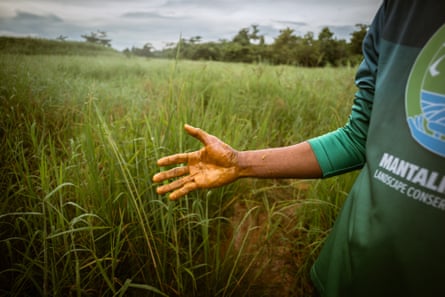 Moharen Tahil Tambiling says rice plants on his farm in Brooke’s Point, Palawan, have died because of laterite in the water
theguardian.com
Moharen Tahil Tambiling says rice plants on his farm in Brooke’s Point, Palawan, have died because of laterite in the water
theguardian.com
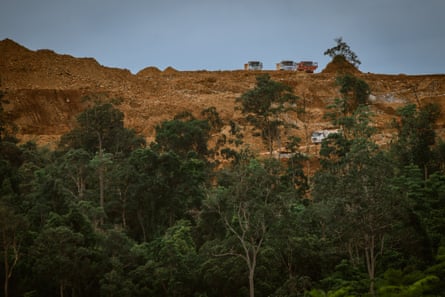 Trucks haul nickel laterite from an open mine near Brooke’s Point
theguardian.com
Trucks haul nickel laterite from an open mine near Brooke’s Point
theguardian.com
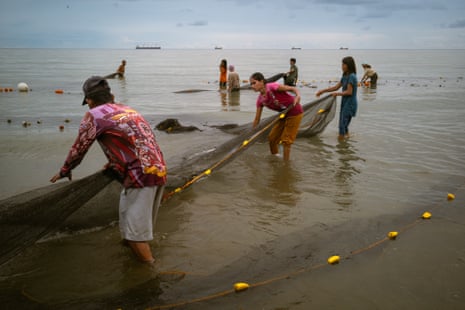 Three people stand in shallow water holding a fishing net. Other people holding nets can be seen behind them
theguardian.com
Three people stand in shallow water holding a fishing net. Other people holding nets can be seen behind them
theguardian.com
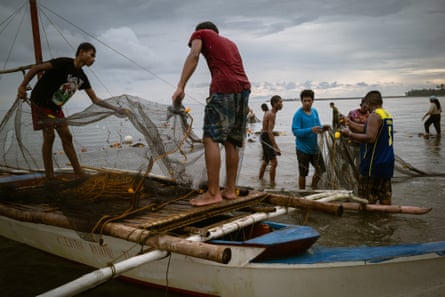 Men stand on boats and in shallow water holding fishing nets
theguardian.com
Men stand on boats and in shallow water holding fishing nets
theguardian.com
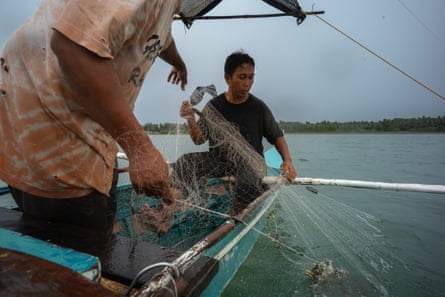 Two men in a boat haul a net from the water
theguardian.com
Two men in a boat haul a net from the water
theguardian.com
Red silt now coats coral heads in Brooke’s Point on the Philippine island of Palawan, where fishermen and farmers say runoff from nearby nickel laterite mining has turned reefs dull and rice paddies orange. The Guardian reports that residents can scoop viscous laterite tailings from riverbeds and shallow bays, and that locals link the change to an open-pit mine operated on a deposit acquired by Global Ferronickel Holdings in 2015.
Palawan markets itself as “the last ecological frontier” of the Philippines, with environmental groups estimating it contains a large share of the country’s remaining old-growth forest, mangroves and coral reefs. Yet nickel laterite — a near-surface ore formed by tropical weathering — is concentrated precisely in places with heavy rainfall, intact rainforest and coastal ecosystems. That geology has become an industrial map: the same humidity that builds laterite deposits also makes it easy for fine sediment to move downhill and into waterways once vegetation is removed.
The immediate driver is battery demand. Nickel is a key input for many lithium-ion chemistries used in electric vehicles and grid storage, and laterite deposits account for a large share of global reserves. The climate transition has therefore expanded the market for a mineral historically tied to stainless steel, pulling new jurisdictions into supply chains that are priced in dollars but policed locally. Where enforcement is weak or contested, the cheapest operational choice is often the one that shifts costs downstream: tailings in rivers, silt on reefs, and lost catches for small-scale fishers.
Palawan’s mining footprint has grown inside a regulatory carve-out. The Guardian notes that the Ipilan mine sits on Mt Mantalingahan, a protected area, and is one of 11 established mining projects exempted from a 2025 moratorium on mining expansion. Exemptions create a predictable scramble: once a project is “grandfathered in”, every additional tonne extracted is revenue today, while the environmental bill is negotiated later — if at all — between companies, local governments and communities with limited leverage.
The supply chain then launders the damage into a finished product with a green label. Battery and car makers can publish emissions targets and ESG statements while sourcing metal from places where the visible externality is not CO₂ but sediment and habitat loss. For Palawan’s coastal villages, the transition is experienced less as decarbonisation than as a new commodity cycle, with the same old question of who carries the risk when the ore leaves.
On the reef outside Brooke’s Point, the evidence residents point to is not a spreadsheet but a colour change: grey water, orange sand under a thin crust, and coral that used to be bright now filmed over with silt.