
China parliament approves ethnic unity law
Mandarin becomes default in schools and signage, autonomy promises survive mainly in older statutes
Images
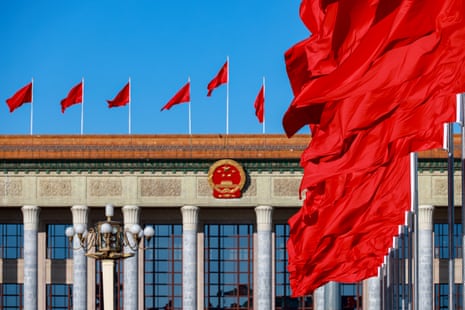 This year’s two sessions meetings are drawing to a close, with China’s National People’s Congress – which has never rejected an item on its agenda – set to approve a new ethnic unity law on Thursday. Photograph: VCG/Getty Images
theguardian.com
This year’s two sessions meetings are drawing to a close, with China’s National People’s Congress – which has never rejected an item on its agenda – set to approve a new ethnic unity law on Thursday. Photograph: VCG/Getty Images
theguardian.com
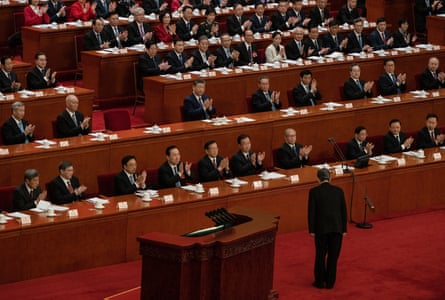 Xi Jinping, China’s president, centre, applauds as Zhao Leji, the chair of the National People’s Congress, bows before his speech in the Great Hall of the People on 9 March. Photograph: Kevin Frayer/Getty Images
theguardian.com
Xi Jinping, China’s president, centre, applauds as Zhao Leji, the chair of the National People’s Congress, bows before his speech in the Great Hall of the People on 9 March. Photograph: Kevin Frayer/Getty Images
theguardian.com
 China’s new ethnic unity law requires schools in the country to use Mandarin as a default. Photograph: China News Service/Getty Images
theguardian.com
China’s new ethnic unity law requires schools in the country to use Mandarin as a default. Photograph: China News Service/Getty Images
theguardian.com
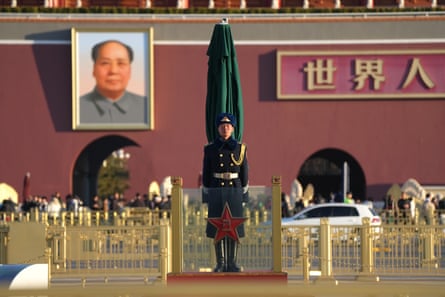 A guard at Tiananmen Gate, close to the Great Hall of the People in Beijing, where the NPC’s annual meetings have been held this month. Photograph: Stringer/Anadolu/Getty Images
theguardian.com
A guard at Tiananmen Gate, close to the Great Hall of the People in Beijing, where the NPC’s annual meetings have been held this month. Photograph: Stringer/Anadolu/Getty Images
theguardian.com
 China is expected to push for an ethnic unity law that critics say will cement assimilation
independent.co.uk
China is expected to push for an ethnic unity law that critics say will cement assimilation
independent.co.uk
China’s National People’s Congress is set to pass a new “ethnic unity” law on Thursday that would make Mandarin the default language of instruction in schools and elevate it over minority languages such as Tibetan, Uyghur and Mongolian. According to The Guardian, the law also requires Mandarin to be displayed more prominently than minority scripts on public signage, codifying practices already reported in places like Inner Mongolia.
The vote comes at the end of the annual “two sessions” meetings, where delegates also approve the next five-year plan and a new environmental code. The NPC has never rejected an item on its agenda, a fact the Guardian notes while describing the legislature’s role as converting party priorities into legal obligations.
The immediate change is administrative: schools and local authorities get a clearer hierarchy of what language is supposed to come first, and officials gain a simpler compliance test. The Independent reports that the draft mandates Mandarin before kindergarten and through the rest of compulsory education, leaving minority languages in a subordinate position even where local autonomy is promised on paper. China’s constitution and its Law on Regional Ethnic Autonomy formally protect the right to use and develop minority languages, but a national statute that specifies “default” instruction gives provincial bureaucracies a new reason to standardise curricula, teacher hiring, and examinations.
Standardisation is also a governance tool. A single language reduces the need for bilingual public administration and narrows the space for local elites—teachers, publishers, broadcasters—who previously controlled parts of the cultural infrastructure. It also makes surveillance and content control cheaper: fewer languages to monitor, fewer scripts to accommodate, fewer local curricula to audit. Human Rights Watch’s Yalkun Uluyol told the Guardian the law is a move to “legalise forced assimilation and political control”, arguing that many of its directives already operate in Xinjiang, Tibet and Inner Mongolia.
The timing matters. The same sessions produced China’s lowest growth target in decades—4.5% for 2026—alongside a push to reassert central control as the economy slows and the cost of managing peripheral regions rises. The Independent cites analysts who see the law as the “capstone” of Xi Jinping’s shift away from earlier promises of meaningful autonomy. Inner Mongolia’s 2020 protests over language policy, and the subsequent crackdown, provide a recent example of how quickly language disputes become security matters.
Thursday’s vote is expected to pass without drama. The concrete test will come later, in classrooms and on street signs, as local officials decide how much Mongolian, Tibetan or Uyghur is allowed to remain visible once Mandarin becomes the default setting by law.