
Drone strike kills schoolgirls in Sudan
Satellite data points to systematic attacks on farming villages, starvation and airpower merge into a war economy
Images
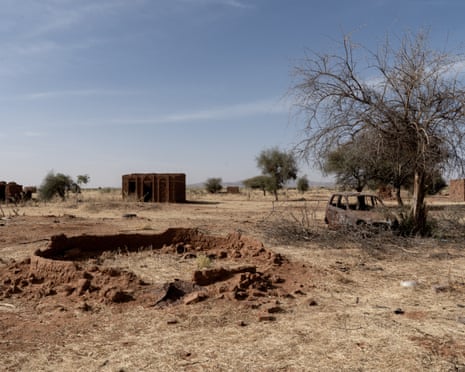 The abandoned African village of Al Birka, about 30km from el-Fasher. Photograph: Giles Clarke/Avaaz
theguardian.com
The abandoned African village of Al Birka, about 30km from el-Fasher. Photograph: Giles Clarke/Avaaz
theguardian.com
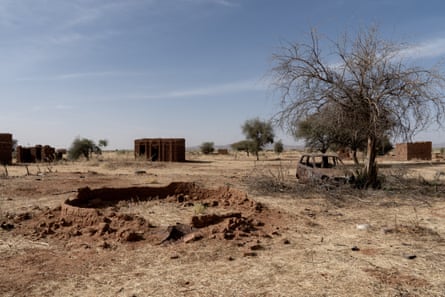 The abandoned village of Al Birka, about 30 km from El Fasher. Villages surrounding the city have been attacked and their livestock enclosures and farming infrastructure destroyed. Photograph: Giles Clarke/Avaaz
theguardian.com
The abandoned village of Al Birka, about 30 km from El Fasher. Villages surrounding the city have been attacked and their livestock enclosures and farming infrastructure destroyed. Photograph: Giles Clarke/Avaaz
theguardian.com
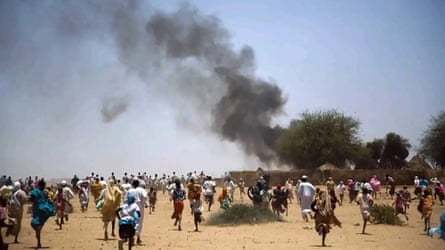 People fleeing an attack on Zamzam camp in April 2025. Photograph: Courtesy of North Darfur Observatory For Human Rights
theguardian.com
People fleeing an attack on Zamzam camp in April 2025. Photograph: Courtesy of North Darfur Observatory For Human Rights
theguardian.com
At least 17 people, most of them schoolgirls, were killed when an explosive-laden drone hit a secondary school and a health facility in the village of Shukeiri in Sudan’s White Nile province, according to the Associated Press. The Sudan Doctors Network said the dead included teachers and a healthcare worker and blamed the Rapid Support Forces, which did not respond to a request for comment. The strike comes as Sudan’s war enters its third year and as drone attacks have become routine across multiple fronts.
A separate Guardian investigation argues that drones and raids are only the visible edge of a broader campaign aimed at controlling the country’s economic systems rather than just its cities. Using satellite imagery and fire-detection sensors, the Guardian’s reporting and an accompanying legal analysis describe repeated attacks on farming villages around El Fasher in North Darfur, including the destruction of livestock enclosures, farming equipment and other infrastructure. Legal scholars Tom Dannenbaum of Stanford and Oona Hathaway of Yale say the pattern supports an allegation of a deliberate “starvation strategy” that deprives civilians of the means to produce food—conduct prohibited under the laws of war.
Remote sensing matters because Sudan’s conflict zones are difficult to access, and both sides have incentives to deny, reframe or outsource responsibility. The Guardian reports a 2,040% increase in detected fires across 41 villages during the period studied, with a quarter of villages attacked more than once and 68% showing no signs of normal life after attacks. Vehicles consistent with those used by the RSF were identified near some scenes, the report says. The same logic that makes drones attractive—cheap, precise enough to terrorise, and easy to deny—also makes attribution a political weapon.
Starvation as a method of war is not just about blocking aid convoys. It is about removing the assets that let people stay put: animals, seed stocks, irrigation, storage, and the safety needed to plant and harvest. Once communities are displaced, roads and checkpoints become revenue points, and humanitarian access becomes a gatekept commodity. Sanctions that name commanders can coexist with a war economy that runs on seized land, tolls, and control of transport nodes.
In Shukeiri, the immediate evidence is physical: a school and a clinic hit at dawn, girls brought to Douiem hospital for surgery, and the absence of any reported military target. In Darfur, the evidence is a map of burned villages and empty livestock pens that satellites can still see long after the gunmen have moved on.