
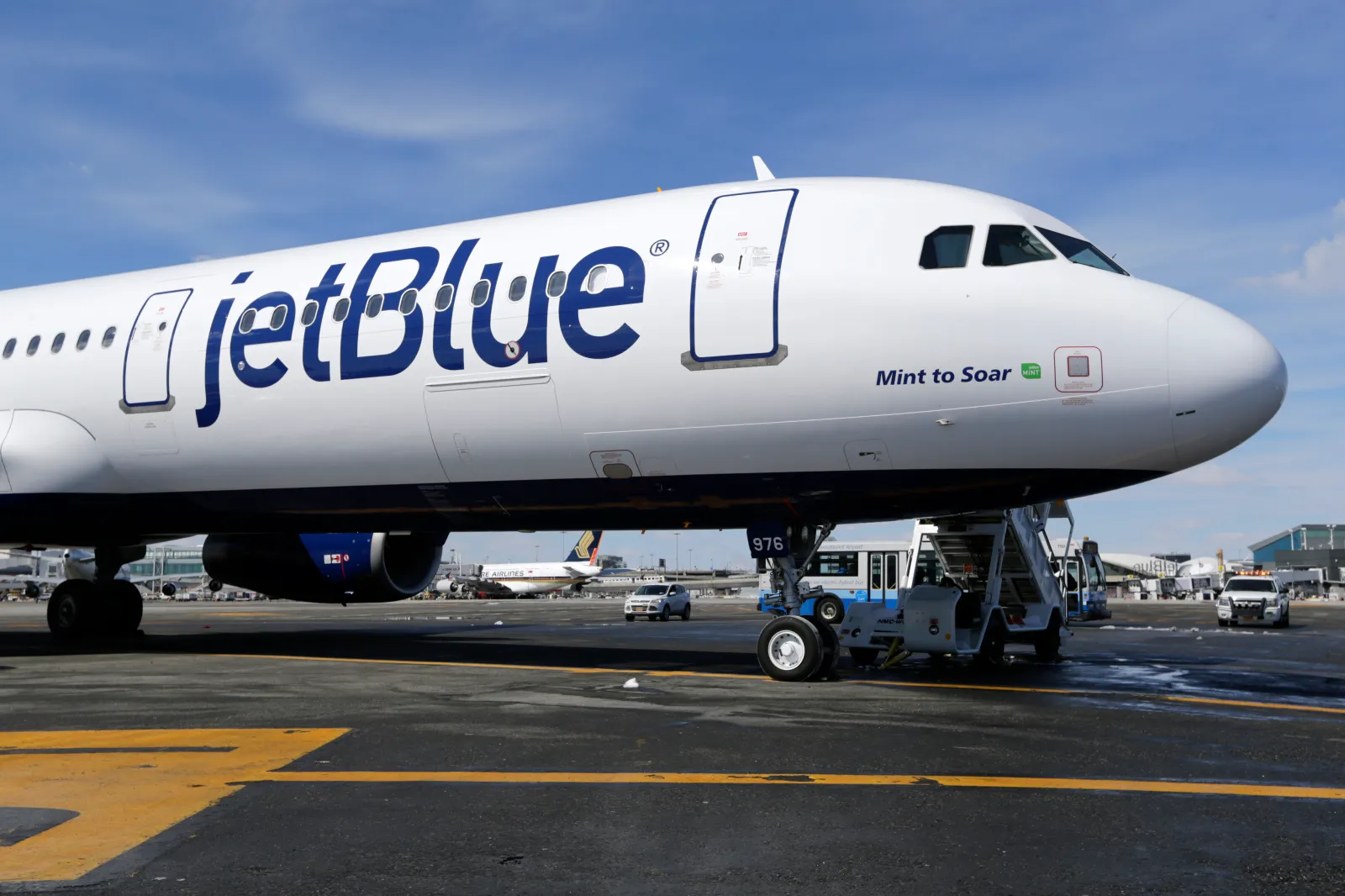
JetBlue grounds flights after internal system outage
FAA lifts nationwide stop after about 40 minutes, operational resilience depends on software behaving like infrastructure
Images
 newsweek.com
 Trump Says Iran Has Tomahawk Missiles When Asked About Deadly School Strike
newsweek.com
Trump Says Iran Has Tomahawk Missiles When Asked About Deadly School Strike
newsweek.com
 Fani Willis Suffers Legal Blow in Fight Against Trump
newsweek.com
Fani Willis Suffers Legal Blow in Fight Against Trump
newsweek.com
 Kavanaugh Defends Supreme Court’s Trump Orders: ‘None of Us Enjoys This’
newsweek.com
Kavanaugh Defends Supreme Court’s Trump Orders: ‘None of Us Enjoys This’
newsweek.com
 Jeffrey Epstein’s ‘Zorro Ranch’ Searched in New Mexico Amid Criminal Probe
newsweek.com
Jeffrey Epstein’s ‘Zorro Ranch’ Searched in New Mexico Amid Criminal Probe
newsweek.com
JetBlue asked the US Federal Aviation Administration on Tuesday to halt its flights nationwide after a “brief system outage”, according to Newsweek, and the ground stop lasted about 40 minutes before operations resumed. The airline said the issue was resolved and flights were released, but the incident briefly turned a single carrier’s internal IT problem into a system-wide operational pause.
In isolation, a 40-minute interruption is a minor disruption in a network designed to absorb weather, maintenance delays and air-traffic constraints. What makes these events recurring is not the duration but the dependency chain: airlines increasingly run dispatch, crew scheduling, weight-and-balance, gate management, and passenger rebooking through tightly integrated systems that assume constant availability. When a core service fails—whether a data centre component, a database, an authentication layer, or a third-party connection—there is rarely a “manual mode” that scales beyond a handful of flights. The result is an expensive choice between letting aircraft push back with incomplete information or stopping the operation until the system state is trusted again.
The industry’s public language is “safety-critical”, but much of the fragility is commercial. Redundancy costs money twice: once to build and again to maintain, test and staff. Backup systems that are never exercised tend to fail when needed; parallel workflows create training burdens and error risk; and duplicated infrastructure is hard to justify on quarterly budgets when outages are infrequent. Yet downtime is also a cost that can be shifted—onto passengers, airports, and downstream connections—until it becomes large enough to force an accounting.
Regulators can mandate procedures, but they cannot easily mandate operational resilience without specifying architectures, vendors and testing regimes, which quickly becomes a procurement and compliance industry of its own. Airlines, meanwhile, optimize for day-to-day throughput: the same centralization that enables high aircraft utilization and rapid rebooking also concentrates failure. The more a carrier markets seamless digital service—app-based boarding passes, automated disruption handling, dynamic pricing—the more its operation depends on the invisible plumbing working continuously.
On Tuesday, JetBlue’s outage was fixed before the queues and cancellations became the story. The FAA ground stop ended after roughly 40 minutes, and flights returned to normal—an interruption measured in minutes, caused by systems built to run without interruption at all.