
Floating fishmeal factories target Guinea-Bissau waters
Guardian investigation tracks motherships and illegal sardinella supply, protected zones depend on enforcement not maps
Images
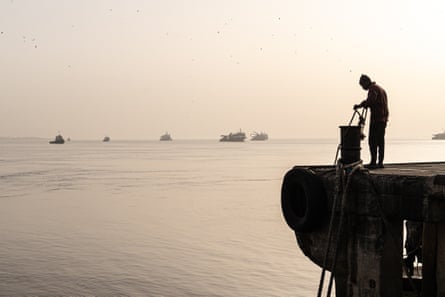 Foreign industrial vessels anchored near the port of Bissau. Photograph: Davide Mancini
theguardian.com
Foreign industrial vessels anchored near the port of Bissau. Photograph: Davide Mancini
theguardian.com
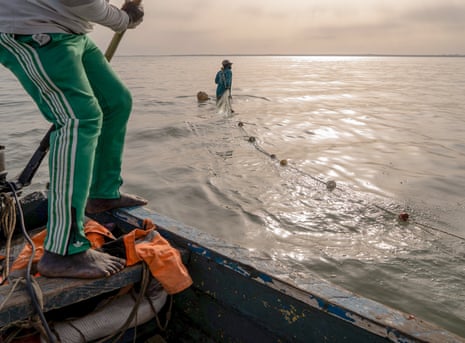 Pedro Luis Pereira wades through the shallow water looking for fish. Photograph: Davide Mancini
theguardian.com
Pedro Luis Pereira wades through the shallow water looking for fish. Photograph: Davide Mancini
theguardian.com
 Artisanal fishers take their catch to Bissau, where it will be sold at Bandim port. Photograph: Davide Mancini
theguardian.com
Artisanal fishers take their catch to Bissau, where it will be sold at Bandim port. Photograph: Davide Mancini
theguardian.com
 Footage shows Chinese vessel Hua Xin 17 receiving fish from a Turkish fishing vessel
theguardian.com
Footage shows Chinese vessel Hua Xin 17 receiving fish from a Turkish fishing vessel
theguardian.com
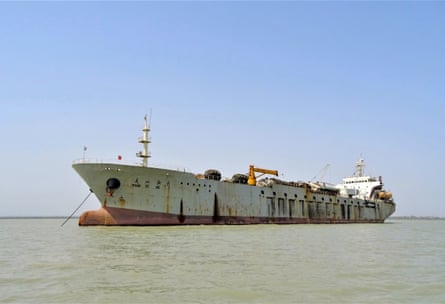 Evidence suggests the Tian Yi He 6 has regularly illegally transshipped sacks of fishmeal. Photograph: CFFA
theguardian.com
Evidence suggests the Tian Yi He 6 has regularly illegally transshipped sacks of fishmeal. Photograph: CFFA
theguardian.com
At least two offshore “fishmeal factory” ships spent most of 2025 anchored off Guinea-Bissau’s Bijagós archipelago, according to a Guardian and DeSmog investigation, processing freshly caught sardinella into fishmeal and oil. The reporting identifies the Chinese-owned Hua Xin 17, described as a floating processing plant, and says it was anchored for 157 days about 50km off Orango island. Eyewitness accounts, video and satellite records cited by the Guardian suggest Turkish supply vessels routinely fished inside the protected area.
The Bijagós is marketed as a marine sanctuary: wooden canoes are the only legal fishing boats inside the archipelago, and the shallow waters function as a nursery for sardinella and other species that feed turtles, manatees, migratory birds and larger fish further offshore. The alleged pattern described by the investigation—industrial vessels working the boundary, switching off or manipulating tracking, and transferring catch to a mothership for processing—turns the protected zone into a line on a map rather than a constraint. When enforcement is weak, the rational strategy is to fish first and argue later; the gains are immediate and the penalties, if they arrive at all, are negotiable.
Fishmeal and fish oil are not primarily eaten locally. They are industrial inputs for aquaculture and animal feed, which means the economic pull comes from distant buyers and contract chains that can absorb reputational noise. The Guardian reports that trade data links the product to international supply chains, while local infrastructure on Bubaque—such as the island’s only ice factory—sits broken for months, forcing artisanal fishers into long trips to the mainland to preserve their catch. The contrast is a recurring feature of export enclaves: capital arrives for extraction and logistics, not for the small bottlenecks that would help local producers compete.
Guinea-Bissau’s problem is not a lack of rules but a lack of leverage. A coastal state with limited patrol capacity is asked to police large, mobile assets operating in international waters’ grey zones, backed by foreign owners, flags, brokers and buyers. A protected area becomes valuable only if someone can reliably impose costs on violators; otherwise it becomes a marketing asset for everyone except the people expected to respect it.
In 2025 the Hua Xin 17 sat offshore for 157 days, the Guardian reports. On Bubaque island, fishers were still waiting for a broken ice machine to be repaired.