
Meta claims BitTorrent seeding pirated books is fair use
Authors say defence appears after discovery deadlines, AI training lawsuits turn distribution into a technicality
Images
 part and parcel
torrentfreak.com
part and parcel
torrentfreak.com
 torrentfreak.com
 torrentfreak.com
Meta has begun arguing in a California federal court that even the act of uploading pirated books to other users via BitTorrent can qualify as fair use, a position that would extend its legal defence beyond training AI models to the mechanics of how it obtained the data.
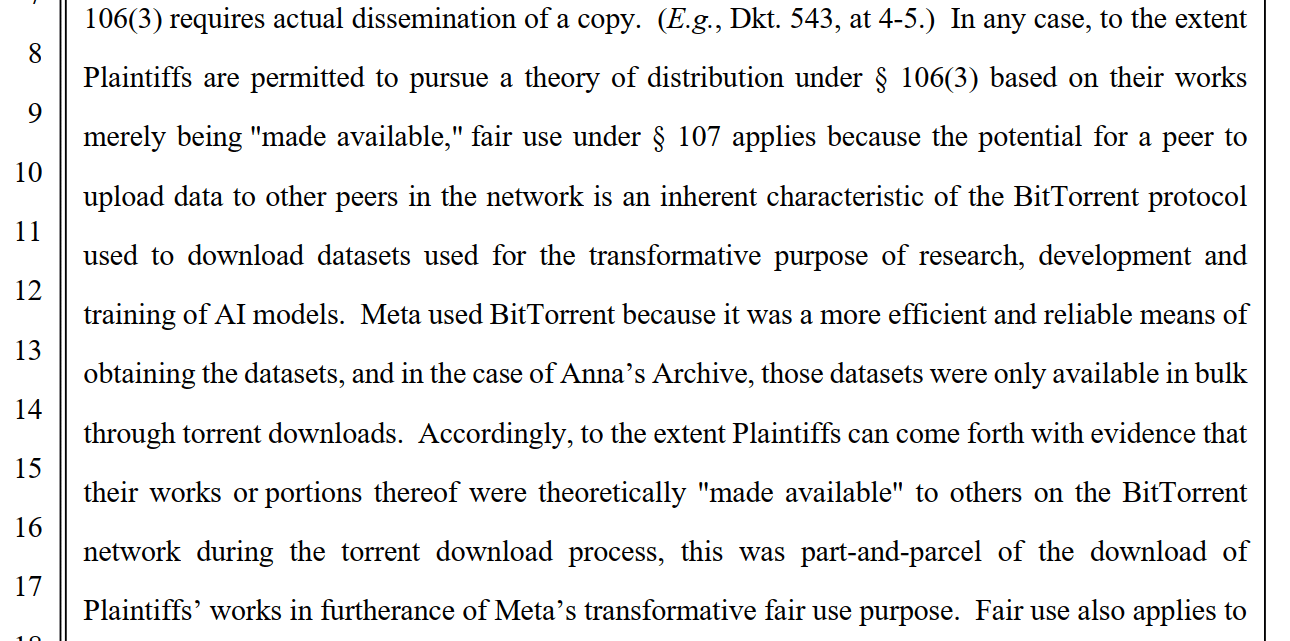
According to TorrentFreak, authors including Richard Kadrey, Sarah Silverman and Christopher Golden sued Meta in 2023 over the use of books from shadow libraries to train its Llama large language model. The court previously accepted that the training itself could fall under fair use, but left a separate claim alive: that Meta engaged in direct infringement by “seeding” the books while downloading them through BitTorrent, thereby redistributing copyrighted files to others. In a supplemental discovery response filed late in the case, Meta now says that any “making available” during the torrent download was “part-and-parcel” of the same allegedly transformative purpose.
The move matters because it tries to convert a distribution claim—normally the cleanest, least debatable form of infringement—into collateral damage of a process Meta portrays as unavoidable. BitTorrent uploads are automatic, Meta argues; and in the case of Anna’s Archive, torrents were allegedly the only practical way to obtain bulk datasets. That is a convenient story for a company whose competitive advantage is scale: the cheapest training set is the one you do not have to license, and the fastest way to assemble it is to treat the internet’s grey-market archives as an input pipeline.
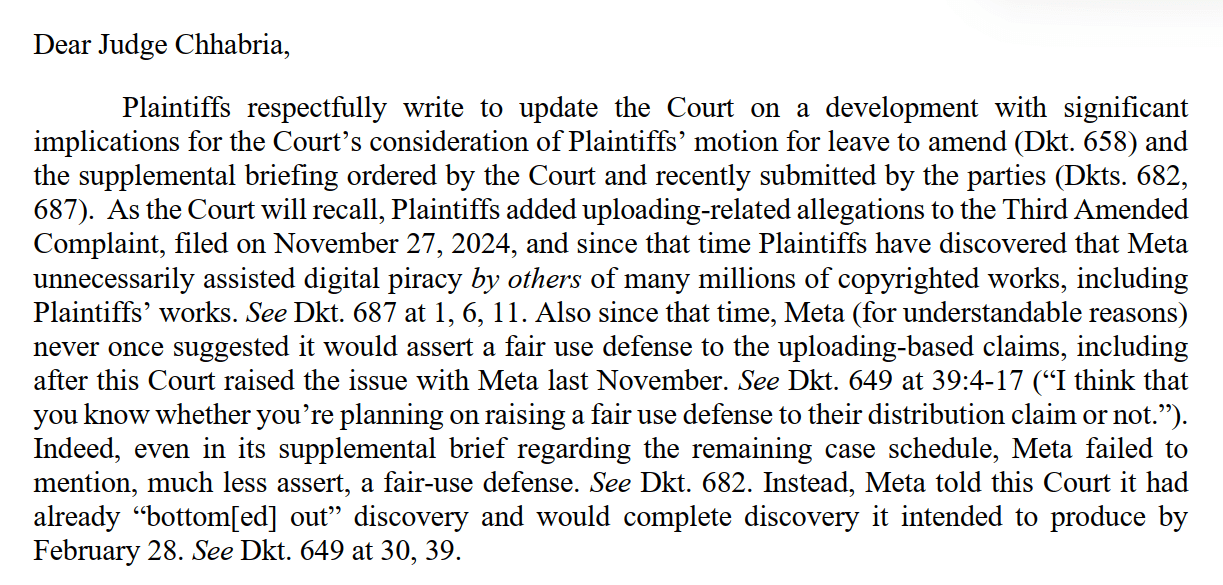
The authors’ lawyers, also cited by TorrentFreak, are not only disputing the substance but the timing. They told Judge Vince Chhabria that Meta had known about the uploading allegations since late 2024 yet did not raise a fair-use defence when the court asked about the issue, and that a “continuing duty” to supplement discovery should not become a loophole for introducing new defences after deadlines. Meta responded that it was properly supplementing its interrogatory answers.
If courts ultimately accept the idea that redistribution through piracy networks can be immunised by downstream “transformative” use, the effect will not be evenly distributed. A small publisher, a startup, or an individual who seeded a library of books would not plausibly survive the litigation costs required to test such a theory, let alone the reputational and platform risks. A firm with Meta’s balance sheet can.
Meta’s defence also has a policy smell: it asks the judiciary to ratify, retroactively, an industrial-scale data acquisition strategy that legislatures have not authorised and that markets have not priced. The case is less about whether AI training can be fair use in the abstract than whether the cost of building AI should be paid by the companies selling it or by the people whose work was copied to make it.
The dispute now turns on whether a court will treat BitTorrent seeding as incidental technical behaviour or as a separate act of distribution with its own legal consequences.
Meta’s argument depends on one factual claim that is easy to state and hard to unwind in court: that piracy was the only efficient way to get the books in bulk.