
Iran apologises to Gulf states
Pezeshkian signals pause unless attacks originate locally, military spokespeople keep bases on the target list
Images
 Israel says it has launched a fresh wave of strikes on Iran, sending 80 fighter jets in a pre-dawn blitz that set one of Tehran’s main airports on fire. Photograph: Atta Kenare/AFP/Getty Images
theguardian.com
Israel says it has launched a fresh wave of strikes on Iran, sending 80 fighter jets in a pre-dawn blitz that set one of Tehran’s main airports on fire. Photograph: Atta Kenare/AFP/Getty Images
theguardian.com
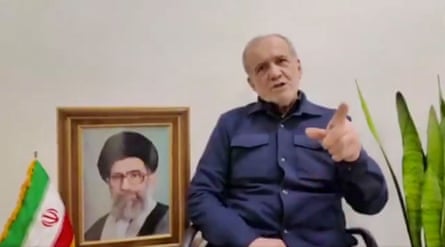 Masoud Pezeshkian apologised to neighbouring countries in a speech broadcast by state TV. Photograph: X
theguardian.com
Masoud Pezeshkian apologised to neighbouring countries in a speech broadcast by state TV. Photograph: X
theguardian.com
 Iran’s president apologises to Gulf nations; Trump threatens further strikes – Middle East crisis live
theguardian.com
Iran’s president apologises to Gulf nations; Trump threatens further strikes – Middle East crisis live
theguardian.com
Iran’s president Masoud Pezeshkian used a prerecorded address on Saturday to reject Donald Trump’s demand for “unconditional surrender”, calling it a “dream” and insisting Iran would never capitulate. In the same speech, he issued a rare apology to Gulf neighbours after Iranian missiles and drones struck targets in states hosting US military installations, according to The Guardian. The remarks came as the war entered its eighth day and Israel said it had launched another wave of strikes, including a pre-dawn raid involving about 80 fighter jets.
The apology was paired with a conditional promise: Iran would suspend attacks on nearby countries unless an assault on Iran originated from those states, Pezeshkian said. That formulation matters because US bases and airspace are spread across the Gulf. A senior Iranian armed forces spokesperson appeared to narrow the pledge further, saying strikes would continue against US and Israeli assets and that Iran would keep targeting “every base that was the origin of aggression against Iran”, The Guardian’s live coverage reported. In practice, the difference between “Gulf states” and “US bases in Gulf states” can be a distinction without a difference.
Western officials, quoted by The Guardian, said they were cautious about reading Pezeshkian’s comments as a genuine off-ramp. The uncertainty is not only diplomatic; it is internal. Pezeshkian said a temporary leadership council had approved the shift, but the messaging was immediately contested in public by military spokespeople. That split leaves Gulf capitals guessing whether Tehran is offering a de-escalatory bargain—stop hosting launch points and avoid being hit—or simply trying to reduce regional anger while continuing the same campaign under a different legal framing.
The practical stakes are visible in the region’s infrastructure. The United Arab Emirates said it intercepted 15 ballistic missiles and 119 drones on Saturday, while video verified by the BBC showed an apparent drone impact near Dubai International Airport’s concourse A, according to The Guardian. Airports, ports and energy assets are not just symbolic targets; they are the mechanisms that keep trade and travel functioning. When they are threatened, insurance prices and rerouting decisions move faster than diplomacy.
Trump responded on Truth Social by warning that Iran faced “complete destruction” if it did not surrender and claimed Tehran’s apology reflected “relentless U.S. and Israeli attack”, The Guardian reported. The exchange leaves the Gulf states in a familiar position: publicly urging restraint while quietly calculating how much exposure they can afford when the operational decisions may not sit with the civilian leadership that issues the apologies.
Pezeshkian’s apology was broadcast from Tehran. Hours later, Gulf air-defence systems were still counting interceptions.