
New Spinosaurus fossil from Niger challenges aquatic diver model
Inland river-basin site supports wading ambush predator interpretation, horned skull feature revives species-splitting debate
Images
 Credit:
UChicago Fossil Lab
Credit:
UChicago Fossil Lab
 Photo of Jacek Krywko
arstechnica.com
Photo of Jacek Krywko
arstechnica.com
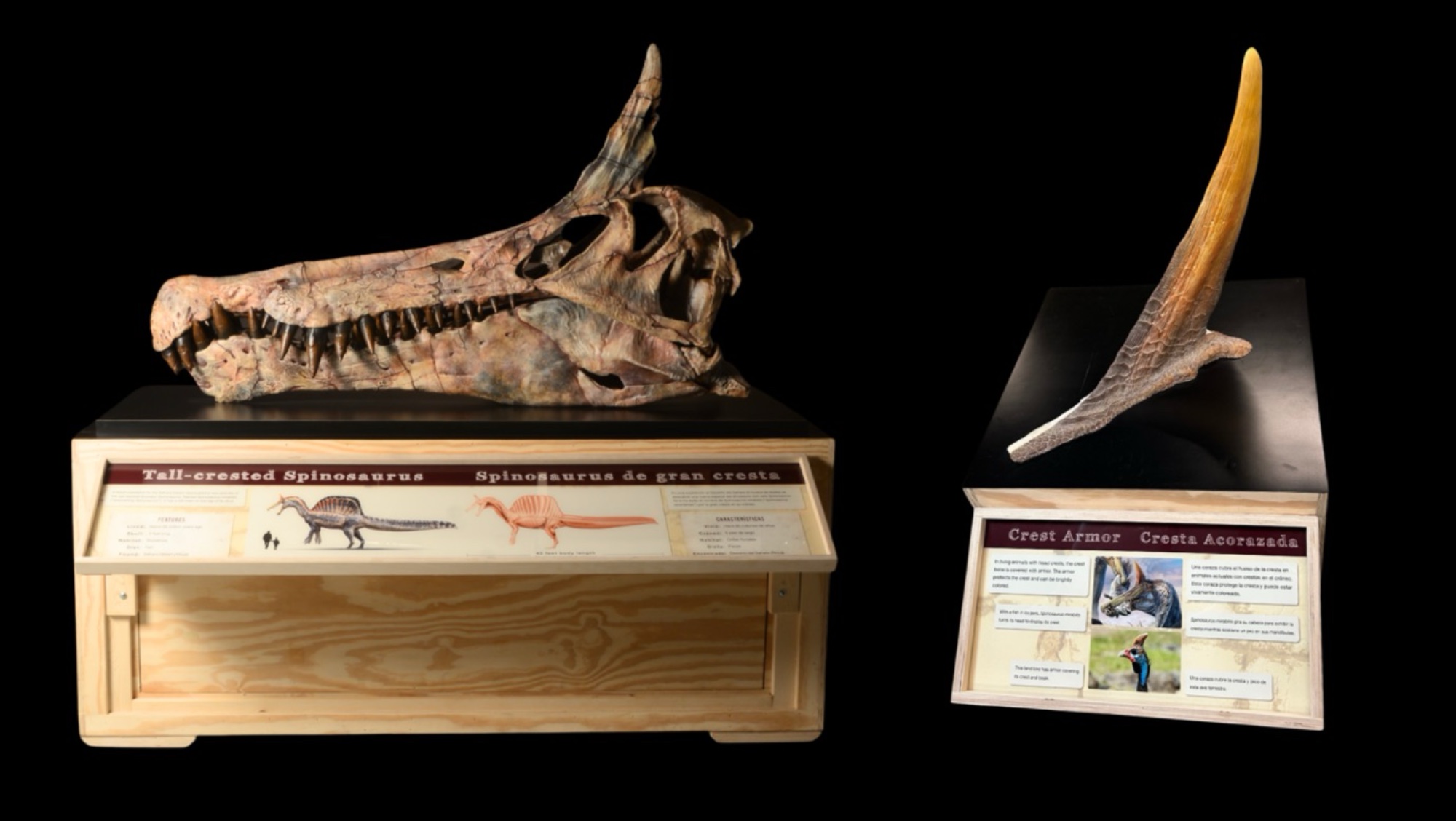
A new Spinosaurus fossil from Niger’s central Sahara includes an unusual cranial structure that researchers describe as a “unicorn-like” horn, adding another twist to the long-running argument over how these giant predators lived. The remains, reported by Ars Technica, come from an inland Late Cretaceous river-basin site called Jenguebi and are attributed to a proposed new species, Spinosaurus mirabilis, described by a team led by University of Chicago paleontologist Paul Sereno.
The location is the story’s first lever. Most Spinosaurus material has been recovered from coastal deposits tied to the ancient Tethys seaway, a pattern often used—sometimes too confidently—to frame spinosaurids as strongly aquatic animals. Jenguebi, by contrast, is described as a freshwater riparian environment hundreds of kilometres from the nearest marine shoreline. The fossils were found alongside large sauropods in the same sediments, which the authors take as evidence that the animals shared the same inland ecosystem rather than being transported from elsewhere.
That inland setting matters because the “fully aquatic diver” version of Spinosaurus has become a popular endpoint in recent reconstructions: an animal that pursued prey underwater, with body proportions and buoyancy control comparable to marine reptiles or mammals. Sereno’s team argues this picture breaks on basic constraints. They point to extensive air spaces in the skeleton—features analogous to avian air sacs—that would increase buoyancy, and they note that diving birds tend to reduce such air volumes. They also argue the limbs are too long to function as effective paddles, pushing the interpretation toward a shoreline ambush predator that waded in shallow water rather than a pursuit diver.
The horn-like cranial morphology then becomes a second lever, because it invites competing explanations that are hard to separate with fragmentary material. A prominent display structure could imply sexual selection or species recognition, which would help justify a new species designation but also raises the risk of over-splitting: a crest or horn can vary with age, sex, or individual development, and fossil samples rarely capture that variation cleanly. Alternatively, if the structure affected feeding—by strengthening the snout, shifting bite mechanics, or interacting with soft tissue—it could be an adaptation to prey capture in rivers. The difficulty is that these hypotheses predict different things (population-level variation, wear patterns, biomechanical correlates) that are often unavailable when a species is erected from incomplete remains.
What the Jenguebi find does supply is a cleaner ecological constraint: a giant spinosaurid thriving far inland. That does not rule out swimming or fish-eating—wading predators can be highly aquatic in diet without being divers—but it does narrow the plausible range of behaviours. It also shifts attention back to the economics of inference in palaeontology: a few new bones can force a rewrite of an animal’s lifestyle, while the uncertainty around what counts as a distinct species can remain.
Sereno’s team reached Jenguebi after more than a day of desert travel with Tuareg guides and a large security detail, according to Ars Technica. The new horned skull fragment is now being asked to carry both a habitat argument and a taxonomy argument at once.