
US investigators link Minab school strike to American forces
Pentagon inquiry tests accountability in allied Iran campaign, Europe pays war risk premium via energy prices
Images
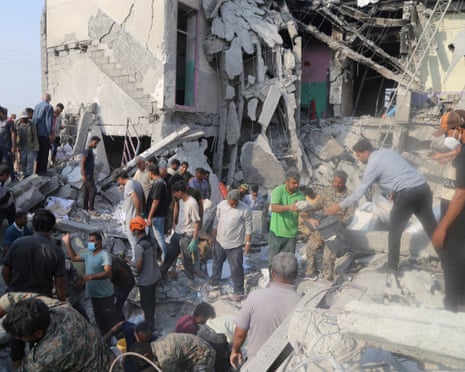 Iran has said more than 160 people were killed in the strike on the school in Minab on 28 February. Photograph: Abbas Zakeri/Mehr News/WANA/Reuters
theguardian.com
Iran has said more than 160 people were killed in the strike on the school in Minab on 28 February. Photograph: Abbas Zakeri/Mehr News/WANA/Reuters
theguardian.com
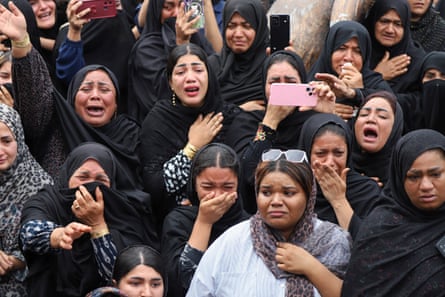 People attend a mass funeral for those killed in the strike on the school in Minab on Tuesday. Photograph: Amirhossein Khorgooei/Reuters
theguardian.com
People attend a mass funeral for those killed in the strike on the school in Minab on Tuesday. Photograph: Amirhossein Khorgooei/Reuters
theguardian.com
 Oil price hits $89 and heads for biggest weekly gain since 2020; shock as US economy loses 92,000 jobs in February – business live
theguardian.com
Oil price hits $89 and heads for biggest weekly gain since 2020; shock as US economy loses 92,000 jobs in February – business live
theguardian.com
 Middle East crisis live: Israel bombards Tehran and Beirut as US says attacks to intensify
theguardian.com
Middle East crisis live: Israel bombards Tehran and Beirut as US says attacks to intensify
theguardian.com
More than 160 people were reported killed when an Iranian girls’ school in Minab was hit on 28 February, and US military investigators now believe American forces probably carried out the strike, according to Reuters. The Pentagon has confirmed only that an inquiry is under way, while Iran’s ambassador to the UN in Geneva has said 150 students died.
If the preliminary US assessment holds, the episode lands in a narrow space where Europe’s preferred vocabulary—international law, accountability, proportionality—meets a practical question: who can force the facts into daylight when the suspected actor is also the alliance’s security guarantor. The UN human rights office has called for an investigation and said “the onus is on the forces that carried out the attack to investigate it,” but that formulation assumes a chain of command willing to publish findings and a political environment willing to absorb them. Washington’s public line is already defensive; the White House spokesperson said the Iranian regime targets civilians “not the United States of America,” while defence secretary Pete Hegseth insisted the US “never target[s] civilian targets” even as he acknowledged the investigation.
The war’s geography highlights how little of this is under European control. Reuters reports that US and Israeli strikes have been divided by region and target type, with the US focusing on southern Iran and naval-related targets while Israel hits western missile sites. That division makes the Minab strike more than an isolated tragedy: it is a test case for how responsibility is assigned inside a joint campaign, and whether allied coordination produces clarity or plausible deniability.
At the same time, the costs are already being priced far from the battlefield. Brent crude rose toward $90 a barrel on Friday, according to the Guardian’s business live blog, on fears that Gulf exports could be disrupted for weeks or months. Qatar’s energy minister, Saad al-Kaabi, warned that Gulf exporters may declare force majeure if the war continues, a signal traders treat as a countdown to tighter supply. Europe’s exposure is not just at the petrol pump: higher energy prices feed into shipping, fertiliser, chemicals and industrial power bills, with the risk premium paid by consumers and manufacturers who have no vote on targeting decisions.
In Minab, small coffins draped in Iranian flags were carried through crowds at a mass funeral shown on Iranian state television. In Brussels, the most immediate metric is still the oil price ticker.