
Woman leaves work boots outside her door
Viral TikTok shows improvised safety signal amid landlord dispute, Deterrence costs less than a locksmith
Images
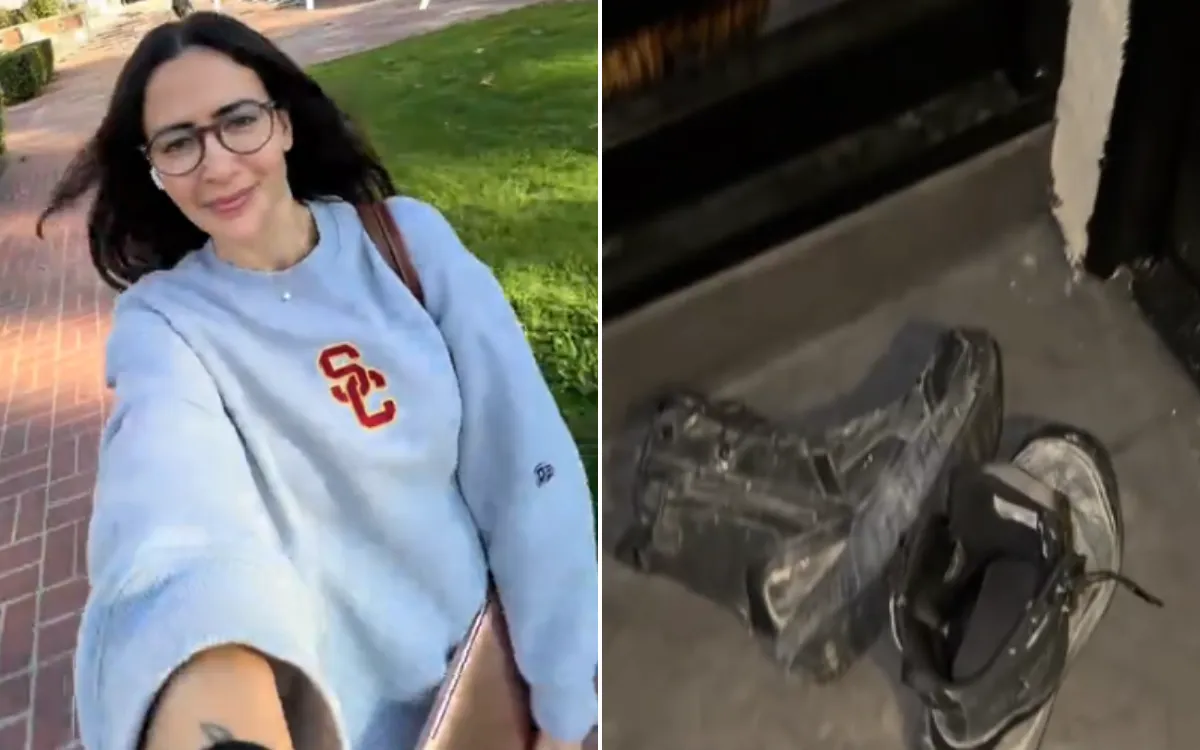 Tata Ramos and the boots.
newsweek.com
Tata Ramos and the boots.
newsweek.com
 Kristi Noem Responds to Firing as Homeland Security Secretary
newsweek.com
Kristi Noem Responds to Firing as Homeland Security Secretary
newsweek.com
 Tony Gonzales Drops Reelection Bid Amid Affair Fallout: Full Statement
newsweek.com
Tony Gonzales Drops Reelection Bid Amid Affair Fallout: Full Statement
newsweek.com
 US and Venezuela Agree to Reestablish Relations: What We Know
newsweek.com
US and Venezuela Agree to Reestablish Relations: What We Know
newsweek.com
 Full List of Republicans Voting to Curb Trump’s Iran War
newsweek.com
Full List of Republicans Voting to Curb Trump’s Iran War
newsweek.com
A Brazilian woman living alone in California says she started leaving a pair of heavy work boots outside her apartment door after a dispute with her landlord escalated into repeated complaints and demands to enter her home. The woman, Tata Ramos, told Newsweek she bought the boots from a nearby construction worker and placed them by the entrance so it would look like a man was inside. A short TikTok showing the boots has been viewed more than six million times, drawing thousands of comments and copycat suggestions.
Ramos’s story is not primarily about footwear; it is about how people improvise when formal protection feels unreliable. She describes a landlord who, in her account, dismissed safety concerns during building renovations, responded sporadically to complaints, and later claimed she was causing noise at dawn—then told her she could not use her shower because the sound disturbed neighbors. When the person who controls access to your housing is also the person you are trying to avoid, the usual advice—call management, escalate, document—starts to look like a slow-motion negotiation with someone who holds the leverage.
The boots are a low-cost way to change the assumptions of whoever might be at the door. For a would-be intruder, the difference between “a woman alone” and “someone else might be inside” is not moral; it is a risk calculation about resistance, witnesses, and consequences. The tactic works precisely because it does not require confrontation, proof, or cooperation from anyone else. It is also hard to argue with: the boots are not a weapon, not a threat, and not an accusation. They are just an object placed where objects are normally placed.
The response to Ramos’s video, according to Newsweek, quickly turned into a crowdsourced manual of similar signals—dirtying the boots, adding men’s jeans on a patio, or pretending to greet a father on the phone in public. That kind of folk security advice spreads because it is portable across cities and legal systems. It also spreads because it acknowledges an uncomfortable point: many everyday safety problems are not solved by dramatic interventions but by small changes that make predation less attractive.
Ramos said she has recorded videos to show she is not making excessive noise. The boots, unlike the videos, are not evidence for a future dispute; they are meant to prevent the next one.
At the end of the day, the most actionable security upgrade in the story is not a camera, an alarm, or a police report. It is a pair of used work boots bought from a stranger and left on a doormat.