
Khalifa Haftar blocks EU delegation in Benghazi
Libya’s recognised governments lack control of oil and migration routes, Visitors leave from the airport lounge
Images
 Composite: Alex Mellon/Guardian Design. Reuters/AFP/Getty Images
theguardian.com
Composite: Alex Mellon/Guardian Design. Reuters/AFP/Getty Images
theguardian.com
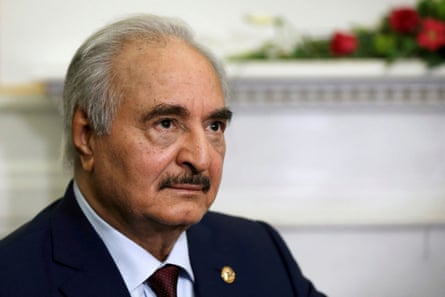 Khalifa Haftar in Athens in 2020. Photograph: Costas Baltas/Reuters
theguardian.com
Khalifa Haftar in Athens in 2020. Photograph: Costas Baltas/Reuters
theguardian.com
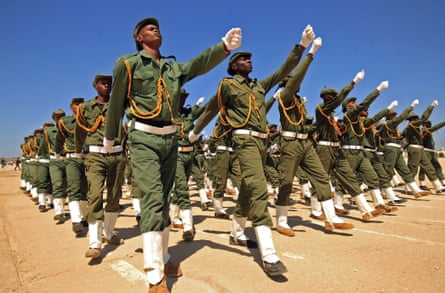 Fighters from the Libyan National Army in Benghazi in 2019. Photograph: Abdullah Doma/AFP/Getty Images
theguardian.com
Fighters from the Libyan National Army in Benghazi in 2019. Photograph: Abdullah Doma/AFP/Getty Images
theguardian.com
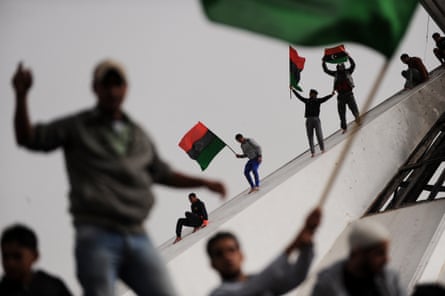 Libyans wave the old national flag in Benghazi in 2011. Photograph: Roberto Schmidt/AFP/Getty Images
theguardian.com
Libyans wave the old national flag in Benghazi in 2011. Photograph: Roberto Schmidt/AFP/Getty Images
theguardian.com
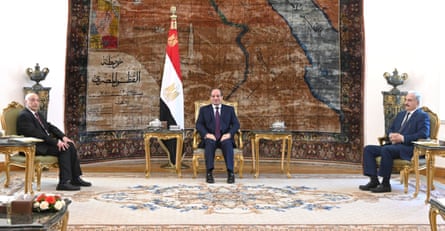 The Egyptian president Abdel Fattah al-Sisi (centre) meeting Aguila Saleh (left) and Haftar in Cairo in 2020. Photograph: Egyptian Presidency/AFP/Getty Images
theguardian.com
The Egyptian president Abdel Fattah al-Sisi (centre) meeting Aguila Saleh (left) and Haftar in Cairo in 2020. Photograph: Egyptian Presidency/AFP/Getty Images
theguardian.com
In July 2025, four senior European officials flew to Benghazi seeking an urgent meeting about migration flows from Libya. They left without seeing the man who controls the coastline, the oilfields and the smuggling routes. According to the Guardian, Khalifa Haftar would only grant access if the delegation first met—publicly and on camera—ministers from an eastern administration Europe does not recognise.
When the Europeans refused, they were denied entry and remained in an airport lounge. The episode exposed a central fact of Libya’s post-2011 order: formal titles and international recognition sit on top of a power graph that runs through armed groups, oil infrastructure and foreign patrons. The UN-backed Government of National Unity in Tripoli, formed in 2021 to oversee elections that never happened, is recognised abroad but does not control the assets that make Libya matter. A rival eastern government appointed in Benghazi in 2022 is not recognised, yet it is the gatekeeper to Haftar.
Haftar, 82, is styled as the commander of the Libyan National Army, a coalition of militias assembled in 2014 and later endorsed by the eastern parliament. The Guardian reports that his forces hold oilfields and export terminals across central Libya, and that his coastal units police parts of the eastern shore while also controlling routes used in smuggling. In practice, that portfolio—oil rents, armed payrolls and border leverage—functions as a substitute for the legitimacy that elections would normally provide.
Foreign involvement is not a side story but part of the operating system. The Guardian describes Libya as a hub where Russia, Turkey, Egypt and the UAE arm rival factions, and where bases in Libya’s south are used to funnel weapons and fighters into Sudan’s civil war. Spillover from Sudan then feeds back into Libya’s migration economy, pushing more people north toward the Mediterranean. For Europe, the immediate cost is measured in arrivals, patrol budgets and political crisis; for Libya’s armed powerbrokers, the same flows are leverage.
The failed Benghazi visit also shows why “unity government” diplomacy often stalls. Recognition is a currency that outside actors control, but access is a currency that Haftar controls. He can demand public meetings that launder status for officials who depend on him, then withhold cooperation when the optics do not suit. Europe’s choice becomes binary: legitimise the eastern administration or lose contact with the one actor who can turn migration on and off.
Libya’s 1,100-mile Mediterranean coastline—the longest in Africa—remains the main departure point for migrants heading north, the Guardian notes. The delegation that came to negotiate control over that coastline never made it past the terminal.