
China sets sub-5% growth target for 2026
Beijing signals post-property era at National People’s Congress, Lower ambition reduces pressure for another credit binge
Images
 Chinese President Xi Jinping and other leaders attend the opening session of the Chinese People's Political Consultative Conference, at the Great Hall of the People in Beijing on Wednesday.
japantimes.co.jp
Chinese President Xi Jinping and other leaders attend the opening session of the Chinese People's Political Consultative Conference, at the Great Hall of the People in Beijing on Wednesday.
japantimes.co.jp
 A solar farm in Nakai, Kanagawa Prefecture, in March 2016. Japan gets about a tenth of its electricity from solar panels despite having nearly no domestic production of photovoltaics (PVs).
japantimes.co.jp
A solar farm in Nakai, Kanagawa Prefecture, in March 2016. Japan gets about a tenth of its electricity from solar panels despite having nearly no domestic production of photovoltaics (PVs).
japantimes.co.jp
 As Japan accelerates AI adoption, policymakers and corporations frame the technology as essential to offsetting a projected labor shortfall of 11 million workers by 2040.
japantimes.co.jp
As Japan accelerates AI adoption, policymakers and corporations frame the technology as essential to offsetting a projected labor shortfall of 11 million workers by 2040.
japantimes.co.jp
 Imperial Hotel, Kyoto: Where hospitality traditions meet
japantimes.co.jp
Imperial Hotel, Kyoto: Where hospitality traditions meet
japantimes.co.jp
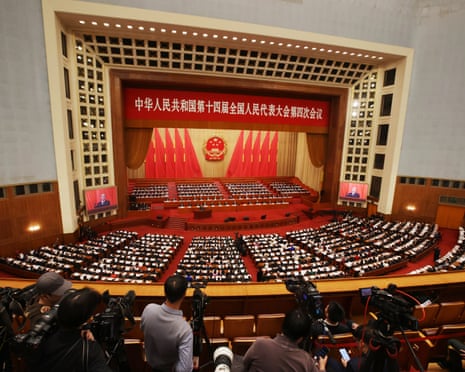 The meeting of the National People’s Congress (NPC), one of China’s Two Sessions meetings, got underway in Beijing on Thursday. Photograph: Andrés Martínez Casares/EPA
theguardian.com
The meeting of the National People’s Congress (NPC), one of China’s Two Sessions meetings, got underway in Beijing on Thursday. Photograph: Andrés Martínez Casares/EPA
theguardian.com
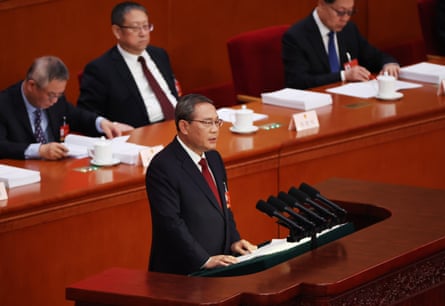 Li Qiang, China’s premier, said that 2025 was a ‘truly remarkable’ year. Photograph: Wu Hao/EPA
theguardian.com
Li Qiang, China’s premier, said that 2025 was a ‘truly remarkable’ year. Photograph: Wu Hao/EPA
theguardian.com
China set its 2026 growth target at 4.5% to 5% at the opening of the National People’s Congress in Beijing, the first time in decades the headline goal has been set below 5%, according to the Japan Times and the Guardian. Premier Li Qiang also reiterated a 5.5% urban unemployment target and a pledge to create more than 12 million new urban jobs, while the government released its 15th five-year plan for 2026–2030.
The lower target is a quiet admission that the old playbook—property-led construction booms and credit-fuelled local investment—has run out of room. China is still carrying a large property overhang and heavy local-government liabilities, while household demand remains weak. A higher target would have implied another round of debt expansion to force activity into existence, pushing more losses into the banking system and local financing vehicles that already depend on rolling short-term funding.
Instead, Beijing is trying to shift the composition of growth without promising the pace. The work report put fresh emphasis on “high-quality growth” and on investment in innovation, advanced manufacturing and scientific research. The Japan Times notes that leaders also pledged a “notable” but unspecified increase in household consumption’s share of output—an ambition that has appeared in past plans but has repeatedly collided with the state’s preference for directing capital into industry.
That tension is visible in the trade numbers. China ended last year with a record trade surplus of about $1 trillion, the Guardian reports, a cushion that keeps factories running even as domestic spending lags. But leaning on exports deepens dependence on foreign demand at the same moment the country’s rivalry with the US is intensifying and trade restrictions are proliferating. A slightly lower target gives officials room to talk about curbing industrial overcapacity without having to replace any lost export momentum with a domestic credit binge.
The plan also implies a different tolerance for pain. Analysts cited by the Guardian described the lower target as a sign of higher tolerance for unemployment, particularly as resources are steered toward high-tech sectors that do not absorb the same volume of blue-collar labour as construction and mass manufacturing. Li’s unchanged jobs target sits awkwardly beside that shift, suggesting that labour-market pressure will be managed through administrative measures and public spending rather than through a return to property stimulus.
In the Great Hall of the People, the headline number was presented as “high-quality” realism. It was also a reminder that China can choose its targets, but it cannot choose the balance sheets it built to reach the old ones.