
Cuba charges six US-based exiles with terrorism
Prosecutors cite US-flagged speedboat shootout near the coast, A diaspora raid becomes a domestic security case
Images
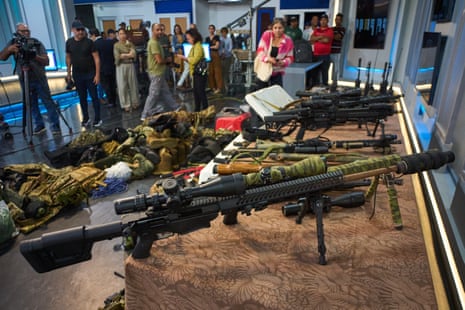 Cache of weapons that Cuban authorities allege were recovered from a US-registered speedboat that was involved in a shootout in Cuban waters. Photograph: Ramón Espinosa/AP
theguardian.com
Cache of weapons that Cuban authorities allege were recovered from a US-registered speedboat that was involved in a shootout in Cuban waters. Photograph: Ramón Espinosa/AP
theguardian.com
Cuban prosecutors have charged six US-based Cuban exiles with terrorism after a US-flagged speedboat was intercepted near the island and a firefight left four people dead, according to The Guardian. Cuban authorities say the boat came within one nautical mile of the coast in the 25 February incident and was carrying 13 rifles, 11 pistols and nearly 13,000 rounds of ammunition. Two of those detained are said to have been on a Cuban list of suspected terrorists; at least two people on the boat were US citizens, one of whom was killed.
The case sits in a familiar grey zone where diaspora politics, private violence and state narratives reinforce each other. Havana has an obvious incentive to frame armed opposition as “terrorism”: it raises the legal ceiling to include long sentences and potentially the death penalty, and it collapses political dissent into a security threat that can be handled by police and intelligence services rather than negotiated in public. Cuban state television’s display of seized weapons and bullet-riddled vessels functions as evidence, but also as a broadcast: the government is showing control, competence and justification at a moment when it is under economic pressure and facing a US administration openly signalling regime-change ambitions.
For exile networks operating from South Florida, the incentive structure runs the other way. Distance reduces personal risk while increasing the symbolic payoff. A small group can create an outsized political effect: a clandestine landing attempt, a shootout at sea, or simply a dramatic story that travels through diaspora media can generate donations, recruitment and status. The logistics are also asymmetric. US territory offers money, equipment, travel documents and a large sympathetic audience; the operational risk is pushed onto whoever gets on the boat.
Washington, meanwhile, is forced into a narrow set of responses. US politicians have questioned Cuba’s version of events and called for independent investigation, but the basic facts—an armed vessel, deaths in Cuban waters, US citizens involved—make it difficult to treat the incident as a mere propaganda invention. Secretary of state Marco Rubio has said it was not a US operation and that no US government personnel were involved. Havana has said the US was willing to cooperate in the investigation, a small but telling detail: even adversaries can share an interest in controlling freelance violence that could trigger escalation.
Cuba’s attorney general’s office has said the defendants will be held in provisional detention. If the case proceeds as described on state television, the outcome will be decided in a courtroom where the maximum penalty is already part of the script.