
US electricity bills rise as utilities expand grid spending
Data centers and regulated returns turn capex into household charges, Protesters show up at state rate commissions
Images
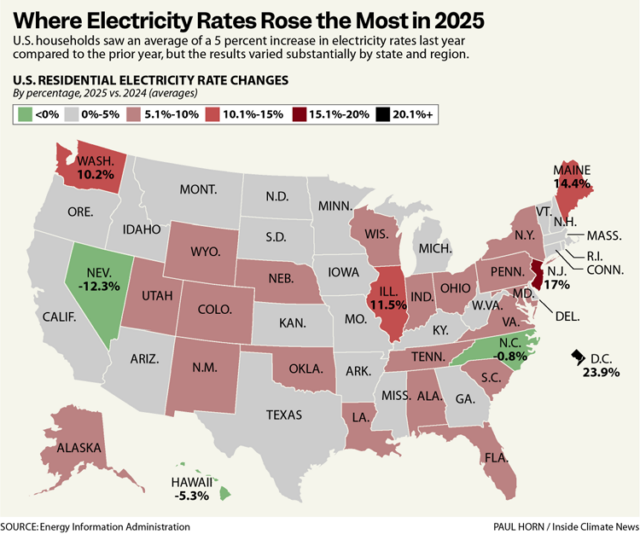 Illustration of US states and electricity rate increases
Credit:
Inside Climate News
Illustration of US states and electricity rate increases
Credit:
Inside Climate News
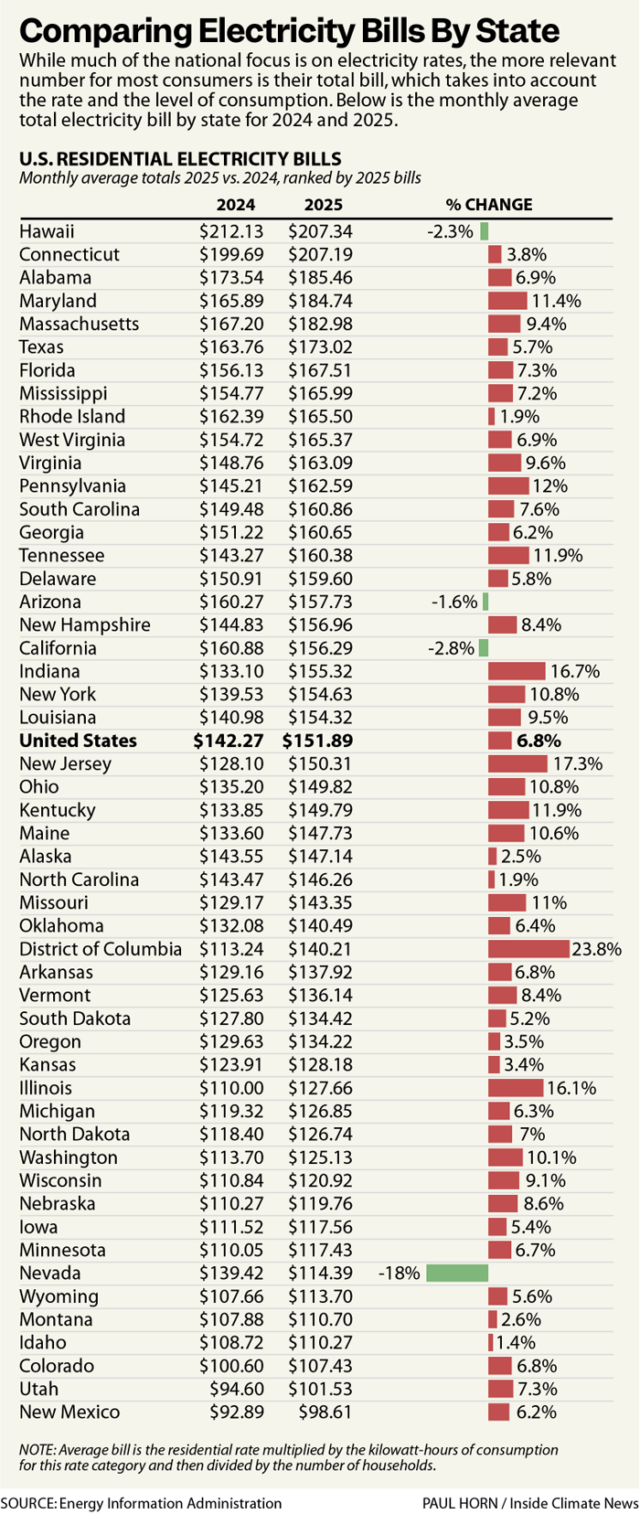 Average electricity prices by state
Credit:
Inside Climate News
Average electricity prices by state
Credit:
Inside Climate News
 photo of gas well under construction
Credit:
Rebecca Droke/AFP via Getty Images
photo of gas well under construction
Credit:
Rebecca Droke/AFP via Getty Images
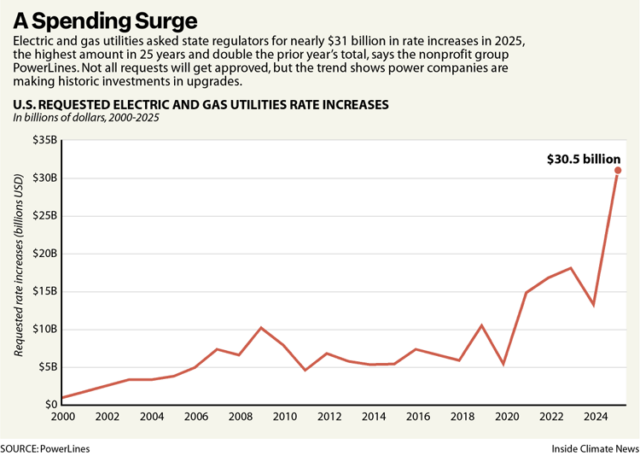 Chart showing electricity rate increases over time
Credit:
Inside Climate News
Chart showing electricity rate increases over time
Credit:
Inside Climate News
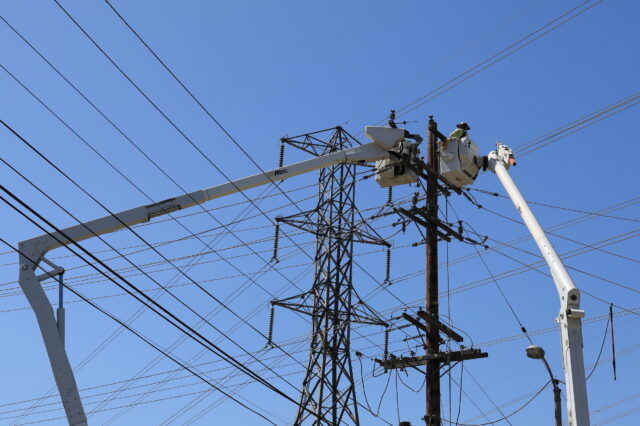 workers repairing power lines
Credit:
VCG via Getty Images
workers repairing power lines
Credit:
VCG via Getty Images
US electricity bills rose about 5% in 2025, according to Energy Information Administration data cited by Inside Climate News, and the increases have pushed utility regulators—normally obscure—to the center of local political anger. In Ohio, protesters gathered outside the state utility commission in January as households complained that monthly power costs are rising even as many other expenses are already high.
The reporting lays out how a “rate hike” is often the visible end of several separate cost streams. One is fuel: higher natural-gas prices lift generation costs in gas-heavy states. Another is policy: renewable procurement mandates can add incremental costs in some regions, especially in the Northeast and Mid-Atlantic. And then there is the category that is easiest to approve and hardest for customers to audit—capital spending on the grid itself.
Inside Climate News describes a surge in utility investment in wires, substations and other delivery equipment, a trend researchers partly link to rising demand from data centers. Under the standard U.S. regulatory model, utilities earn their profits largely through “cost recovery” plus an allowed return on equity on capital expenditures. Charles Hua of the advocacy group PowerLines argues that this creates a built-in preference for building new assets over sweating existing ones: companies are paid for expanding the rate base, not for lowering the bill.
That incentive becomes more powerful when demand stops being flat. For years, stagnant consumption limited how much infrastructure spending could be justified. Now utilities can point to load growth—whether from electrification, industrial reshoring, or server farms—and return to regulators with multi-year investment plans that are difficult for non-specialists to challenge. In Ohio, AEP told the outlet that some drivers are “beyond the company’s control,” including costs tied to participation in the multi-state PJM grid.
The result is that electricity inflation is not only a question of wholesale power prices. It is also a financing story: large capex programs are turned into customer charges via regulated rates, while higher interest rates raise the cost of utility borrowing and make the allowed return debates more contentious. Inside Climate News notes that the hardship can be understated by looking only at rates, because consumption itself is rising—meaning households can pay more even if the per-kilowatt-hour price moves modestly.
Utilities and their trade group, the Edison Electric Institute, counter that national averages are skewed by a handful of states with the sharpest hikes and that many increases track broader inflation. But the protest outside a regulator’s office suggests the practical problem: customers see one number—an automatic debit—while the cost drivers are spread across fuel markets, capital plans and regulatory formulas.
In Columbus, the dispute was triggered by a proposed rate plan from AEP Ohio. The arguments on both sides ultimately run through the same document: a spreadsheet of approved investments that turns poles and wires into a monthly bill.