
Middle East airspace closures trigger worst travel chaos since Covid
Gulf hubs built for global connectivity become single points of failure, Stranded passengers meet hard limits of aircraft and consular capacity
Images
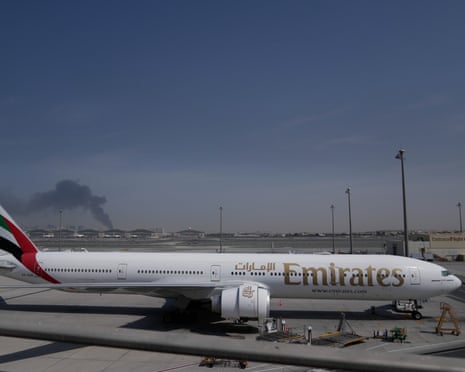 A plume of smoke caused by an Iranian strike is visible behind an Emirates plane parked at Dubai international airport on Sunday. Hundreds of flights have been cancelled since the US and Israel launched their war on Iran. Photograph: Altaf Qadri/AP
theguardian.com
A plume of smoke caused by an Iranian strike is visible behind an Emirates plane parked at Dubai international airport on Sunday. Hundreds of flights have been cancelled since the US and Israel launched their war on Iran. Photograph: Altaf Qadri/AP
theguardian.com
More than 1,500 flights to the Middle East were cancelled by Monday morning as Gulf hubs shut down for a third consecutive day, the Guardian reported, calling it the worst disruption to global air travel since the Covid-19 pandemic. Dubai International—normally the world’s busiest international hub—remained closed, alongside Abu Dhabi, Doha and other key airports, leaving hundreds of thousands of passengers stranded. Airspace over Iran, Iraq, Kuwait, Israel, Bahrain, the UAE and Qatar was described as “virtually empty” on tracking services, as airlines suspended routes and crews ended up scattered across the network.
The immediate effect is visible on departure boards, but the deeper vulnerability sits in the plumbing of global aviation. The Gulf carriers built their business model on stitching continents together through a handful of hubs; when those hubs close, the system does not degrade gracefully. Aircraft are in the wrong places, pilots and cabin crews are out of position, and leased jets sit idle while contractual costs keep running. Even when airspace reopens, restarting a long-haul schedule is not a switch you flip; it is a logistics problem constrained by duty-time rules, maintenance windows, and where the planes physically are.
Markets have already translated the disruption into prices. Airline and travel shares fell, according to the Guardian, while private jet brokers quoted up to $350,000 for a Riyadh-to-Europe charter as the wealthy bought their way around the bottlenecks. That split—commercial passengers queuing for rebooking and consular advice while private aviation reroutes—reflects how capacity is allocated when the constraint is sudden and hard. Airlines can offer refunds or fee-free changes, but they cannot conjure replacement airspace or spare wide-body aircraft.
Business Insider reported that some flights began departing Abu Dhabi despite public notices that operations remained suspended, adding to passenger confusion. Etihad flights, including an A380 to London, took off as the airport’s website simultaneously displayed warnings to check with airlines before travelling. Lufthansa, for its part, flew an A380 out of Abu Dhabi with only two pilots on board because it could not position the required cabin crew amid the air-traffic restrictions.
The second-order costs are now shifting to states. As travellers pile up in transit zones from Bali to Frankfurt, governments are pressured to promise evacuations, assistance and special flights—services that quickly run into hard limits of aircraft availability, landing rights and safe corridors. The private sector can reprice risk instantly; the public sector can only queue it.
Dubai’s runways are closed because missiles and drones are in the region. The invoices for hotels, rebooked tickets and stranded crews are already being issued.