
Coach sells book charms for 95 dollars
Luxury brands turn reading into an accessory market, BookTok aesthetics travel faster than the pages
Images
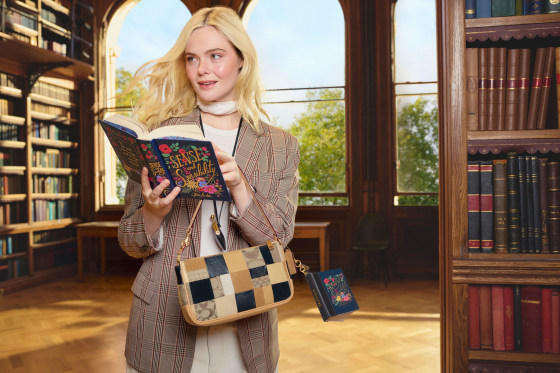 Elle Fanning.
nbcnews.com
Elle Fanning.
nbcnews.com
Coach launches a set of $95 book-shaped bag charms, betting that carrying literature has become a visible marker of taste rather than a private habit. According to NBC News, the Spring 2026 “Explore Your Story” campaign includes 12 miniature titles—from Jane Austen’s Sense and Sensibility to Maya Angelou’s I Know Why the Caged Bird Sings—marketed as both decorative and readable.
The product is a small object with a large purpose: it turns “long-form storytelling” into something that can be photographed, tagged, and circulated. Coach’s chief marketing officer, Joon Silverstein, told NBC News the campaign responds to Gen Z’s search for refuge from “fragmentation, digital overload, and constant acceleration.” Yet the distribution channels highlighted in the same campaign—BookTok, Bookstagram, and BookThreads—are built around short clips, rapid recommendation loops, and constant novelty. The result is a market where books function as both content and prop: the text can be consumed slowly, but the signal travels fast.
Luxury brands have noticed that the book, unlike most cultural goods, still reads as disciplined attention. That makes it useful in an era where attention is scarce and curated identity is abundant. NBC News notes that book clubs have become a popular social scene for Gen Z and millennials, while “performative” public reading has become a joke category in itself. The joke works because the incentive is legible: a visible book is a low-friction way to broadcast seriousness without arguing for it.
Coach is not alone. Dior recently introduced tote bags embroidered with first-edition book covers, with prices in the thousands of dollars, including a Dracula tote listed at $3,550, NBC News reports. Miu Miu ran a “Summer Reads” activation in 2024 that handed out classic novels in multiple cities, and Saint Laurent opened a bookstore in Paris selling rare and branded editions. These are not publishing ventures so much as accessory strategies: the book supplies the aura, while the brand supplies the margin.
Coach says it partnered with Penguin Random House in the United States and independent publishers in China, Japan and Korea, positioning the charms as a cross-cultural collaboration rather than pure merchandising. But the economics point in one direction. A charm does not compete with streaming video for hours of attention; it competes with other status objects for a place in the frame. For publishers, the upside is exposure; for brands, the upside is turning a cultural symbol into inventory.
The charms sold quickly enough that some titles were reported as sold out or not yet available. The “renewed embrace of long-form storytelling” is being measured, at least initially, in units that fit on a handbag.