
Israel says Ayatollah Ali Khamenei is killed
Iranian succession hinges on IRGC control more than clerical procedure, proof of life remains absent as satellite images show compound damage
Images
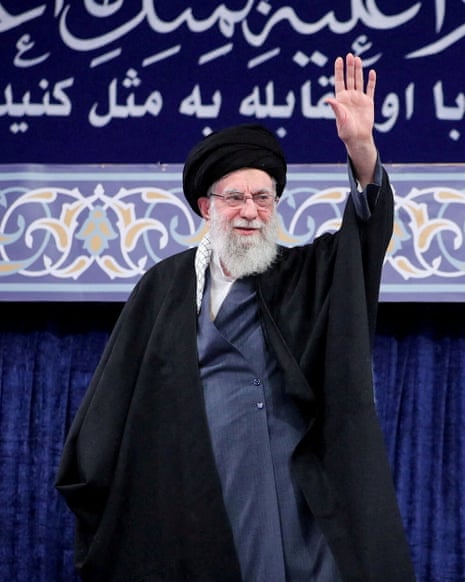 Ayatollah Ali Khamenei in Tehran on 17 February 2026. Photograph: Office of the Iranian supreme leader/Wana/Reuters
theguardian.com
Ayatollah Ali Khamenei in Tehran on 17 February 2026. Photograph: Office of the Iranian supreme leader/Wana/Reuters
theguardian.com
Israel said on Saturday that Iran’s supreme leader Ayatollah Ali Khamenei had been killed, a claim that had not been confirmed by Iranian authorities as of publication. Euronews reported the Israeli statement, while The Guardian said satellite imagery showed heavy damage to a secure compound associated with Khamenei in Tehran and noted that officials in Iran had not provided proof that he escaped.
Khamenei’s possible death is less a “decapitation” than an institutional stress test. Iran’s constitution contains a succession mechanism via the Assembly of Experts, but the practical question is who can enforce a decision in real time: the Islamic Revolutionary Guard Corps (IRGC), the Basij militia, and the security services that control streets, prisons, and key infrastructure. The Guardian’s profile of Khamenei describes a leader who spent decades balancing factions and building deterrence through proxy forces; removing that coordinator does not remove the networks, the payrolls, or the weapons.
The IRGC is not merely a military formation. It is also a large economic actor with interests spanning construction, energy, logistics, and sanctions-era trade, giving it leverage that does not depend on theological legitimacy. In a succession scramble, that matters more than formal titles: whoever can keep salaries paid, communications working, and commanders loyal can present stability as a public good and rivals as a security risk. The Assembly of Experts may anoint a successor, but the security apparatus can decide which names are “safe” enough to survive the first week.
External actors often treat leadership removal as a shortcut to regime change because it produces a clean headline and a sense of momentum. Yet the same strike that removes a leader also raises the value of internal cohesion: defections become riskier, and “order” becomes a scarce commodity controlled by those with guns. Iran’s leadership has anticipated this scenario. According to The Guardian, Khamenei had previously named potential successors in case he was killed and layers of replacement planning for key posts have been reported in recent weeks.
If Khamenei is dead, the immediate contest is unlikely to be a public ideological debate. It will be a sequence of closed meetings, loyalty tests, and control over broadcast statements, travel permissions, and force deployments—signals that determine whether a transition is accepted as routine or treated as a coup.
By Saturday evening, Iran had still not publicly produced proof of life or a death announcement. The most concrete evidence available to the public remained satellite images of a damaged compound and statements from Israel describing a successful strike.