
US lawmakers move to force war powers vote
Democrats and a few Republicans challenge Trump strikes on Iran, Congress seeks a recorded line after the bombs fall
Images
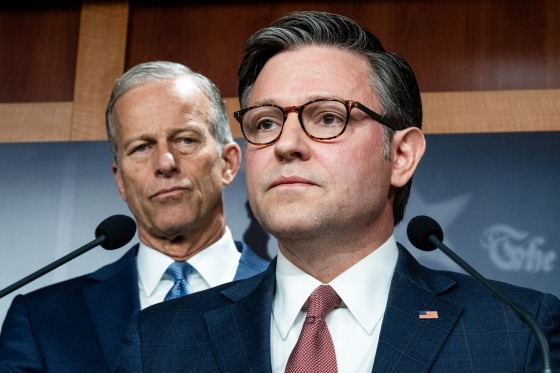 Mike Johnson and John Thune.
nbcnews.com
Mike Johnson and John Thune.
nbcnews.com
 nbcnews.com
House Democrats and a small group of Republicans say they will force a vote next week to limit President Donald Trump’s ability to conduct further strikes on Iran, after a new round of US attacks carried out without prior congressional authorization. According to NBC News, Rep. Thomas Massie and Rep. Ro Khanna had already introduced a war powers resolution before the overnight operation, and House Minority Leader Hakeem Jeffries said Democrats would bring it to a vote when lawmakers return to Washington.
The push is not just a constitutional argument; it is a fight over who owns the downside. Leadership Republicans—Senate Majority Leader John Thune and House Speaker Mike Johnson—backed the strikes, framing them as the endpoint of failed diplomacy and a necessary move against Iran’s nuclear program, NBC reports. But the dissenters are explicit about the practical effect of skipping Congress: it keeps political accountability diffuse while costs become real. Massie called the strikes “acts of war unauthorized by Congress” and urged constituents to demand their representative go on record. Sen. Rand Paul, another critic, said he opposed “another Presidential war,” while still wishing US forces “safety and success,” a formulation that separates support for troops from endorsement of the mission.
The mechanics matter because the War Powers process is built to be hard to ignore once triggered. In the Senate, a resolution to restrict operations would require only a simple majority—51 votes—rather than the 60 usually needed to overcome a filibuster. With Republicans holding 53 seats, a small number of defections could change the outcome, especially if the House vote is close in a narrowly divided chamber. That possibility is what turns a procedural complaint into leverage: lawmakers who prefer ambiguity can keep praising “strength” while avoiding a recorded vote on escalation, while those with electoral or factional reasons to draw a line can force a binary choice.
The timing also exposes how war powers fights tend to arrive after sunk costs. Sen. Andy Kim argued that waiting until next week is “not soon enough,” calling for Congress to reassemble over the weekend to vote immediately. Jeffries, meanwhile, questioned why Trump ordered new strikes after previously declaring that June 2025 attacks had “completely and totally obliterated” Iran’s nuclear program—an implicit claim that the administration’s own public messaging makes the new operation harder to justify as an emergency.
The vote, if it happens, will not decide whether the strikes already carried out were legal or wise. It will decide whether the next phase—whatever it becomes—must be owned by 535 named legislators rather than absorbed into executive discretion.
Trump ordered the strikes first. Congress is now preparing to count who is willing to sign their name to what comes next.