
Bolivian military cargo plane carrying banknotes crashes at El Alto airport
Cash scatters across highway as police use teargas and later burn the bills
Images
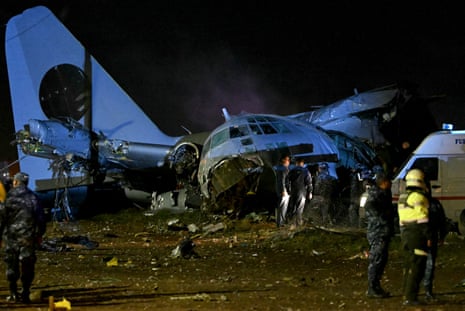 Military personnel guard the wreckage of a military plane that crashed in el Alto, Bolivia, on Friday, scattering its payload of banknotes. Photograph: Aizar Raldes/AFP/Getty Images
theguardian.com
Military personnel guard the wreckage of a military plane that crashed in el Alto, Bolivia, on Friday, scattering its payload of banknotes. Photograph: Aizar Raldes/AFP/Getty Images
theguardian.com
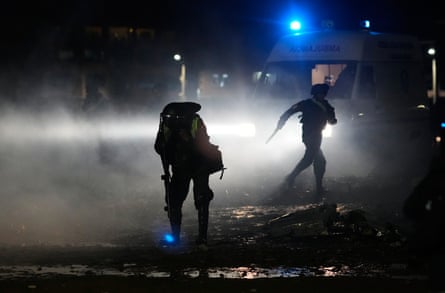 A police offer protects himself from teargas spread to disperse people from getting near the site of the crashed aircraft and its cargo of newly printed money in El Alto, Bolivia. Photograph: Juan Karita/AP
theguardian.com
A police offer protects himself from teargas spread to disperse people from getting near the site of the crashed aircraft and its cargo of newly printed money in El Alto, Bolivia. Photograph: Juan Karita/AP
theguardian.com
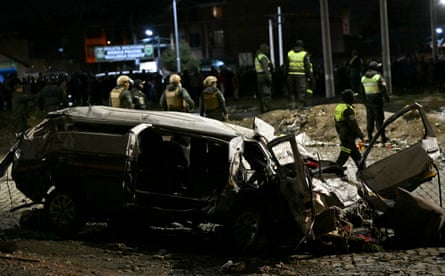 A destroyed car is pictured near the site where a military plane crashed in el Alto. Photograph: Aizar Raldes/AFP/Getty Images
theguardian.com
A destroyed car is pictured near the site where a military plane crashed in el Alto. Photograph: Aizar Raldes/AFP/Getty Images
theguardian.com
A Bolivian Air Force C-130 Hercules carrying newly printed banknotes from the central bank crashed while landing at El Alto international airport on Friday, killing at least 20 people and injuring at least 28, according to The Guardian. The aircraft skidded off the runway, struck vehicles on a highway and came to rest in a field, scattering bills across the crash site as crowds rushed to collect them.
Local footage showed riot police using teargas to push people back from the wreckage. Authorities were later seen burning the scattered banknotes in a bonfire. Bolivia’s defence ministry said the money had “no official serial number” and therefore “no legal or purchasing power,” adding that collecting or using it would be a crime.
The crash is a blunt illustration of how cash logistics become critical infrastructure in countries where trust in banks is thin and digital payments do not fully substitute for physical currency. When a central bank must move large volumes of notes by military transport between cities, the payment system inherits aviation risk: weather, runway conditions and a single mechanical failure can turn monetary distribution into a mass-casualty event.
It also creates a predictable security problem. Cash shipments advertise themselves the moment they fail. The Guardian reports that bystanders were on the scene within minutes, grabbing loose bills while police tried to secure the area. Even if the notes are declared invalid, a crowd does not learn that from a press release, and enforcement becomes a public-order operation in the middle of a disaster response.
Officials said the plane had departed Santa Cruz and that airport operations in La Paz were suspended after the crash. Witnesses cited by Agence France-Presse described lightning and a heavy hailstorm at the time of landing. The defence ministry said it would investigate.
By late Friday, the air force said two of the six crew members had not been found. On the ground, the banknotes were still visible in photographs—mixed with wreckage, broken glass and the remains of vehicles crushed on the highway.