
Study links business class to aviation emissions
Nature Communications analysis models all-economy cabins and higher load factors, airlines would have to replace premium revenue with higher fares or fewer routes
Images
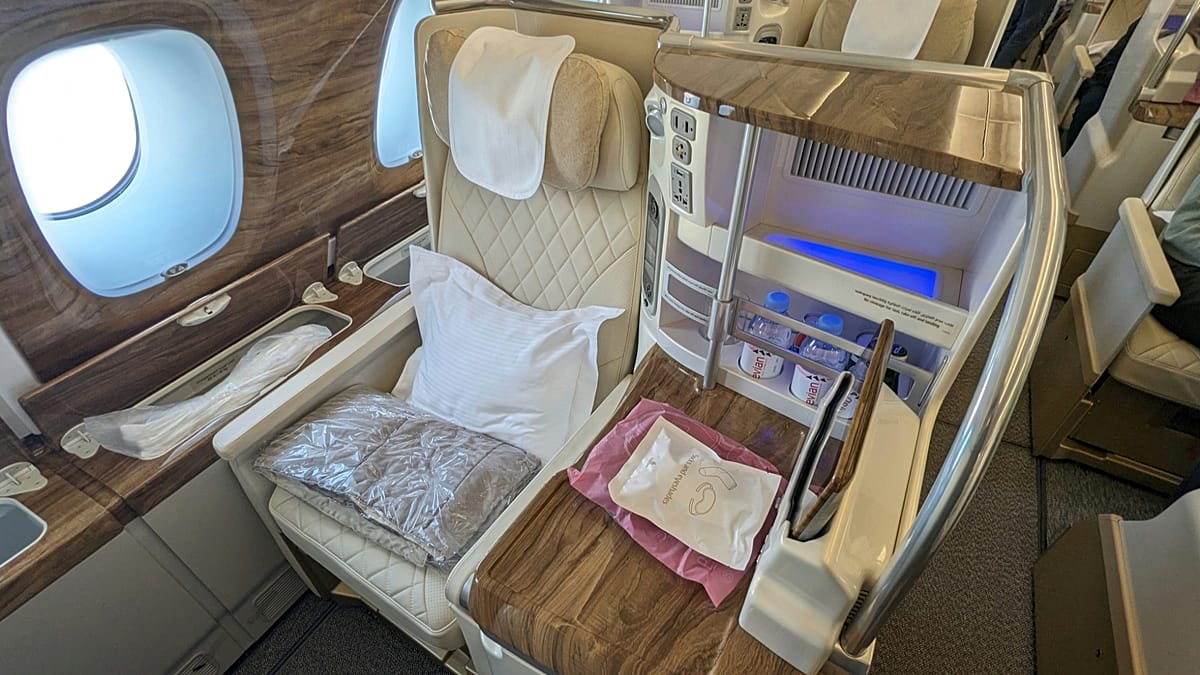 Business class flight ban could slash emissions, study suggests
euronews.com
Business class flight ban could slash emissions, study suggests
euronews.com
Business-class seats can be up to five times more carbon-intensive than economy, and a new study argues that removing premium cabins could cut aviation emissions by as much as half. The analysis, published in Nature Communications Earth & Environment and summarised by Euronews, draws on more than 27 million commercial flights in 2023 covering roughly 26,000 city pairs and nearly 3.5 billion passengers.
The study’s core claim is mechanical rather than technological: aircraft burn fuel largely based on distance and weight, while emissions per passenger depend on how many people share that burn and how the cabin is configured. Premium seating consumes more space per traveller, so an “all-economy” layout can carry more passengers on the same flight, lowering emissions per paying passenger-kilometre. The authors estimate that reconfiguring aircraft to economy-only could reduce emissions by 22% to 57%, depending on route and aircraft type.
They pair that with two operational levers. First is load factor: in 2023, average passenger occupancy was about 79%, with some flights reportedly operating at around 20% capacity. Pushing average occupancy to 95% would cut emissions by a further 16%, the study finds. Second is fleet efficiency: replacing older aircraft with newer models could reduce fuel use by roughly a quarter. Combined, the paper suggests a 50% to 75% reduction is possible without waiting for sustainable aviation fuel to scale.
What the study does not resolve is who pays for the transition. Airlines price long-haul travel around a small share of high-yield passengers; premium cabins often subsidise cheaper economy fares and help make thin routes viable. Removing that revenue stream does not just “remove seats”; it changes the economics of routes, frequencies and network breadth. If airlines respond by raising economy fares, reducing service, or concentrating on the densest corridors, the emissions ledger shifts from aircraft efficiency to demand suppression by price and reduced connectivity.
Europe is where that trade-off becomes visible first. The study notes that the UK was Europe’s largest aviation emitter in 2023, followed by Spain, Germany, France and Italy. It also flags Norway for relatively inefficient flying, often linked to smaller airports and lower-load routes that in some countries are supported by government subsidies for regional connectivity. Cutting premium seating on routes that are already marginal would either require higher public support or accept fewer flights.
The paper also points to external constraints that make “efficiency gains” less linear: longer routings caused by airspace closures linked to Russia’s war in Ukraine, and prospective detours to avoid contrail-forming regions that may increase fuel burn. In that context, the simplest variable to control is not fuel chemistry but cabin layout.
The study’s headline intervention—scrapping business class—would be implemented one aircraft at a time, contract by contract, route by route. The first place passengers would notice is not the climate model but the seat map.