
Sicily firefighters salvage rare books from landslide library
Niscemi evacuation leaves collection hanging over four-kilometre chasm, Robots discussed but unavailable
Images
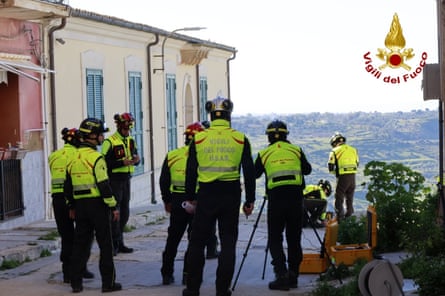
 The operation was ‘like pulling off a bank heist’, said the commander of the fire brigade in Caltanissetta. Photograph: Courtesy of Sicilian Unit of Firefighters
theguardian.com
The operation was ‘like pulling off a bank heist’, said the commander of the fire brigade in Caltanissetta. Photograph: Courtesy of Sicilian Unit of Firefighters
theguardian.com
 Houses and cars teeter on cliff edge after Sicilian landslide – video
theguardian.com
Houses and cars teeter on cliff edge after Sicilian landslide – video
theguardian.com
 Firefighters recovered 350 volumes from the library. Photograph: Courtesy of Sicilian Unit of Firefighters
theguardian.com
Firefighters recovered 350 volumes from the library. Photograph: Courtesy of Sicilian Unit of Firefighters
theguardian.com
Firefighters in the Sicilian town of Niscemi have removed about 400 rare books from a municipal library that now sits on the edge of a landslide scar, after a January collapse carved a chasm roughly four kilometres long, according to The Guardian. The building is described as partly “hanging in mid-air”, with more volumes still trapped in a basement judged too dangerous for crews to enter.
The rescue was staged like an engineering operation rather than a cultural event. The fire brigade studied floor plans and interior photographs to map where shelves stood, then drilled through a wall from an adjacent building to avoid loading the unstable structure. Teams entered only for minutes at a time, strapped bookcases together and pulled them backwards through the breach. A drone streamed live overhead video while laser sensors monitored micro-movements in the concrete; a separate device tracked vibration and the building’s tilt.
The library’s collection is not a museum piece so much as a local working asset that became a liability overnight. It holds around 4,000 volumes, including rare editions on Sicilian history dating from before 1830 and at least one 16th‑century book, The Guardian reports. With more than 1,600 residents evacuated from the town, the books are a small fraction of what the landslide displaced—but they are the part that can be carried out by hand.
The episode also shows how Italy’s risk management often arrives as emergency logistics. Geologists working alongside the firefighters expect the landslide front to retreat another 10 to 15 metres, potentially dragging more buildings down the slope, including the library. The commander of the provincial fire brigade, Salvatore Cantale, said the structure is a single reinforced-concrete block: if it fails, it will go “all at once”. Officials are considering using robots to retrieve the remaining books from the basement, but none suitable are available locally.
That shortage matters because the limiting factor is no longer goodwill or public attention—writers have appealed for the collection to be saved—but equipment and capacity. If a robot cannot be found, the operation pauses while the ground continues to move. In the meantime, the state’s most reliable tool is still manpower under time pressure, backed by sensors and a drone feed.
By the end of the first week, crews had removed roughly 400 books and left thousands more where they were, in a basement that may be the first part of the building to go.