
Cuban border guards kill four on US-registered speedboat
Havana calls it terrorism as Washington denies involvement, a sanctions-strained coastline turns enforcement into leverage
Images
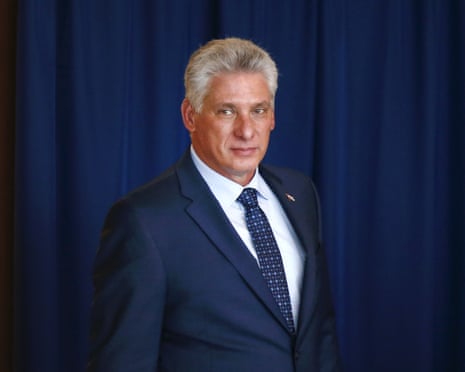 Cuba's president, Miguel Diaz-Canel, arrives for a meeting with the UN secretary-general, on the sidelines of the 73rd session of the UN general assembly, at the UN headquarters in November 2019. Photograph: Jason DeCrow/AP
theguardian.com
Cuba's president, Miguel Diaz-Canel, arrives for a meeting with the UN secretary-general, on the sidelines of the 73rd session of the UN general assembly, at the UN headquarters in November 2019. Photograph: Jason DeCrow/AP
theguardian.com
Cuba’s interior ministry said border guards killed four people and wounded six others after intercepting a Florida-registered speedboat off the island’s northern coast near Varadero. According to The Guardian, Havana claims the boat’s occupants opened fire first and were carrying assault rifles, handguns, Molotov cocktails and other “military-style” gear; Cuban officials also said they detained a separate person who allegedly flew in to meet the group.
The incident lands in the narrow space where both governments have reasons to sound tough and to avoid escalation. Cuban president Miguel Díaz-Canel called it “terrorist and mercenary aggression” while adding that “Cuba does not attack nor threaten,” a formulation aimed as much at foreign audiences as at domestic ones. In Washington, Secretary of State Marco Rubio said the U.S. had “nothing to do with” the clash and was still gathering facts, even as U.S.-Cuba contacts reportedly continue in parallel, including a meeting on the sidelines of a Caribbean leaders’ gathering with Raúl Castro’s grandson, who holds no formal post but sits close to the regime’s inner circle.
For Havana, the immediate incentive is deterrence. A successful landing—even a small one—would advertise that the state’s maritime perimeter is porous at a moment when fuel shortages and blackouts are already eroding the government’s image of control. Labeling the attackers “terrorists” also widens the justification for surveillance, raids and prosecutions at home, and for demanding cooperation from foreign jurisdictions. The same sanctions-driven scarcity that cripples electricity also pushes more activity into informal markets: fuel, boat parts, and the services needed to move people and goods across a 90-mile strait. In that environment, the coastal force is not only a security service but a gatekeeper for an economy that increasingly runs on permission.
For the U.S., the calculation is different. The Trump administration has tightened pressure on Cuba and disrupted the island’s energy lifeline, but a lethal incident involving a U.S.-registered vessel creates legal and diplomatic liabilities: who owned the boat, whether it was stolen, what U.S. authorities knew, and what obligations follow if survivors are captured and prosecuted. Even if Washington wants to keep Havana isolated, it also has to prevent a spiral that turns a sanctions regime into a security crisis with unpredictable spillovers—migration, maritime retaliation, or pressure for direct U.S. involvement.
The boat itself, described as a 24-foot Pro-Line center-console typically used for coastal fishing, is an awkward platform for a paramilitary raid, and that mismatch will feed competing narratives: heroic “liberators,” reckless adventurists, criminal smuggling, or a staged provocation. What is already clear is that the event is being processed as messaging before it is processed as evidence.
The shooting happened among the keys east of Varadero, where a small craft from Florida can reach Cuban waters in a single run. By Thursday, both Havana and Washington were still saying they needed more facts, while the bodies had already been assigned a political purpose.