
Japan naked festival crowd crush hospitalises six in Okayama
Saidaiji Eyo ritual draws 10,000 men into dark temple hall, defibrillators used as organisers weigh rule changes
Images
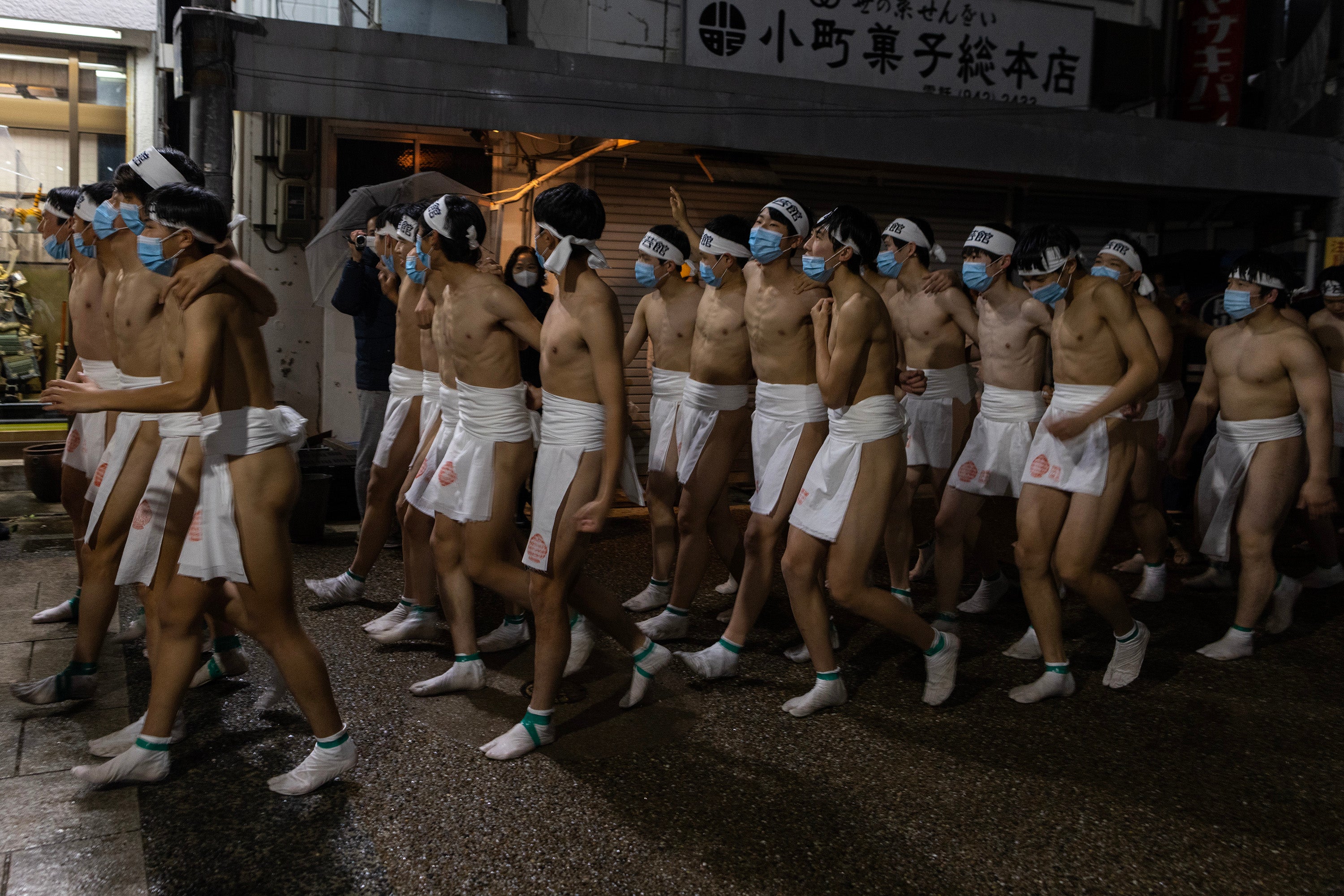 File. Participants arrive for Hadaka Matsuri at Saidaiji Kannonin Temple in Okayama, Japan, on 18 February 2023 (Getty)
Getty
File. Participants arrive for Hadaka Matsuri at Saidaiji Kannonin Temple in Okayama, Japan, on 18 February 2023 (Getty)
Getty
Three men were hospitalised after a crowd crush at Japan’s Saidaiji Eyo—better known as the “naked festival”—in Okayama, where organisers say around 10,000 men packed into the temple’s main hall for the climax of a 500-year-old ritual. According to The Independent, six participants collapsed and were taken to hospital; three later regained consciousness while three remained unconscious, with emergency crews performing CPR and using defibrillators at the scene.
The timing of the surge is familiar: officials told NHK they suspect the crush began when the lights were switched off and sacred wooden sticks (shingi) were thrown from above, triggering a sudden forward movement in a confined space. Crowd disasters tend to look like moral failure—people “pushing”—but the mechanics are closer to fluid pressure than individual choice once density passes a threshold. When bodies are compressed tightly enough that people cannot freely step or turn, a local stumble can propagate as a wave, and compressive forces can build without any one person intending harm. In that regime, adding stewards or loudspeaker instructions often changes little; what matters is how many people are allowed into the space, how fast they can leave it, and whether the event’s design creates predictable surges.
Hadaka Matsuri’s design does exactly that. Participants first undergo purification by bathing in freezing water, then crowd into a dark hall to await a small number of talismans that confer status and good fortune, creating a high-reward, low-visibility scramble. Organisers now say the severity of the injuries was unprecedented and could threaten the festival’s continuity “in its current form,” the paper reports, with the support association’s chair Minoru Omori promising an investigation and rule changes.
The festival also carries its own institutional memory: The Independent notes fatalities in 1987 and 2007, meaning the event has already absorbed the lesson that “tradition can kill” without necessarily redesigning the choke points that make crushes likely. In practice, the pressure to preserve spectacle—dense crowds, dramatic lighting changes, and photogenic chaos—pulls in the opposite direction of engineering controls such as hard caps, staggered entry, and physically separated flows.
In Okayama, the turning off of the lights and the throwing of a few wooden sticks into a packed hall again produced a predictable bottleneck: too many bodies, too little space, and a trigger designed to make everyone move at once.