
Microplastics detected in prostate tumours
Small ASCO-presented study compares tumour vs benign tissue, contamination and causality remain unresolved
Images
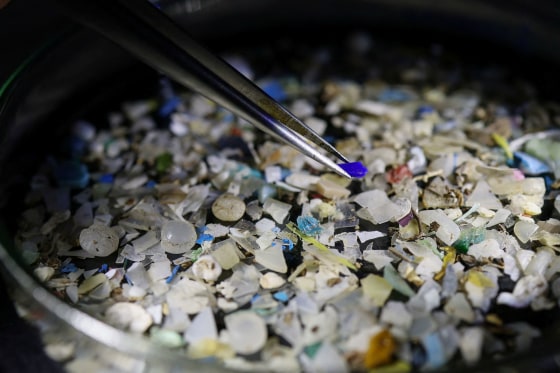 A researcher examines microplastic fragments collected from seawater samples.
nbcnews.com
A researcher examines microplastic fragments collected from seawater samples.
nbcnews.com
Microplastics have been detected inside prostate cancer tissue in a small, early-stage study presented this week at the American Society of Clinical Oncology’s Genitourinary Cancers Symposium. According to NBC News, researchers analysed prostate samples from 10 men who had undergone prostate removal as part of cancer treatment, comparing tumour tissue with noncancerous tissue from the opposite side of the same organ.
The headline number is straightforward: microplastics were found in 90% of tumour samples and 70% of noncancerous samples. The tumour tissue contained about 2.5 times more plastic on average—roughly 40 micrograms per gram of tissue—than the benign tissue. The finding echoes a 2024 study in The Lancet from China that also reported higher plastic levels in prostate tumours than in nearby tissue, but the new work claims more precise identification of polymer types.
What the result does not yet show is what many readers will instinctively infer: that microplastics cause prostate cancer, accelerate tumour growth, or explain rising rates of advanced disease. The study is small, not yet peer-reviewed, and—crucially—microplastics research is unusually vulnerable to contamination. Plastic is everywhere in clinical and laboratory environments: surgical tools, collection containers, lab air, filtration systems, even synthetic clothing. The central methodological question is always the same: did the plastic come from the patient, or did it enter the sample during collection and processing?
The researchers attempted to pre-empt that criticism. Lead author Stacy Loeb of NYU Langone told NBC News that the team planned the protocol for a year and tried to eliminate plastic from the operating room “as much as possible.” They also focused on tissue taken from deep inside the prostate, and compared tumour and benign samples that were handled identically within each patient. That within-patient design helps: if contamination were random and equal, both samples should drift in the same direction. But it does not fully eliminate the possibility of systematic bias—tumour tissue can differ in texture, vascularity, or handling time, any of which could change how much contamination adheres during processing.
Even if the measurement is correct, the interpretation remains open. A higher concentration in tumour tissue could reflect causation (plastic exposure contributing to carcinogenesis), correlation (a shared underlying factor driving both cancer and plastic accumulation), or reverse causation (tumours altering local biology in a way that traps or concentrates particles). Without longitudinal data, timing is unknown.
To move from “found in tumours” to “contributes to disease,” the next steps are concrete and difficult: larger cohorts with preregistered protocols; rigorous blank controls and contamination audits across the entire chain; dose–response evidence; mechanistic work showing plausible pathways such as inflammation, oxidative stress, or endocrine disruption; and replication in independent labs using different analytical methods. For now, the study mainly demonstrates that even deep human tissue is not insulated from environmental plastics—and that measurement, not meaning, is still the hard part.