
Yunxian skulls in China re-dated to 1.77 million years
Cosmogenic isotope ratios push Homo erectus east earlier, Denisovan ancestry claim loses its clock
Images
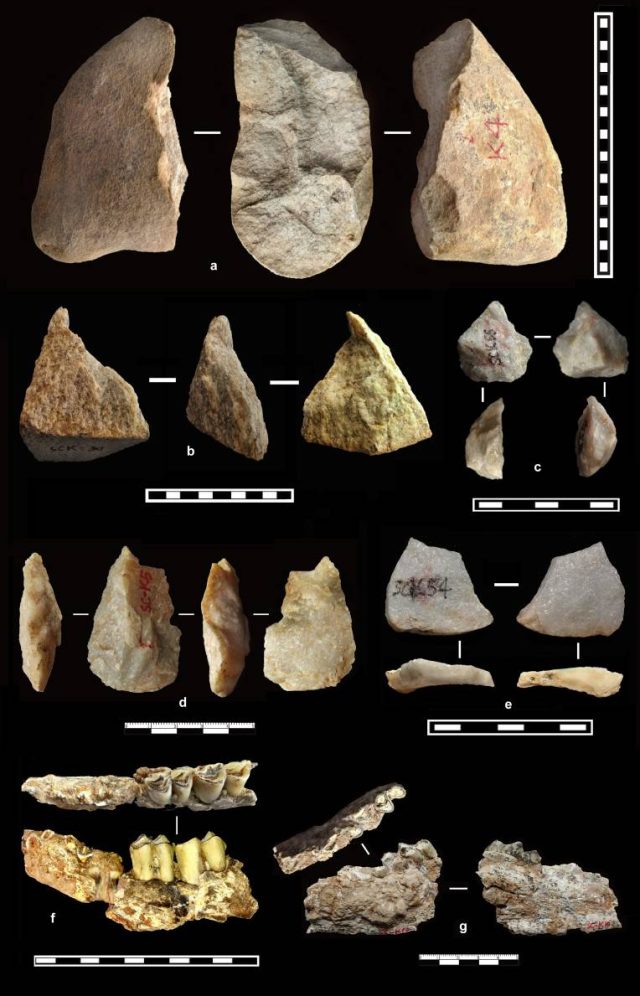 Photograph of stone tools
Credit:
Prof. Zhaoyu Zhu
Photograph of stone tools
Credit:
Prof. Zhaoyu Zhu
 Photo of Kiona N. Smith
arstechnica.com
Photo of Kiona N. Smith
arstechnica.com
Two fossil skulls discovered at Yunxian on the Han River in central China have been re-dated to about 1.77 million years old, making them the oldest known hominin remains in East Asia. The new age estimate comes from measuring aluminum-26 and beryllium-10 isotopes in quartz grains from the sediment layer that once held the skulls, Ars Technica reports.
That date is not a small correction. It places Homo erectus in central China roughly within the same window as the famous Dmanisi fossils in Georgia, dated to about 1.85–1.77 million years ago. If hominins were in the Caucasus and deep in East Asia at nearly the same time, the old picture—slow dispersal out of Africa, then a gradual eastward creep—looks less convincing.
The Yunxian site has long been important because it combines hominin skulls with stone tools and animal bones in river-laid sediments that can be difficult to date cleanly. The new approach tries to anchor the fossils in time by using cosmogenic nuclides, which accumulate in minerals exposed at Earth’s surface and change once buried. In practice, that means a laboratory measurement can constrain when the sediment was last exposed to sunlight and cosmic rays—an indirect but quantifiable way to bracket the fossils.
A faster timeline also reshuffles a more recent claim: that the Yunxian skulls might be early members of the Denisovan lineage, sometimes associated with the name Homo longi. A 2025 study had argued that a digitally reconstructed Yunxian skull resembled the 146,000-year-old Harbin skull, which genetic work has linked to Denisovans, and used older paleomagnetic dates to place Yunxian close to a hypothesised Denisovan split.
At 1.77 million years, that linkage becomes hard to sustain. Ars Technica quotes paleoanthropologist John Hawks saying the date is “too old” to connect credibly to Denisovans, whose genetic divergence is thought to be far more recent—on the order of hundreds of thousands of years, not nearly two million.
The knock-on effects reach beyond taxonomy. If Homo erectus was in East Asia by 1.77 million years ago, it becomes more plausible that very early Chinese tool sites—some older than the previous fossil benchmarks—were made by Homo erectus or close relatives rather than by later, more derived groups. It also raises a logistical question that fossil headlines rarely address: dispersal at that speed implies either rapid population movement, repeated waves, or a much earlier start date than the fossils currently capture.
The Yunxian skulls do not rewrite human origins on their own, but they tighten the calendar. When the measurement improves, the map has to move with it.