
China retakes top spot as Germany largest trading partner
Merz Beijing trip highlights car and energy dependence, EU derisking rhetoric collides with exemption politics
Images
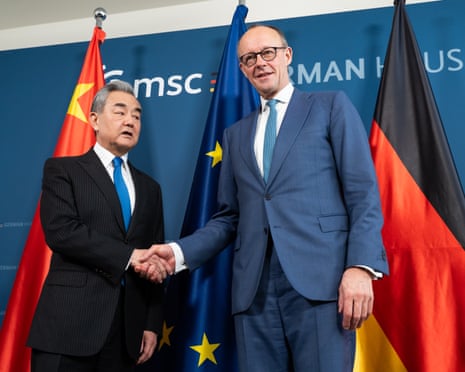 Friedrich Merz with the Chinese foreign minister, Wang Yi, at the Munich Security Conference earlier this month. Photograph: Getty Images
theguardian.com
Friedrich Merz with the Chinese foreign minister, Wang Yi, at the Munich Security Conference earlier this month. Photograph: Getty Images
theguardian.com
China has again become Germany’s largest trading partner, underlining how Europe’s biggest industrial economy is drifting deeper into a supply chain relationship that Brussels increasingly describes as a strategic liability.
Germany’s Federal Statistical Office data show total trade with China reached €251bn in 2025, up 2.2% from 2024, while trade with the US fell 5% to €240bn, according to The Guardian. The composition matters: Germany imported about €170.6bn of goods from China but exported only €81.3bn, a gap that highlights Germany’s dependence on Chinese inputs and consumer demand even as policymakers talk about “de-risking”.
Chancellor Friedrich Merz is heading to China this week for his first visit since taking office, with meetings scheduled with Prime Minister Li Qiang and President Xi Jinping, and a business-heavy itinerary that includes Mercedes-Benz, Siemens Energy and Chinese robotics firm Unitree, The Guardian reports. Reuters, cited by The Guardian, quoted BMW CEO Oliver Zipse—travelling with a delegation of roughly 30 executives—arguing that “complex global challenges can only be solved by working together.”
The trip lands in the middle of the EU’s familiar contradiction: it wants to curb Chinese industrial overcapacity and strategic leverage, but it also wants cheap electrification inputs and export markets for European manufacturers. The bloc’s 2024 tariffs on Chinese electric vehicles have “had little impact on sales,” The Guardian notes, and Brussels is threatening further measures such as steel safeguards.
From an incentives perspective, the split is predictable. German export industries and Länder governments have strong, immediate payoffs from keeping China open: jobs, tax receipts and shareholder value. Brussels, meanwhile, earns political credit for “strategic autonomy” language and regulatory activism, while the costs are dispersed through higher prices, slower investment and a growing need for exceptions.
That is how Europe ends up with a hybrid model in which companies bear market risk but governments increasingly control the permission structure. When policy is built around tariffs, carve-outs and “derisking” checklists, firms must invest not only in production and R&D but also in political insurance—lobbying for exemptions, compliance staff, and supply-chain narratives that satisfy regulators.
Merz is expected to raise Ukraine, human rights and trade in Beijing, according to The Guardian. But the hard constraint is economic: Germany’s carmakers treat China as a “second home market”, and the EU’s clean-tech push relies on Chinese-dominated supplies of rare earths, processed minerals, lithium refining and permanent magnets.
The result is a European strategy that tries to penalise dependence while simultaneously subsidising the very technologies that deepen it. In game-theory terms, Brussels signals toughness while member states quietly maximise payoffs—until the next round of sanctions, tariffs or “autonomy” initiatives forces everyone back to the bargaining table to negotiate who gets to keep trading.