
French court orders ProtonVPN to block sports piracy domains
Canal+ injunctions shift censorship from ISPs to privacy infrastructure, Overblocking dismissed for lack of proof
Images
 proton order
torrentfreak.com
proton order
torrentfreak.com
French courts are increasingly treating VPNs as just another lever in copyright enforcement—pushing internet blocking down the stack from access providers to privacy infrastructure.
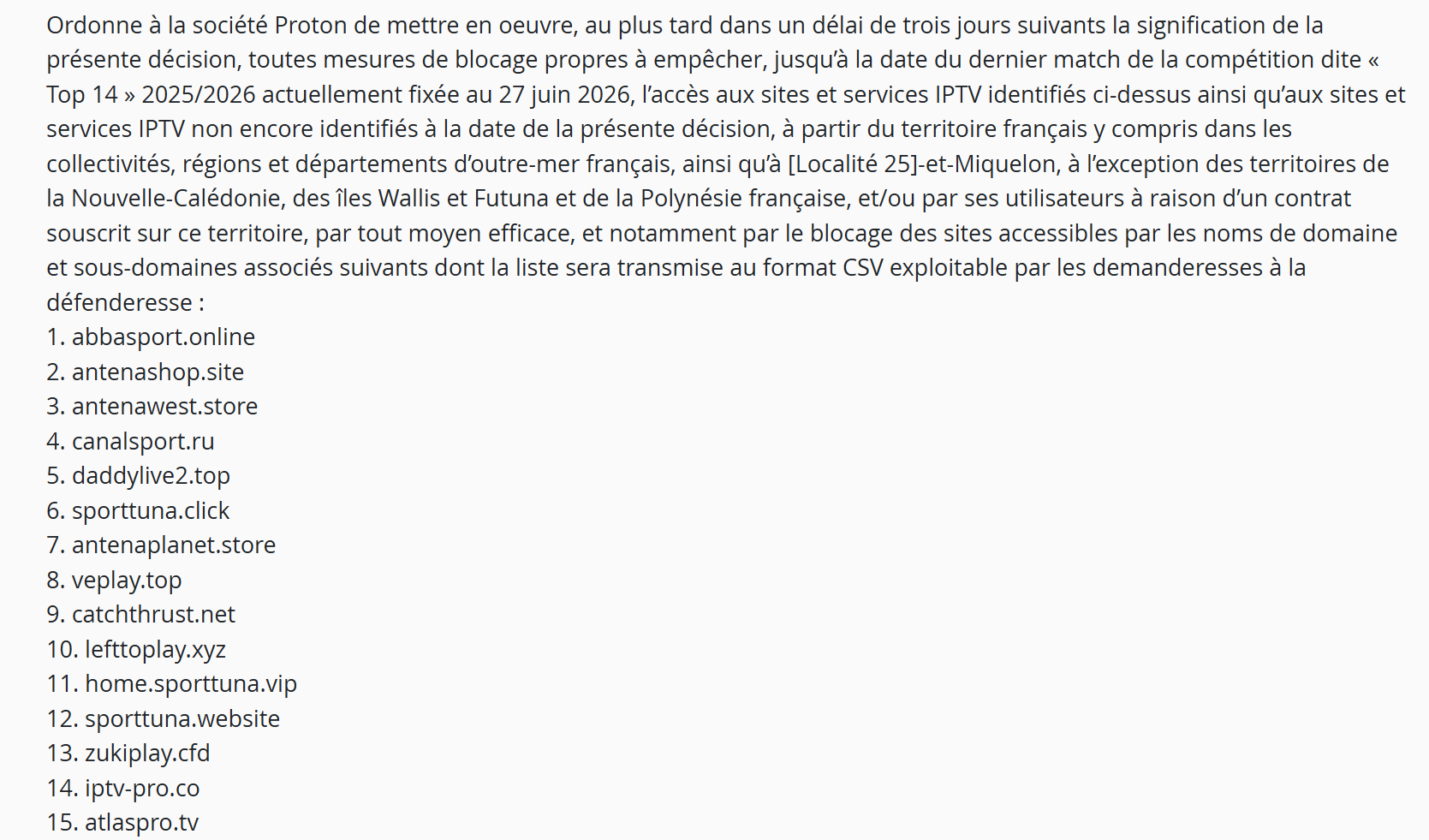
TorrentFreak reports that the Paris Judicial Court issued two blocking orders on January 28 and 29 targeting Proton AG, the Swiss company behind ProtonVPN. Rightsholders led by Canal+ sought to protect sports broadcasts by forcing the VPN provider to block pirate streaming sites: one order covered 16 domains linked to Premier League streams, the other targeted Top 14 rugby streams. Both injunctions run through the end of the 2025/2026 seasons (May 24 and June 27, 2026). One domain in the rugby case was excluded because the URL tested by investigators didn’t match what Canal+ asked to block.
Unlike a recent Spanish case—where a court ordered ProtonVPN and NordVPN to block LaLiga streams without involving the VPNs in proceedings—Proton was able to argue its case in France. It still lost.
Proton challenged jurisdiction and demanded proof that Canal+ held the relevant rights. It also invoked net neutrality, arguing that the French sports-code provision used for these injunctions conflicts with the EU Open Internet Regulation. The court rejected the argument as insufficiently specific, effectively requiring a defendant to do the regulator’s job of mapping which provisions are breached.
The more revealing dispute was technical: Proton argued that VPN blocking cannot be limited to French users, meaning a French order risks becoming a de facto global blockade—an obvious overreach given Canal+’s territorial rights. Proton also warned of overblocking and disproportionate costs.
The court’s response, per TorrentFreak, was blunt: no “quantifiable and verifiable technical evidence” was provided to substantiate implementation difficulty or overblocking risk. In other words, the burden is on the intermediary to prove the collateral damage of a censorship tool—while rightsholders can obtain orders that, by design, are hard for outsiders to audit.
This is how enforcement regimes quietly evolve. ISP-level blocking is at least bounded by national networks and regulated operators. Moving enforcement to VPNs, DNS resolvers, and other cross-border intermediaries creates a private filtering layer that is harder to see, easier to expand, and more likely to spill across jurisdictions. It also changes market structure: compliance becomes a fixed cost. Large providers can amortize legal and engineering overhead; smaller VPNs face a choice between expensive geo-targeted blocking systems (if even feasible) or exit.
The economic logic is straightforward. Rightsholders want to reduce piracy, but they also want to externalise enforcement costs. Courts, under pressure to “do something,” deputise intermediaries that didn’t create the infringement and may not even have visibility into it. The intermediary’s product is privacy and neutrality; the state’s demand is selective discrimination.
Once a VPN is forced to maintain a blocklist for sports, the precedent is in place for everything else—gambling, speech “harms,” political content—especially when courts have already signalled that overblocking concerns are speculative until someone can prove them at scale. By then, of course, the scale is the point.